Shining a Light on Female Entrepreneurs in Tech

Last night, MIT’s Martin Trust Center hosted a screening of the award-winning documentary “She Started It” which follows five women in their journeys to launch businesses in the technology industry. We were honored to have the director and co-producer of the film, Nora Poggi , with us to introduce the film and join in our discussion along with our own panel of budding tech entrepreneurs.

The event was inspiring and featured accomplished women who beat the odds. If one message came through “loud and clear” it was that the entrepreneurial journey is all about persistence and networking. Our discussion reinforced that entrepreneurship can be taught, and that practicing entrepreneurial skills will pay off in the end.

The “She Started It” film focuses on five female entrepreneurs and their experiences, along with empowering the next generation of women tech founders. (You can check out the trailer here.) The film cited statistics about being a female entrepreneur in the technology industry that were bleaker than a cross-industry perspective. For example:

  • Women create only 3% of tech startups
  • In Silicon Valley, women earn only 49 cents to a man’s dollar
  • Women receive less than 10% of venture capital funding
  • Only 12% of undergrad computer science degrees are earned by women
  • 96% of venture capitalists are men

Yet, the five women profiled in the film are out to break the mold.

headerimage

Following the screening, I moderated a discussion with Poggi and a panel of female founders sharing their own experiences. They included:

  • Elsa Sze of Agora which uses technology to bring more people to the civic conversation
  • Melissa James of The Tech Connection, a premier marketplace for purpose driven, diverse technical talent
  • Alex Wright-Gladstein of Ayar Labs which brings high bandwidths and energy efficiency of fiber optics to silicon chips
img_0076_cropped

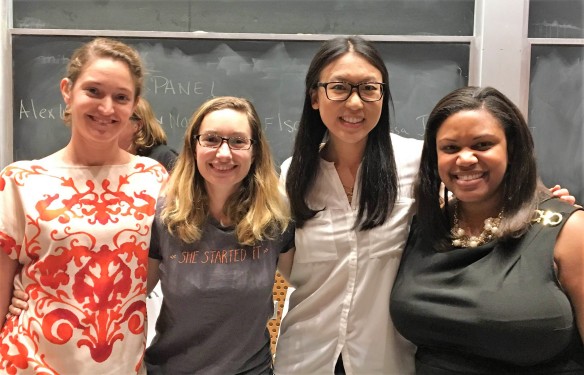
L to R: Alex Wright Goldstein, Nora Poggi, Elsa Sze and Melissa James


The panelists discussed challenges and what is most intimidating about starting a tech business. The audience – which included many women in the process of exploring entrepreneurship for themselves was extremely engaged and had many questions. We also talked about how today’s female entrepreneurs can be role models to help other women and girls embrace the entrepreneurial path. Essentially, “you can’t be what you don’t see.”

One of the insightful quotes in the film is from Meghan Smith, Chief Technology Officer for the United States. She says, “There have always been women and minorities in all of the areas of technology for all history. It’s just the stories are less known. And so, we need to embrace our history and tell it to each other.”

Although women are a small minority of tech startup founders, it is also an issue that many women tend to understate their achievements, and not let their own light shine. “She Started It” is a first step to showcase some of these achievements. My thanks to everyone who participated in our event! It was a great success!

P.S. On a personal note, this week I received the exciting news that I’ve been selected as a finalist for the Stevie Awards for Women in Business the category of mentorship. As I worked with the panel for this our film event, I drew parallels to my own submission for the Stevie Awards. Often, as women, we dismiss the things that we do and don’t let our own lights shine (especially when surrounded by all the brilliance here at MIT). For me, this is a reminder to value our successes and share them with other women.


It’s a Wrap: MIT’s Educational Accelerator Demo Day 2016!

mit-gfsa-demo-16

Congratulations to all of the teams that presented at our Educational Accelerator Demo Day! We kicked off MIT’s campus-wide t=0 celebration of entrepreneurship and innovation, which will continue through September 18.

If you couldn’t join us, this post gives a quick recap; and you can catch all of the presentations on video as well. For an overview of the companies presented, check out this BostonInno article – “These are the 17 Startups MIT Kept Hush-Hush this Summer.”

First of all, in my last post I had let you know that our Global Founders’ Skills Accelerator (GFSA) would be changing its name. We are now MIT’s delta v accelerator.  Why the name change? The derivative of velocity is acceleration!  Hence, the MIT Acceleration Program delta v.

delta v literally means a change in velocity, and we believe this truly captures what happens to these students when they join us for MIT’s accelerator program.

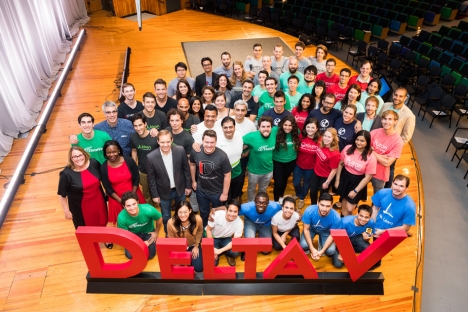
The delta v Demo Day is focused on MIT students, and students filled the auditorium and were even sitting in the aisles. Our Managing Director Bill Aulet kicked of the program and explained how these startups have reached “escape velocity” and have been “kicked out of the house” so to speak.

Bill was followed by keynote speaker Dharmesh Shah, the CTO of HubSpot and an MIT grad. He talked about increasing the success for these student startups – how to get started, why you should avoid stealth mode, why speed matters, how to find a co-founder, attract amazing people, and give yourself crazy ambitious goals. He tells students to take advantage of all your classes to hone your skills… and he says he has never heard of a single entrepreneur who regrets taking a shot at a startup (even if it failed).

Governor Charlie Baker also joined us at Demo Day, and spoke about the amount of wizardry that comes out of MIT and the staggering contribution that MIT has made to the Commonwealth of Massachusetts, the country and the world.

It was then on to the student presentations. Fourteen startups made it through to Demo Day, and their company ideas covered topics from mental health to virtual reality.  We saw compelling videos from farmers whose lives have been changed because of MIT students, transportation in Rwanda and Mexico that will reduce costs for carriers, a way to make freight transportation more efficient and increase the income of truck drivers, and several ways to improve the environment.  We learned about innovations could change the lives of families dealing with cancer treatment and students in Africa.

Interested in learning more? Check out the companies that presented. They are listed below, in alphabetical order, along with links to their websites.  And, if you have a bit more time, check out the teams presenting in our Demo Day video recording.

Alfie
Armoire
Deepstream
dot Learn
Emerald
Factory Shop
FleteYa
Hive Maritime
kiron
Kumwe Logistics
Lean on Me
Leuko Labs
perch
Rendever
ricult
Solstice Initiative

I think everyone who attended Demo Day was inspired and impressed by the power of entrepreneurship at MIT. Now, we’re onward and upward, with t=0 this week with a full schedule of activities every day. Later this month, the delta v teams will be heading to New York City and San Francisco to meet with alumni and investors.

We hope you are inspired too!

Join us September 9th for MIT’s Educational Accelerator Demo Day!

demo-day-banner

I’m wrapping up “boot camp” with this year’s MIT Global Founders’ Skills Accelerator (GFSA) cohort this week, and wanted to let you know about our Educational Accelerator Demo Day on September 9th! As Associate Director of the Martin Trust Center and the Director of the GFSA program, it’s been an amazing summer for me, helping to shape our teams of entrepreneurs and guiding them as they prepare to present their companies.

Sign up Now

On Demo Day, each of the groups that have been working in the accelerator will reveal their company to a live audience. This event is free and open to the public – just register here and then join us at MIT Kresge Auditorium; the program runs from 4 – 7 pm, and Dharmesh Shah, founder and CTO of HubSpot will be our keynote speaker.

Demo Day is the culmination of three months of intensive work and focus by our student teams in the educational accelerator. It’s the first chance to present their world-changing products and services to an audience of MIT students, mentors, friends, investors, and potential customers.

Who are this year’s Entrepreneurs?

Our 2016 cohort is bigger than last year with 86 entrepreneurs on 17 teams. We can’t reveal the companies or their concepts until September 9th, but innovative ideas will be presented by the fantastic teams – in vertical industries from healthcare to energy to logistics. To give you an idea of what Demo Day involves, here’s a round-up of inspiring startups from Demo Day in prior years.

As the premier university student accelerator in the world, the MIT GFSA provides a capstone educational opportunity for MIT student entrepreneurs and prepares them to hit “escape velocity” and launch their companies into the real world. We hope you can join us for this amazing event.

We’re Live Streaming too!

Can’t be there live? You can still watch the live stream. (Visit now and mark your calendar.)

After the Boston event, we’re on to New York on September 15 and San Francisco on September 22 to present Demo Day in those cities as well.


P.S. We’ll also be announcing a name change for the GFSA program at Demo Day … stay tuned.

Exploring India Accelerators

India

In my role as Entrepreneur in Residence at MIT and Program Director for MIT’s Global Founders’ Skill Accelerator (GFSA), I’ve been researching accelerator programs worldwide, and I thought I’d share some of that research in a series of blog posts. This is the fourth post in the series; read the other posts starting here.

Most startups in India, irrespective of the apparent strength of their products, realized that they needed external support in the form of incubators and accelerators to grow and mature. At the early stages of incubation, most of these ambitious startups simply received funding, but as business complications began to surface, the need for mentorship, expert guidance, training, even technology-enabled office space became necessary components of accelerator programs. Though differing in operational models, the accelerators and incubators share one common goal—to provide an impetus to a brilliant business idea so that the idea succeeds and sustains as a commercial venture in this competitive world.

The accelerators provide mentors, guides, and a platform to raise issues ranging from venture capitals, legal problems, to technology enablement. Most accelerators in India expect equity in a startup in return for the valuable support system they provide. The accelerator program in some cases can charge a fixed fee and no equity for all the rendered services, and considers the startup success to be their biggest reward.

Here are some future predictions for the Indian accelerator program market as outlined in the Indian media platform YourStory:

  • To expand their global reach, accelerators will launch both online and offline programs.
  • The funding will shift from early-stage companies to late-stage companies. In 2014, and 300+ Indian startups have received over $5 billion.
  • As more corporate like Microsoft, Coca Cola, or PayPal continue to set up their own accelerator programs, the corporate giants will increasingly focus on funding startups.
  • Some accelerators will experiment with venture building models.
  • More vertical accelerators will surface in the advertising, medical, and food industries.
  • Investor networks and non-profit networks will collaborate to provide support and resources to startups.
  • Under-funded or direction-less accelerators will shut down.

A recent byproduct of this growing trend of “boosted entrepreneurship” is the growth of specialized accelerators for vertical markets, such as education, finance, or health. More and more, industry-specific accelerators are filling up the Indian accelerators landscape.

There has been a sharp rise in the number of Indian accelerator programs in the last few years. The best part is that this growth has come pretty much equally in all spheres. The rising wave has left its undercurrents in all spheres of Indian business, beginning with colleges with their own incubator cells, and global accelerators like Kyron Global Accelerators have turned to the Indian market for expansions. This particular accelerator aims to fund 300 Indian startups by 2020.

This article on the Top 50 Incubators & Accelerators in India, by Truelancer, lists the top India-based incubator and accelerator programs by region, and is a great resource.

If you want to read my next post in this series check back here on my blog or follow me on LinkedIn or Twitter.

Learning from the Silicon Valley Entrepreneur Community

Sloan Fellows photo

The MIT Sloan Fellows recently traveled to Silicon Valley to “live and breathe” the culture of the leading innovation center in the world. It was a fascinating few days focused on innovation in the startup ecosystem that accounts for one-third of all the venture capital investment in the U.S. Coming from another renowned area of innovation, this was a fantastic opportunity to learn from each other and to think about ways in which the culture of innovation can be spread throughout the world.   I joined the trip as a faculty member, and wanted to share my experiences.

The MIT Sloan Fellows Program is a one year full-time MBA or MS program for executives with exceptional promise.  The program focuses on three pillars – Leadership, Innovation and Global perspective. This year we have 121 MIT Sloan Fellows from 38 countries with an average of 14 years of work experience.

Our four days in Silicon Valley were jam-packed with learning experiences – visiting startups and established companies, venture capitalists and research facilities – all playing a role in the innovation ecosystem.

Throughout our trip the theme of innovation was a constant, and we learned from accomplished leaders. Their outstanding leadership skills enable them to embrace innovation while building for the future, taking risks, creating and fostering experimentation, and attracting, retaining and motivating talent. Each and every day they work toward their innovative missions while still tackling the day-to-day.

If our trip could be summed up in an equation, it would be:

Innovation = Invention x Commercialization

Here’s a recap of who we visited, and how their invention and commercialization is driving innovation:

Coupa Software

Coupa is the leader eProcurement which improves visibility and control of indirect costs. The company focuses on Savings as a Service. CEO & President Rob Bernshteyn focused on the importance of people and aligning the core values of the company to employees, suppliers and customers as they all learn from each other.

His take was innovation is not just for the sake of innovation it is focused on results and a differentiated approach creating a unifying platform. Customers only stay if you provide value.

GE

CTO Dave Bartlett discussed Predix which provides the technical foundation to power industrial applications that drive outcomes ranging from the reduction of unplanned down time to improved asset output and operational efficiency. He also discussed Ecomagination which is a focus on developing solutions to enable economic growth while avoiding emissions and reducing water consumption, committing to reduce environmental impact. The essence of his briefing was that GE is an analytics company and is partnering with companies to solve some of the toughest environmental challenges.

Intuitive Surgical

Intuitive Surgical is the global technology leader in minimally invasive robotic-assisted surgery. The company has a surgical system called da Vinci. The system features a magnified 3D HD vision systems and tiny wristed instruments that bend and rotate far greater than the human hand resulting in surgeon enhanced vision, precision and control.

stem, Inc.

stem is a company that creates innovative solutions of energy distribution and consumption through learning software and advanced energy storage. Chief Commercial Officer Karen Butterfield shared her experiences in building an energy company that focuses on software, control, analytics and is technology agnostic.

Karen shared her experiences as it relates to attracting, retaining and motivating talent. Her belief that transparency is key, alignment with mission and inspired R&D is how she was able to manage growth from 40 people to 110 in 8 months.

AnswerLab

We met CEO and Founder Amy Buckner Chowdhry who bootstrapped her company which creates more engaging digital experiences based on user experience research and recommendations for Fortune 1000 clients. She recruits PhDs in cognitive science, cognitive psychology, human-computer interaction, and computer science that have done a lot of work in their academic field.  Amy, co-founder Dan Clifford and their teams were able to provide the right research methodology to bring an objective view so organizations could focus on the voice of the customers.

Beepi

We met Alejandro Resnik a graduate of MIT Sloan (2013) that started a company after purchasing a car that was a lemon.  Resnik and his co-founder, Owen Savir, have raised close to $150M to create a transparent and easy way to buy and sell cars online and via your mobile phone. The car is fully detailed and wrapped in a big bow for delivery with a 10 day money back guarantee. The customer stories are posted as “Love Stories” on the website. Alejandro stated that innovation belongs to the disciplined, tough minded, relentless, optimistic entrepreneur.

Highland Capital

Partner Peter Bell, who was an early employee at EMC, is focused on companies in the information security, e-commerce, cloud infrastructure, mobile, enterprise software, and communication industries. He talked to the students about what they should look for in an investor. The investor needs to be relevant to them, an expert in the sector, have a good network, access to customers in the segment, and someone who can systematically help build your team.  The investors are looking for relevant, hungry and compelling teams.  Innovation is the life blood of growth and change.

eBay

We met eBay’s Chief Product Officer RJ Pittman who is responsible for design, product, and engineering for eBay’s worldwide commerce experience. RJ is working on platform experiences for connecting customers to make the business more competitive and personalized service globally. The growth will be through mobile so the look and feel of the end to end user experience aligned with eBay’s brand. RJ is bringing the customer into the narrative and creating the eBay commerce experience through simple, engaging personalize and multi-screen. He pointed out that fast movers need to have grit. It is your job to swing the bat as many times as you can.

Lawrence Livermore National Laboratories

We met with Richard Rankin, Director of Industrial Partnerships Office and Economic Development Office. This was a different spin for the Fellows as they saw a broader focus on pure research versus commercialization. The mission of LLNL is to strengthen the United States security by developing and applying world class science, technology and engineering. The labs have history of developing, deploying and delivering innovative technology.

We concluded the week speaking with innovator Una Ryan. Una talked about her experience looking through an electron microscope, and how that set her path for science. She is a British-American biologist who was awarded the Albert Einstein prize for her development of new vaccines to combat global infectious diseases. She has worked on clean water solutions and inexpensive diagnostics test for developing countries.  She has is now an angel investor as well as an artist.  Una takes electron micrographs of living cells, including mitochondria, nuclei and vesicles and composes each image with colors of the earth viewed from space, bodies of water or land masses. This was fascinating to take the micro and match with the macro to create a connection and see the majesty yet fragile fundamentals of life.  Una also spent considerable time taking questions from Sloan Fellows on how she negotiated her career, family, science and investment community.

We thank all of the innovators we visited! We are sure that this year’s MIT Sloan Fellows learned a lot that they will incorporate into their own future as innovators!



Some of the Best Academic Accelerator Programs in the U.S.

In my role as Entrepreneur in Residence at MIT and Program Director for MIT’s Global Founders’ Skill Accelerator (GFSA), I’ve been researching accelerator programs worldwide, and I thought I’d share some of that research in a series of blog posts. This is the third post in the series; read the other posts starting here.

 MITThe accelerator community in the U.S. can be broadly divided into two segments: The accelerators owned by university campuses and the independent accelerator programs. Educational accelerators, driven by universities, bring unique capabilities and access to talent.

In my work with MIT, I’ve observed a very ambitious group that was also very aligned with the MIT community culture, which supports the teams through its educational process and ecosystem.

Naturally, I’ll start with MIT, but also highlight other excellent accelerator programs.

The Martin Trust Center at MIT has played a pivotal role in fostering a spirit of innovation and entrepreneurship among the student community. According to reported estimates at the end of 2014, 30,200 active companies were founded by living MIT alumni—employing 4.6 million people and generating annual world revenues of nearly $2 trillion. These MIT alumni startups collectively represent the 10th largest economy in the world (you can get even more stats here).

The Martin Trust Center offers a series of entrepreneurship courses for undergraduates and graduate students, hardware infrastructure, collaborative workspace, meeting rooms, videoconference system, and even coffee and snacks to inspire young innovators. The advisory panel boasting the brightest minds in the industry is available to provide guidance; while the MIT Global Founders’ Skills Accelerator (MIT GFSA) and events like Speaker Series’, Roundtable sessions, or MIT $100K competition are additional facilities to boost entrepreneurship around the campus.

The Harvard Rock Accelerator Program serves both student entrepreneurs and student investors who work together to grow and sustain a startup operation. This one-year long program offers 10-20 founding teams with each funding $8,000 in seed capital, excellent mentors, and peer exchange sessions till completion.

Stanford’s StartX Accelerator Program helps Stanford’s top entrepreneurs through a combination of empirical studies and collaborative expertise. This unique accelerator program does not charge any fee and takes zero equity from student companies. This program has managed to attract funds from leading investors like Greylock Partners and Andreessen Horowitz, boasts over 200 mentors who are field experts—including individuals from Twitter, LinkedIn, Google, and other luminaries in Silicon Valley, delivers custom education, and offers the latest technological resources.

The Babson College Butler Venture Accelerator Program has packed in seed-funding, advising, workspace, mentoring, and even self-assessments and peer support in a highly focused program. Additionally, this program includes the Glavin Office of Multicultural & International Education, where immigration attorneys offer work authorization guidelines to international students with restrictive visas.

In 6 college startup programs beyond Harvard and MIT, Beta Boston provides a roundup of some serious accelerator-program owners beyond the likes of MIT and Harvard, who offer strong accelerator programs in Massachusetts.

Does your college or university offer an accelerator program? How do you think it stacks up? Let me know below under “Leave a Reply.”

If you want to read my next post in this series check back here on my blog or follow me on LinkedIn or Twitter.

Accelerator Programs in the U.S.

In my role as Entrepreneur in Residence at MIT and Program Director for MIT’s Global Founders’ Skill Accelerator (GFSA), I’ve been researching accelerator programs worldwide, and I thought I’d share some of that research in a series of blog post. This is the second post in the series; read the first post here.

startup picIn recent years, many global accelerator programs have launched in the US, and Silicon Valley certainly takes the lead in this effort. The original accelerators such as Y Combinator or Techstars are still regarded as leaders, followed by many other programs as role models.

However, the sterling lineup of mentors in Techstars or YC makes these two programs highly desirable to both entrepreneurs and the venture capitalists. As literally hundreds of startups from all over the globe appear everyday looking for ideal accelerators, it is prudent to know that joining an accelerator program in itself does not guarantee success.

Incubators versus Accelerators

When Paul Graham created the Y Combinator program in 2005, the program was thought of as an incubator, which largely promises office space in exchange for equity. However, later this program developed into a strong accelerator displaying marked differences from the incubator model. While both the incubator and the accelerator share a common mission of guiding a startup, the main differences between the two are the applicable time periods which are short and defined in case of accelerators; time-bound funding in exchange of equity for accelerators; and the rare incentive of A-list mentors offered by most accelerators.

The 500 Startups accelerator network has connected the Silicon Valley with the rest of the world in an excellent manner. Catering mostly to international startups, this program is doing a commendable job of supporting startup founders from abroad to get their feet wet.

Accelerators Who Take Equity versus Who Don’t

It is widely known that YC takes 7% equity, 500 Startups takes 5%, but there are some accelerator programs who take as much as 50%. This practice may make it difficult to raise another funding round later with less equity to offer VCs.

On the other hand, the programs offered by top university campuses like MIT, Stanford or Harvard do not take any equity from student companies. Non-academic accelerator programs like Mass Challenge also do not take any equity. The programs who do not take any equity usually demonstrate strong networks with the VC community and other corporate sponsors for fund raising issues.

Academic vs. Independent Accelerator Programs

The accelerator community in the U.S. can be broadly divided into two segments: The accelerators owned by university campuses and the independent accelerator programs. For additional information, budding entrepreneurs with startup ambition should refer to this Mashable article: The Pros and Cons of Startup Accelerators.

The accelerators who take equity believe they are the ones who will finally survive; they say accelerators who have no financial stake in a startup are simply there for public relations and no real financial growth for the company. Yet, educational accelerators are driven by universities, with unique capabilities and access to talent. My next post will delve into some of the best academic accelerators in the U.S.

If you want to read my next post in this series check back here on my blog or follow me on LinkedIn or Twitter, as I will post about new updates there as well.


Can you guess which country has the world’s 10th largest economy?

Illustration: Christine Daniloff / MIT

Illustration: Christine Daniloff / MIT

Did you guess Russia, with a Gross Domestic Product of $1.86 trillion? You’re right!  – sort of.  It’s a trick question, because really, I want to talk to you about entrepreneurship.

With nearly $2 trillion in annual revenues, the impact of companies founded by living MIT alumni is roughly equivalent to the GDP of the world’s 10th largest economy. Wow! Even working day-to-day in the Martin Trust Center for MIT Entrepreneurship, I still find these numbers staggering.

In a recent report, MIT unveiled that the university’s alums have founded 30,200 active companies that generate annual revenues of $1.9 trillion and employ approximately 4.6 million people. This is quite impressive, especially given the fact that the researchers excluded companies that are no longer active, as well as many large companies whose co-founders are deceased, such as Hewlett-Packard, Intel, Raytheon, and Texas Instruments.

In a first-of-its-kind initiative in 2003, Professor Edward Roberts along with then PhD student Charles Eesley developed a survey to explore the entrepreneurial activities of MIT alumni. In 2014, Professor Roberts and Associate Dean Fiona Murray updated the data, assisted by PhD candidate J. Daniel Kim.

The report shows a shift in entrepreneurial activity over the past decade. On one hand, fund raising and capital access became more challenging as the US economy entered a recession in 2007, resulting in declining venture capital assets and investments. On the other hand, entrepreneurship may be seen as a more appealing career choice than working for a large corporation. The proportion of MIT undergrads selecting employment in venture capital–backed start-ups upon graduation increased from less than 2% in 2006 to 15% in 2014.

The average age of MIT entrepreneurs has also decreased. The age dropped from 39 for alumni who graduated in the 1940s, to 30 years old for those graduating in the 2000s, to today’s median age of 27. The factors contributing to this are not entirely known, but it could be tied to the rise in service-based businesses which are less capital intensive, today’s tools such as cloud computing and application program interface (API) tools that can reduce IT costs, and enhanced access to alternative forms of capital, such as crowdfunding campaigns.

Here are a few more stats about MIT entrepreneurs and their businesses:

  • 25% of MIT alumni have founded companies, with 40% of those considered serial entrepreneurs, founding two or more companies.
  • While roughly only 8% of MIT undergraduates were admitted from Massachusetts, 31% of alumni-founded companies in the US are based here, followed by 21% in California and 7% in New York.
  • The rate of startup foundation by gender is 12% for women versus 29% for men—a more than two-fold difference. This finding is consistent with the fact that roughly only 30% of U.S. businesses are women-owned.
  • MIT alumni-founded companies have a better track record than startups as a whole. 80% of MIT startups survived five or more years and 70% have survived 10 years. Compare this to the U.S. average of roughly 50% of startups last five years and only 35% last 10 years.
  • Overall, 2% of MIT alumni companies in the survey experienced an IPO while 8% were bought out through acquisition as an exit strategy. The majority remain privately held.

Why so many successful MIT entrepreneurs? MIT’s ambitious entrepreneurship educational program rests upon three principles: 1) “Mens et Manus” (Mind and Hand), 2) teams, not individuals, and 3) cross-disciplinary collaboration. These principles are reinforced by the support offered by the Martin Trust Center and by other centers and programs committed to the innovation inherent at MIT. Together we work across campus to go beyond the classroom and engage all MIT students in co-curricular activities that strengthen the entrepreneurial practice and skills.

You can check out more fascinating statistics in this MIT News article or download the full report.


September 12 is Demo Day at MIT!

Demo Day 2015 It’s like the first day of school jitters magnified a thousand times … MIT’s Demo Day is coming September 12th!

What is Demo Day?

Demo Day is an event put on by the MIT Global Founders’ Skills Accelerator (MIT GFSA) and will showcase passionate and talented entrepreneurs at MIT and their innovative, potentially world-changing, companies.

On Demo Day, each of the groups that have been working in the accelerator will present their company to a live audience. As an Entrepreneur in Residence at MIT, this is my first time guiding students through the process, and we’ve certainly had an exciting summer. Some of the challenges the teams faced were moving from a concept to a real plan for a product or service, defining their beachhead market, determining costs and pricing, and figuring out how to clearly and succinctly present their ideas to the board.

Who will be presenting?

We can’t reveal the companies or their concepts until September 12th, but innovative ideas will be presented by 14 fantastic teams – with inspirations that cover everything from fitness to farming to fertilization. To whet your appetite, here’s a recap of inspiring startups from last year’s Demo Day.

As the premier university student accelerator in the world, the MIT GFSA provides a capstone educational opportunity for MIT student entrepreneurs and prepares them to hit “escape velocity” and launch their companies into the real world. We hope you can join us for this amazing event.

Yes, you can attend!

This event is open to the public! Last year, over a thousand people gathered to see the latest innovative companies presented.

Join us in the heart of MIT under the dome in 10-250. (Overflow space will be available where the presentations will be live streamed.) Demo Day is free; but, you do need to register in advance. Come and encourage our next generation of entrepreneurs in Boston! You can also watch the live stream from your computers. And, after the Boston event, we’re on to New York and San Francisco … I’ll keep you posted!

MIT Global Founders

Are you a Disciplined Entrepreneur?

Picture1_croppedAs some of my loyal blog readers know, I’ve recently started a new position as Entrepreneur-in-Residence at the Martin Trust Center for MIT Entrepreneurship.

I’m thrilled to have joined this incredible program at MIT, and have met some wonderful people, including the Center’s Managing Director Bill Aulet. Bill is also the author of a book called “Disciplined Entrepreneurship: 24 Steps to a Successful Startup.” I’ve enjoyed reading it and thought I would share some of the highlights.

In my mind, “disciplined” and “entrepreneur” – are two words that are seemingly in juxtaposition. Most of us think of entrepreneurs as brilliant people with lots of ideas flying around in their heads and innate entrepreneurial talent. We think that they get lucky – or, are at the right place at the right time – when they actually launch a business based on one of these ideas.

In his book, Bill asserts that entrepreneurship can be taught, and that intelligent, hardworking people can become successful entrepreneurs by following a systematic, disciplined approach to starting a new company.

The book is structured around six themes, and the 24 steps mentioned in the title each fall into one of these themes:

  • Who is your customer?
  • What can you do for your customer?
  • How does your customer acquire your product?
  • How do you make money off your product?
  • How do you design and build your product?
  • How do you scale your business?

Bill points out that while following the sequential steps, entrepreneurs will undoubtedly learn new information that will take you back to revise what you’ve done in previous steps. The graphic showing the steps is a wonderful curvy path with “go back” arrows reminiscent of the game Candy Land. This shows me that that wacky, yet brilliant entrepreneur is in there somewhere! Yet, I love that the steps give structure to the process of launching your own business.

I also really embrace the idea Bill sets forth in his book that “ideas mean nothing without execution.” If there was one nugget of advice that I would share with entrepreneurs, this would be it.

As an entrepreneur myself, I value the examples in every chapter, drawn from projects that Bill has worked on with MIT students. Bill uses these real-life examples to guides those with ideas, new technologies, or passion into channeling that energy into a viable business.

At MIT, I am currently taking 14 student-founder teams through the disciplined entrepreneur process in a program called Global Founders Skills Accelerator (GFSA) … I will let you know how it goes!