
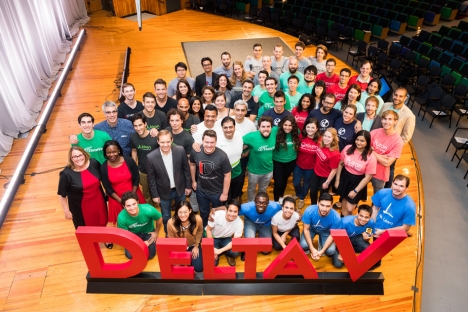
It’s a Wrap: MIT’s Educational Accelerator Demo Day 2016!

mit-gfsa-demo-16

Congratulations to all of the teams that presented at our Educational Accelerator Demo Day! We kicked off MIT’s campus-wide t=0 celebration of entrepreneurship and innovation, which will continue through September 18.

If you couldn’t join us, this post gives a quick recap; and you can catch all of the presentations on video as well. For an overview of the companies presented, check out this BostonInno article – “These are the 17 Startups MIT Kept Hush-Hush this Summer.”

First of all, in my last post I had let you know that our Global Founders’ Skills Accelerator (GFSA) would be changing its name. We are now MIT’s delta v accelerator.  Why the name change? The derivative of velocity is acceleration!  Hence, the MIT Acceleration Program delta v.

delta v literally means a change in velocity, and we believe this truly captures what happens to these students when they join us for MIT’s accelerator program.

The delta v Demo Day is focused on MIT students, and students filled the auditorium and were even sitting in the aisles. Our Managing Director Bill Aulet kicked of the program and explained how these startups have reached “escape velocity” and have been “kicked out of the house” so to speak.

Bill was followed by keynote speaker Dharmesh Shah, the CTO of HubSpot and an MIT grad. He talked about increasing the success for these student startups – how to get started, why you should avoid stealth mode, why speed matters, how to find a co-founder, attract amazing people, and give yourself crazy ambitious goals. He tells students to take advantage of all your classes to hone your skills… and he says he has never heard of a single entrepreneur who regrets taking a shot at a startup (even if it failed).

Governor Charlie Baker also joined us at Demo Day, and spoke about the amount of wizardry that comes out of MIT and the staggering contribution that MIT has made to the Commonwealth of Massachusetts, the country and the world.

It was then on to the student presentations. Fourteen startups made it through to Demo Day, and their company ideas covered topics from mental health to virtual reality.  We saw compelling videos from farmers whose lives have been changed because of MIT students, transportation in Rwanda and Mexico that will reduce costs for carriers, a way to make freight transportation more efficient and increase the income of truck drivers, and several ways to improve the environment.  We learned about innovations could change the lives of families dealing with cancer treatment and students in Africa.

Interested in learning more? Check out the companies that presented. They are listed below, in alphabetical order, along with links to their websites.  And, if you have a bit more time, check out the teams presenting in our Demo Day video recording.

Alfie
Armoire
Deepstream
dot Learn
Emerald
Factory Shop
FleteYa
Hive Maritime
kiron
Kumwe Logistics
Lean on Me
Leuko Labs
perch
Rendever
ricult
Solstice Initiative

I think everyone who attended Demo Day was inspired and impressed by the power of entrepreneurship at MIT. Now, we’re onward and upward, with t=0 this week with a full schedule of activities every day. Later this month, the delta v teams will be heading to New York City and San Francisco to meet with alumni and investors.

We hope you are inspired too!

Join us September 9th for MIT’s Educational Accelerator Demo Day!

demo-day-banner

I’m wrapping up “boot camp” with this year’s MIT Global Founders’ Skills Accelerator (GFSA) cohort this week, and wanted to let you know about our Educational Accelerator Demo Day on September 9th! As Associate Director of the Martin Trust Center and the Director of the GFSA program, it’s been an amazing summer for me, helping to shape our teams of entrepreneurs and guiding them as they prepare to present their companies.

Sign up Now

On Demo Day, each of the groups that have been working in the accelerator will reveal their company to a live audience. This event is free and open to the public – just register here and then join us at MIT Kresge Auditorium; the program runs from 4 – 7 pm, and Dharmesh Shah, founder and CTO of HubSpot will be our keynote speaker.

Demo Day is the culmination of three months of intensive work and focus by our student teams in the educational accelerator. It’s the first chance to present their world-changing products and services to an audience of MIT students, mentors, friends, investors, and potential customers.

Who are this year’s Entrepreneurs?

Our 2016 cohort is bigger than last year with 86 entrepreneurs on 17 teams. We can’t reveal the companies or their concepts until September 9th, but innovative ideas will be presented by the fantastic teams – in vertical industries from healthcare to energy to logistics. To give you an idea of what Demo Day involves, here’s a round-up of inspiring startups from Demo Day in prior years.

As the premier university student accelerator in the world, the MIT GFSA provides a capstone educational opportunity for MIT student entrepreneurs and prepares them to hit “escape velocity” and launch their companies into the real world. We hope you can join us for this amazing event.

We’re Live Streaming too!

Can’t be there live? You can still watch the live stream. (Visit now and mark your calendar.)

After the Boston event, we’re on to New York on September 15 and San Francisco on September 22 to present Demo Day in those cities as well.


P.S. We’ll also be announcing a name change for the GFSA program at Demo Day … stay tuned.

Exploring India Accelerators

India

In my role as Entrepreneur in Residence at MIT and Program Director for MIT’s Global Founders’ Skill Accelerator (GFSA), I’ve been researching accelerator programs worldwide, and I thought I’d share some of that research in a series of blog posts. This is the fourth post in the series; read the other posts starting here.

Most startups in India, irrespective of the apparent strength of their products, realized that they needed external support in the form of incubators and accelerators to grow and mature. At the early stages of incubation, most of these ambitious startups simply received funding, but as business complications began to surface, the need for mentorship, expert guidance, training, even technology-enabled office space became necessary components of accelerator programs. Though differing in operational models, the accelerators and incubators share one common goal—to provide an impetus to a brilliant business idea so that the idea succeeds and sustains as a commercial venture in this competitive world.

The accelerators provide mentors, guides, and a platform to raise issues ranging from venture capitals, legal problems, to technology enablement. Most accelerators in India expect equity in a startup in return for the valuable support system they provide. The accelerator program in some cases can charge a fixed fee and no equity for all the rendered services, and considers the startup success to be their biggest reward.

Here are some future predictions for the Indian accelerator program market as outlined in the Indian media platform YourStory:

  • To expand their global reach, accelerators will launch both online and offline programs.
  • The funding will shift from early-stage companies to late-stage companies. In 2014, and 300+ Indian startups have received over $5 billion.
  • As more corporate like Microsoft, Coca Cola, or PayPal continue to set up their own accelerator programs, the corporate giants will increasingly focus on funding startups.
  • Some accelerators will experiment with venture building models.
  • More vertical accelerators will surface in the advertising, medical, and food industries.
  • Investor networks and non-profit networks will collaborate to provide support and resources to startups.
  • Under-funded or direction-less accelerators will shut down.

A recent byproduct of this growing trend of “boosted entrepreneurship” is the growth of specialized accelerators for vertical markets, such as education, finance, or health. More and more, industry-specific accelerators are filling up the Indian accelerators landscape.

There has been a sharp rise in the number of Indian accelerator programs in the last few years. The best part is that this growth has come pretty much equally in all spheres. The rising wave has left its undercurrents in all spheres of Indian business, beginning with colleges with their own incubator cells, and global accelerators like Kyron Global Accelerators have turned to the Indian market for expansions. This particular accelerator aims to fund 300 Indian startups by 2020.

This article on the Top 50 Incubators & Accelerators in India, by Truelancer, lists the top India-based incubator and accelerator programs by region, and is a great resource.

If you want to read my next post in this series check back here on my blog or follow me on LinkedIn or Twitter.

Some of the Best Academic Accelerator Programs in the U.S.

In my role as Entrepreneur in Residence at MIT and Program Director for MIT’s Global Founders’ Skill Accelerator (GFSA), I’ve been researching accelerator programs worldwide, and I thought I’d share some of that research in a series of blog posts. This is the third post in the series; read the other posts starting here.

 MITThe accelerator community in the U.S. can be broadly divided into two segments: The accelerators owned by university campuses and the independent accelerator programs. Educational accelerators, driven by universities, bring unique capabilities and access to talent.

In my work with MIT, I’ve observed a very ambitious group that was also very aligned with the MIT community culture, which supports the teams through its educational process and ecosystem.

Naturally, I’ll start with MIT, but also highlight other excellent accelerator programs.

The Martin Trust Center at MIT has played a pivotal role in fostering a spirit of innovation and entrepreneurship among the student community. According to reported estimates at the end of 2014, 30,200 active companies were founded by living MIT alumni—employing 4.6 million people and generating annual world revenues of nearly $2 trillion. These MIT alumni startups collectively represent the 10th largest economy in the world (you can get even more stats here).

The Martin Trust Center offers a series of entrepreneurship courses for undergraduates and graduate students, hardware infrastructure, collaborative workspace, meeting rooms, videoconference system, and even coffee and snacks to inspire young innovators. The advisory panel boasting the brightest minds in the industry is available to provide guidance; while the MIT Global Founders’ Skills Accelerator (MIT GFSA) and events like Speaker Series’, Roundtable sessions, or MIT $100K competition are additional facilities to boost entrepreneurship around the campus.

The Harvard Rock Accelerator Program serves both student entrepreneurs and student investors who work together to grow and sustain a startup operation. This one-year long program offers 10-20 founding teams with each funding $8,000 in seed capital, excellent mentors, and peer exchange sessions till completion.

Stanford’s StartX Accelerator Program helps Stanford’s top entrepreneurs through a combination of empirical studies and collaborative expertise. This unique accelerator program does not charge any fee and takes zero equity from student companies. This program has managed to attract funds from leading investors like Greylock Partners and Andreessen Horowitz, boasts over 200 mentors who are field experts—including individuals from Twitter, LinkedIn, Google, and other luminaries in Silicon Valley, delivers custom education, and offers the latest technological resources.

The Babson College Butler Venture Accelerator Program has packed in seed-funding, advising, workspace, mentoring, and even self-assessments and peer support in a highly focused program. Additionally, this program includes the Glavin Office of Multicultural & International Education, where immigration attorneys offer work authorization guidelines to international students with restrictive visas.

In 6 college startup programs beyond Harvard and MIT, Beta Boston provides a roundup of some serious accelerator-program owners beyond the likes of MIT and Harvard, who offer strong accelerator programs in Massachusetts.

Does your college or university offer an accelerator program? How do you think it stacks up? Let me know below under “Leave a Reply.”

If you want to read my next post in this series check back here on my blog or follow me on LinkedIn or Twitter.

Accelerator Programs in the U.S.

In my role as Entrepreneur in Residence at MIT and Program Director for MIT’s Global Founders’ Skill Accelerator (GFSA), I’ve been researching accelerator programs worldwide, and I thought I’d share some of that research in a series of blog post. This is the second post in the series; read the first post here.

startup picIn recent years, many global accelerator programs have launched in the US, and Silicon Valley certainly takes the lead in this effort. The original accelerators such as Y Combinator or Techstars are still regarded as leaders, followed by many other programs as role models.
However, the sterling lineup of mentors in Techstars or YC makes these two programs highly desirable to both entrepreneurs and the venture capitalists. As literally hundreds of startups from all over the globe appear everyday looking for ideal accelerators, it is prudent to know that joining an accelerator program in itself does not guarantee success.

Incubators versus Accelerators

When Paul Graham created the Y Combinator program in 2005, the program was thought of as an incubator, which largely promises office space in exchange for equity. However, later this program developed into a strong accelerator displaying marked differences from the incubator model. While both the incubator and the accelerator share a common mission of guiding a startup, the main differences between the two are the applicable time periods which are short and defined in case of accelerators; time-bound funding in exchange of equity for accelerators; and the rare incentive of A-list mentors offered by most accelerators.

The 500 Startups accelerator network has connected the Silicon Valley with the rest of the world in an excellent manner. Catering mostly to international startups, this program is doing a commendable job of supporting startup founders from abroad to get their feet wet.

Accelerators Who Take Equity versus Who Don’t

It is widely known that YC takes 7% equity, 500 Startups takes 5%, but there are some accelerator programs who take as much as 50%. This practice may make it difficult to raise another funding round later with less equity to offer VCs.

On the other hand, the programs offered by top university campuses like MIT, Stanford or Harvard do not take any equity from student companies. Non-academic accelerator programs like Mass Challenge also do not take any equity. The programs who do not take any equity usually demonstrate strong networks with the VC community and other corporate sponsors for fund raising issues.

Academic vs. Independent Accelerator Programs

The accelerator community in the U.S. can be broadly divided into two segments: The accelerators owned by university campuses and the independent accelerator programs. For additional information, budding entrepreneurs with startup ambition should refer to this Mashable article: The Pros and Cons of Startup Accelerators.

The accelerators who take equity believe they are the ones who will finally survive; they say accelerators who have no financial stake in a startup are simply there for public relations and no real financial growth for the company. Yet, educational accelerators are driven by universities, with unique capabilities and access to talent. My next post will delve into some of the best academic accelerators in the U.S.

If you want to read my next post in this series check back here on my blog or follow me on LinkedIn or Twitter, as I will post about new updates there as well.


September 12 is Demo Day at MIT!

Demo Day 2015 It’s like the first day of school jitters magnified a thousand times … MIT’s Demo Day is coming September 12th!

What is Demo Day?

Demo Day is an event put on by the MIT Global Founders’ Skills Accelerator (MIT GFSA) and will showcase passionate and talented entrepreneurs at MIT and their innovative, potentially world-changing, companies.

On Demo Day, each of the groups that have been working in the accelerator will present their company to a live audience. As an Entrepreneur in Residence at MIT, this is my first time guiding students through the process, and we’ve certainly had an exciting summer. Some of the challenges the teams faced were moving from a concept to a real plan for a product or service, defining their beachhead market, determining costs and pricing, and figuring out how to clearly and succinctly present their ideas to the board.

Who will be presenting?

We can’t reveal the companies or their concepts until September 12th, but innovative ideas will be presented by 14 fantastic teams – with inspirations that cover everything from fitness to farming to fertilization. To whet your appetite, here’s a recap of inspiring startups from last year’s Demo Day.

As the premier university student accelerator in the world, the MIT GFSA provides a capstone educational opportunity for MIT student entrepreneurs and prepares them to hit “escape velocity” and launch their companies into the real world. We hope you can join us for this amazing event.

Yes, you can attend!

This event is open to the public! Last year, over a thousand people gathered to see the latest innovative companies presented.

Join us in the heart of MIT under the dome in 10-250. (Overflow space will be available where the presentations will be live streamed.) Demo Day is free; but, you do need to register in advance. Come and encourage our next generation of entrepreneurs in Boston! You can also watch the live stream from your computers. And, after the Boston event, we’re on to New York and San Francisco … I’ll keep you posted!

MIT Global Founders

Are you a Disciplined Entrepreneur?

Picture1_croppedAs some of my loyal blog readers know, I’ve recently started a new position as Entrepreneur-in-Residence at the Martin Trust Center for MIT Entrepreneurship.

I’m thrilled to have joined this incredible program at MIT, and have met some wonderful people, including the Center’s Managing Director Bill Aulet. Bill is also the author of a book called “Disciplined Entrepreneurship: 24 Steps to a Successful Startup.” I’ve enjoyed reading it and thought I would share some of the highlights.

In my mind, “disciplined” and “entrepreneur” – are two words that are seemingly in juxtaposition. Most of us think of entrepreneurs as brilliant people with lots of ideas flying around in their heads and innate entrepreneurial talent. We think that they get lucky – or, are at the right place at the right time – when they actually launch a business based on one of these ideas.

In his book, Bill asserts that entrepreneurship can be taught, and that intelligent, hardworking people can become successful entrepreneurs by following a systematic, disciplined approach to starting a new company.

The book is structured around six themes, and the 24 steps mentioned in the title each fall into one of these themes:

  • Who is your customer?
  • What can you do for your customer?
  • How does your customer acquire your product?
  • How do you make money off your product?
  • How do you design and build your product?
  • How do you scale your business?

Bill points out that while following the sequential steps, entrepreneurs will undoubtedly learn new information that will take you back to revise what you’ve done in previous steps. The graphic showing the steps is a wonderful curvy path with “go back” arrows reminiscent of the game Candy Land. This shows me that that wacky, yet brilliant entrepreneur is in there somewhere! Yet, I love that the steps give structure to the process of launching your own business.

I also really embrace the idea Bill sets forth in his book that “ideas mean nothing without execution.” If there was one nugget of advice that I would share with entrepreneurs, this would be it.

As an entrepreneur myself, I value the examples in every chapter, drawn from projects that Bill has worked on with MIT students. Bill uses these real-life examples to guides those with ideas, new technologies, or passion into channeling that energy into a viable business.

At MIT, I am currently taking 14 student-founder teams through the disciplined entrepreneur process in a program called Global Founders Skills Accelerator (GFSA) … I will let you know how it goes!

Does our Education System Benefit from Data-driven Decision Making?

THE Journal cover story on

THE Journal cover story on “The Power of Small Data”

Big data is everywhere. You may not expect it to impact how decisions are made in a kindergarten classroom, but big data and analytics are becoming more deeply engrained in the education system – even at the youngest grade levels

A recent article in THE Journal on “The Power of Small Data” asserts that in order to deliver personalized education, districts have to gather and share students’ statistics. The article goes on to explain how the strategic use of data can boost teaching and learning.

The author was kind enough to reach out to me to provide some context for this article. My dissertation for my doctorate in work-based learning at the University of Pennsylvania focused on “Analytics by Degree: The Dilemmas of Big Data Analytics in Lasting University/Corporate Partnerships.” I was able to share my insights in higher education, and also discuss how big data has a major impact on school systems at every level.

Here are some excerpts from the article, along with some of my additional thoughts and research on the topic:

I am seeing a renaissance in data collection in the education field, supported by new tools and technologies. “Recent technologies like big data, the Internet of Things, mobile apps and improved storage have made it possible to acquire, combine, store, analyze, interpret and report findings during any phase of data management.”

“The data repositories residing in disconnected, fragmented departments with little sharing have now been transformed into centralized, interrelated data systems to enable fast and efficient retrieval of interrelated data for quick and informed decision-making.”

However, leadership, based solely on data, will not be successful. Educational systems need to involve key players in the community, particularly the educators themselves, to listen and ascertain what is needed most.

As the article points out, analytics can have many positive uses in the school system, including:

  • Instant Feedback for Students and Parents
  • Formative Assessments that Help Students Grow
  • Using Data to Connect people

However, sadly sometimes educators are spending so much time gathering data (and posting it) that there is little time for instruction. We need to think of how technology, data collection and the onus on high test scores impacts our next generation.

“Data is not the problem. The problem is getting the data to the right people so it can be used…. Data only tells part of the story, and a lot of it is basic so it doesn’t provide the insights that teachers and schools need to pinpoint teaching and learning problems and identify the best ways to solve them.”

We need to ensure that the educators are involved in determining what is needed in terms of useful data, and that a balance is achieved between gathering and analyzing data and effectively teaching our students.

I encourage you to read the full article to learn more.

Colleges and T-Shaped Training: Build it and They Will Learn?

Though the idea of T-shaped management is gaining traction on American campuses, there are some important roadblocks along the way. Some of those roadblocks are ivy covered. In some ways, the relationship between colleges and major tech corporations is beginning to look a bit like ju jitsu. Ju jitsu, roughly translated, means that when you get pushed, pull, and when you get pulled, push.

fieldofdreamscorn-400In principle, most business colleges clearly want better partnerships with major corporations. Most colleges accept the importance of using business analytics, T-shaping their students, and embrace change when it comes to education, at least in concept. In reality, however, change seems to move at a glacial pace in the halls of higher learning.

In 2011, the president of New York University observed that monumental change in America was something “people love to talk about,” while also referring to universities as islands of stability in that sea of change: “(W)e should not lose sight of the fact that, of the 80 institutions that existed 500 years ago and still do, 75 are universities.”

And while NYU’s president praised university longevity, he also said that academia continued to do some things badly, in the same old way, over and over again. Specifically, he noted universities still hadn’t come to grips with T-shaping their learning: “One thing the proprietary institutions do that is not a good thing is delivering an ‘I-shaped’ education (depth in one area) as opposed to a ‘T-shaped’ education (broad learning, with depth in one area).”

Academic resistance to T-shaped training often seems to be over matters of control, and fears about giving it up. It is true that the enormous potential influence of corporate technology giants, who are donating massive sums of money and expecting nothing less than drastic changes in what universities teach, cannot be overlooked.

The “Gates Effect”

While Bill and Melinda Gates are not the only major influence on university reforms, they are big enough to have a gravitational effect. In the context of their almost $500 million in donations to universities, this is to be expected. In a July, 2013 article, The Chronicle of Higher Education (which has also received Gates Foundation support) noted that the bulk of these donations (over $300 million) have come in since 2008. That’s a lot of money. And a lot of influence.

One example of how the Gates Effect is transforming the future of college education is seen in a sprawling ConAgra plant in Troy, Ohio. Employees there are participating in an Gates-funded program that awards college credits — not for conventional course work — but for mastering “core competencies.”

Working through the University of Southern New Hampshire and taking online course work, students are assessed in such areas as “logic, reasoning, and analysis,” which help the student solve real-world business problems.

Everyone seems to like the potential of this approach: except for entrenched college executives.

“Build it and they will learn”

In the movie Field of Dreams, the apparently crazy idea of turning a cornfield into a baseball field is justified based on the mantra, “Build it, and they will come.” The threat to American competitiveness, in terms of highly desirable T-shaped employee skills, is that there is a whole lot of T-building going on — elsewhere in the world. Until recently, Poland’s national education system was widely perceived as falling apart, regarded as suitable only for low-trained, low-tech, and low-paying jobs. This view changed with the successful adoption of innovative T-shaped education strategies there.

Interestingly enough, critics of the Gates approach have claimed the Gates Foundation is approaching the “problem” as something that “engineering” can measure (through technical algorithms) and fix . Yet the Gates Foundation seems to be hewing very closely to the Polish model of making T-shaped students. We know through example that it works. Confusing the necessity for a better, T-shaped core curriculum with the need to accurately measure that curriculum is confusing cause and effect.

The lesson for America from Poland is the benefit of every college developing a core curriculum that leverages that specific institution’s unique offerings in such a way to develop T-shaped skills. The shift from a traditional, “I” shaped curriculum to a T-shaped one is very much in evidence in what the Gates Foundation has done with the Southern University of New Hampshire. Whether crossing that “I” to get a “T” will happen in the next decade or not may rest on the influence of a new era of outside-the-box, dotcom entrepreneurs. Will it be enough for the U.S. to compete globally? Or will it be too little, too late? We shall see.

Big Data and Women Leaders: A Fresh Perspective

big-data-eyeIs “Big Data” a fad? I recently heard someone claim that it was, and all I could do was shake my head in disbelief.

Big Data is definitely not a fad.  People are talking about it all the time, everywhere because Big Data IS all the time, everywhere. As the power of computers and data analysis continue to grow by leaps and bounds, Big Data will become an increasingly important part of our world and our lives. Even if the term “Big Data” goes by the wayside, the reality is that Big Data is going to be with us until the day we die.  For the time being, it’s like an old-fashioned gold rush, and the undeniable benefits seem to be around every corner. Case study after case study shows us how using data wisely unlocks the door to better productivity, improved customer satisfaction, higher margins – the list goes on.

So if Big Data is here to stay, how do women fit into the picture? Is Big Data a threat, or an opportunity, for women in leadership roles?  My feeling is that the Big Data paradigm shift has the potential to be hugely positive for women, because women leaders and Big Data share an important quality: the ability to provide a new perspective and “transcend the obvious.”

When looking at the historical exclusion of women leaders from the boardroom, we’ve almost always defined this as a problem, a malady, something to be fixed or rectified. Call the diagnosis the “absence of women.” Make no mistake, the numbers still suggest an ongoing problem. Forbes reports that a mere 2.4 percent of Fortune 500 Company CEOs are women. European countries, from Finland and Spain to Sweden and France, are considering legally mandating the number of women executives in major corporations. However, I’d like to offer a different perspective. Instead of being a purely quantitative problem to be solved by adding x number of women to leadership roles, the lack of women leaders is a monumental opportunity to be uncovered and exploited.

Why is it so important to make a distinction? Because solving problems generally leads to incremental improvements in the status quo. Exploiting opportunities lead to paradigm shifts in the way things are done, a.k.a. genuine progress.