Many of today’s early-career professionals are struggling. They’ve worked through a pandemic; they’ve embraced work from home (WFH) and may now be facing a return to the office (RTO) or hybrid model. Although working from home has many benefits, employees who are just starting their careers miss out on the support, training, informal mentorship, and camaraderie that were once a normal part of corporate life.
In my last blog post on preparing our next generation of corporate leaders, I explored the shifts in traditional employment and how many companies no longer provide scaffolding for their employees to learn and grow. I offered 11 strategies for employers to improve employee satisfaction, engagement, and development to foster a more engaged and loyal workforce.
Yet, this responsibility doesn’t solely rest on the shoulders of employers. Ultimately, employees are responsible for managing their own careers, particularly if their current company doesn’t provide a lot of support.
The following strategies can be used by all early-career professionals to take ownership of their careers and successfully navigate advancement and job satisfaction:
1. Enhance Your Networking Skills
Leverage Existing Contacts: Contact college friends, family, and colleagues to rekindle connections and explore opportunities.
Expand Your Network: Attend industry events, join professional associations, and engage in online forums related to your field.
Informational Interviews: Schedule meetings with people in roles you aspire to. Ask about their career paths, challenges, and advice for joining similar positions.
2. Develop and Utilize a Personal Brand
Build an Online Presence: Update your LinkedIn profile with your accomplishments and skills. Ask for LinkedIn recommendations to share on your profile. Share relevant content and engage with posts to increase your visibility.
Showcase Your Skills: Create a personal website or portfolio if applicable. Highlight projects, achievements, and skills that make you stand out.
3. Stay Informed About Industry Trends
Set Up Alerts: Use tools like Google Alerts to keep track of developments in your field or industry.
Follow Industry Leaders: Keep up with thought leaders and organizations in your sector through social media and industry publications.
4. Document Your Achievements
Maintain a Log: Regularly update a document with your accomplishments, skills developed, and project contributions. This can help you during performance reviews or job interviews. Create a folder and save those “kudos” emails.
Create Impact Statements: Quantify your achievements with specific metrics (e.g., increased sales by X%, reduced costs by Y%).
5. Seek Continuous Learning and Development
Enroll in Courses: Take advantage of online courses, certifications, or workshops to enhance your skills and make yourself more marketable. Ask your manager what professional development courses they would recommend that the company will fund.
Stay Updated: Learn new tools, technologies, and methodologies relevant to your industry.
6. Evaluate and Explore New Opportunities
Set Career Goals: Define what you want in your next role, whether it’s higher pay, more responsibility, or better work-life balance.
Apply Strategically: When exploring new job opportunities, target roles that align with your career goals and offer growth potential.
7. Communicate Effectively with Your Current Employer
Request Feedback: Regularly seek feedback from supervisors to understand areas for improvement and express your interest in taking on more responsibilities.
Discuss Career Development: Talk with your manager about your career aspirations and seek guidance on achieving them within the company.
8. Consider Freelancing or Consulting
Explore Side Projects: If feasible, undertake freelance work or consulting projects to build experience, expand your network, and discover new career paths.
Diversify Income Streams: Freelancing can offer financial flexibility and open new professional opportunities.
9. Maintain Work-Life Balance
Set Boundaries: Ensure a healthy balance between work and personal life to avoid burnout and maintain job satisfaction.
Engage in Hobbies: Pursue interests outside of work to stay motivated and keep a positive outlook on your career.
By combining these strategies, employees can effectively navigate their career paths, find new opportunities, and achieve greater job satisfaction.
Other suggestions or strategies that have worked for you? Please add them to the comments!
Living life boldly means exposing yourself to all sorts of risk – risk of loss, risk of criticism and judgement, risk of mental, emotional, or physical distress. It’s no wonder, so many of us are raised to not live boldly, to not take risks, to not push ourselves to reach our highest potential.
Bold Journey, an online magazine, asks people to share the story of their lives and how they got to where they are today. Their mission is to create a space for all of us to learn from each other. They recently reached out to profile my bold journey – the interview is shared below.
Trish, thank you so much for joining us today. Let’s jump right into something we’re really interested in hearing about from you – being the only one in the room. So many of us find ourselves as the only woman in the room, the only immigrant or the only artist in the room, etc. Can you talk to us about how you have learned to be effective and successful in situations where you are the only one in the room like you?
I began my career in the chemical industry, initially working in the lab and later as an engineer running a plating line. I was often the only woman in meetings, in the manufacturing area, and at lunch. My upbringing with six brothers (and two sisters) and playing team sports prepared me for that experience. As the only female, I was frequently offered training programs aimed at increasing diversity. Early in my career, my boss would joke that I went to another facility for lunch because there were more women, and he was right. I did feel lonely and excluded at times, but being the only female also brought unique opportunities. The support, mentorship, and sponsorship I received from men far outweighed the challenges I faced.
Thanks, so before we move on maybe you can share a bit more about yourself?
I am currently in the fourth stage of my career. I started as an engineer making circuit boards and gradually expanded to building various computer components and ultimately overseeing comprehensive product testing. Moving laterally within the company proved to be a transformative experience, allowing me to work with new people in a management role and learn skills and techniques I would call upon for years – this was the second stage of my career.
In my third stage, I ventured into academia, teaching entrepreneurship at MIT and spearheading its capstone accelerator, delta v. This experience was exceptional, immersing me in cutting-edge technology daily and mentoring students eager to make a positive impact on the world. It also provided opportunities to research entrepreneurial ventures globally (check out my free ebook on Start-up Accelerator Programs Around the World).
I continue to collaborate with MIT in the fourth stage of my career, contributing to partner programs in entrepreneurship education. Additionally, I focus on entrepreneurship and energy coaching through my own business. This work has been particularly inspiring, enabling me to help clients maximize their positive impact through enhanced focus and joy in their lives.
There is so much advice out there about all the different skills and qualities folks need to develop in order to succeed in today’s highly competitive environment and often it can feel overwhelming. So, if we had to break it down to just the three that matter most, which three skills or qualities would you focus on?
My career success is significantly attributed to the invaluable mentorship and sponsorship I received, which provided me with a solid foundation of technical, leadership, and personal skills. Several mentors offered training opportunities, and sponsors recommended I transition into the executive ranks. Without their support, I don’t believe my career would have been as successful.
A mentor encouraged me to explore opportunities in the startup realm, a decision that proved to be highly rewarding. I played a pivotal role in the remarkable growth of two startups, helping the first grow to over $100M, and the second to over $225M before it was acquired by IBM.
At MIT, I dedicated my tenure to sharing my entrepreneurship experience and preparing students to excel in business. Over six years, I worked with a fantastic team to teach and develop the skills of student entrepreneurs. Our energy coaching program empowered them to understand their professional presence better and take control of their business and career. We also introduced a mental health aspect into the entrepreneurial journey, a focus that was previously absent. I co-authored an article for HBR about this program titled, “Passion for Your Startup Doesn’t Have to Mean Constant Stress.” This investment in the mental health of entrepreneurs has created a more resilient generation of business leaders ready to face the challenges of the outside world.
We’ve all got limited resources, time, energy, focus, etc. – so if you had to choose between going all in on your strengths or working on areas where you aren’t as strong, what would you choose?
A well-rounded approach will serve you well. Some skills that I’ve developed include the ability to take risks, a strong work ethic, and being a good listener.
I never considered myself a risk taker until my dad, who had been with an employer forever, asked why I was changing jobs. My reason was that there was so much more in the world to learn. I moved from making computers to testing them, using them, monitoring them, and analyzing data. This wasn’t a wild risk, but the shift from large companies to startups was viewed as one. However, as the companies got smaller, I had more control and impact.
I knew that no one would outwork me, and I surrounded myself with a great group of people in a culture I crafted. In this environment, work was recognized, teams were rewarded, and customers received value from our products. I also knew I needed to get comfortable with being uncomfortable, learning from intelligent people who had clever ways to solve problems, regardless of their position.
A learning mindset serves you well. Good listening skills help you zero in on the root cause of issues rather than revisiting them repeatedly. As an entrepreneur, you’re not just taking risks; you’re mitigating them every day. The key is to surround yourself with intelligent and creative people who can build a team where – even if we miss – we win by learning together.
The original article was published in Bold Journey here: “Meet Dr. Trish Cotter.” Thank you for the opportunity!
International Women’s Day is an occasion to shine a spotlight on gender equity issues around the world. When women embrace entrepreneurship, they can expand opportunities to forge their own path and reap the economic rewards. If you’ve thought about starting your own business – even part-time or as a side hustle – there is a supportive community to help you explore this option.
The theme of this year’s International Women’s Day (#IWD2024) is to Inspire Inclusion (#InspireInclusion). As explained on the IWD site, when we inspire others to understand and value women’s inclusion, we help to build a better world. And when women themselves are inspired to be included, there’s a sense of belonging, relevance, and empowerment.
One of the ways organizations and groups can inspire inclusion is through action in building women’s economic empowerment. According to Equality Now, full and equal economic participation by women would increase global GDP by more than a quarter, representing nearly $28 trillion of additional shared wealth being contributed to the worldwide economy every year.
Women Entrepreneurs by the Numbers
Women entrepreneurs are a force to be reckoned with. Here’s an excellent list of recent statistics on women entrepreneurs compiled by Luisa Zhou, some of which I’ve highlighted below:
42% of all U.S. businesses are owned by women
Women-owned businesses have grown 114% in the last two decades
Startups with all-women teams only received 1.9% of venture capital funding
About half of all startups in the U.S. are founded by women
One-third of businessesworldwide are owned by women
Lower-income countries have the highest participation (55.6%) of young female entrepreneurs
Interestingly, one in six women globally reported an intention to start a business in the near future. The highest entrepreneurial intention rates were observed in low-income countries, where approximately 28% of women expressed intentions to start a business. For these women, entrepreneurship is a way to change their life circumstances.
Why do Women Start their own Businesses?
Among all entrepreneurs, there are various reasons why someone decides to start their own business. At MIT, I worked with many women-led startups and the reasons are often connected to a passion or an experience in the founder’s life. Alicia Cong Rodriguez’ grandmother died of a heart attack when she was only 13 years old. This fueled her personal mission to co-found Bloomer Tech, a company that makes a bra that monitors women’s heart health, as she explains in this CBS News profile.
Yet, worldwide, more than 70% of women reported job scarcity as the motive behind their startups, according to the Global Entrepreneurship Monitor (GEM) Women’s Entrepreneurship report ‘22/’23. It is interesting to note the differences between necessity-based entrepreneurs and innovation-based entrepreneurs. Women and minority entrepreneurs are often necessity-based entrepreneurs – starting their own business after losing a job, to supplement their income, or to gain flexibility to attend to other demands in their lives. This doesn’t take anything away from their entrepreneurship. In fact, in addition to economic gain, necessity-based entrepreneurs are often motivated when traditional labor options are insufficient to meet their needs and goals.
How to Explore Entrepreneurship
If you’re considering becoming an entrepreneur, now might be the perfect time to explore opportunities – even for an entrepreneurial side hustle. You don’t necessarily have to leave your current job (and regular paycheck and benefits) just yet, but taking some time to delve into entrepreneurship can be immensely rewarding. Start by conducting research and testing the waters to gauge the viability of your business idea.
Fortunately, there are a wealth of resources available within the entrepreneurial community to support you, including networks specifically geared towards women in business. Look into organizations and programs designed to assist female entrepreneurs, such as Women’s Business Centers (part of the U.S. Small Business Administration). Additionally, take advantage of events and workshops hosted by colleges and universities, where you can connect with fellow entrepreneurs and gain valuable insights from experienced speakers.
Conferences serve as vibrant hubs for entrepreneurs to connect with like-minded individuals. When selecting a conference to attend, you could choose one that may be geared toward entrepreneurs, or it could be focused on the industry where you want to start your business. After attending an event, are you thinking, “I could do that!”? By immersing yourself in the conference environment and connecting with others who share your vision, you can enrich your entrepreneurial journey and expand your network of supportive peers and mentors.
LinkedIn is also an invaluable tool for entrepreneurs. Take advantage of its vast network to connect with other entrepreneurs in your industry. Don’t hesitate to reach out and request an informational interview. Use this opportunity to gain insights into an entrepreneur’s journey – ask about how they got started, the challenges they faced, and any advice they have for breaking into the field.
Resources for Women Entrepreneurs around the Globe
One place to start researching entrepreneurial opportunities is with the ebook I created titled, “An Introduction to Start-up Accelerator Programs around the World,” a free guide for entrepreneurs who may be exploring ways to start their own businesses, especially in countries outside the U.S.
I’ve found that diversity, thought leadership, and collaboration all work together to make the ecosystem of entrepreneurs a much richer place. To that end, this ebook includes information about entrepreneurship around the world to show how different countries support their entrepreneurs with various programs and accelerators.
Boston-area Resources for Women Entrepreneurs
Closer to home, I’ve also included a list of local resources. Boston and Cambridge are renown for some of the world’s most prestigious universities and they support the Boston area’s unique entrepreneurial DNA for success. MIT even offers a free online course on Becoming an Entrepreneur.
Here are several resources and organizations in the Boston and Cambridge area. For other regional areas, search online to find local resources.
The key message here is that you’re not alone on this journey – there are people and resources ready to support and guide you as you explore the world of entrepreneurship. So, take that first step, and embrace the possibilities that lie ahead!
Think like an entrepreneur to cultivate creativity and innovation in your role.
As a learning and development (L&D) professional, you may not think of yourself as an entrepreneur, but embracing an entrepreneurial mindset can help you foster creativity and innovation in your organization. Understanding how you can encourage an antifragile approach to deal with internal forces as challenges arise within your company is essential. Connect that to how you show up in your job and how it affects both your own effectiveness as well as co-workers’ effectiveness.
What it is
The pursuit of entrepreneurship in the context of an existing organization is often called corporate entrepreneurship or intrapreneurship – whether it is a for-profit corporation, a not-for-profit organization, a government agency, or any other type of company.
Corporate entrepreneurship is a method used to develop new businesses, products, services, or processes inside of an existing organization to create value and generate new revenue growth through entrepreneurial thought and action. People who see themselves as corporate entrepreneurs are the engines of growth within a company; they are often corporate leaders or develop into leadership roles.
L&D professionals are well positioned to harness their intrinsic entrepreneurial skills to create value in their organizations given their roles entail working with both internal customers and a variety of other stakeholders. Further, the skills, knowledge, and ability L&D practitioners possess can help them solve corporate problems by thinking like an entrepreneur.
How it works
Here’s an example: The operations team at a small technology company in the data analytics space had a major problem – the startup competed against industry giants such as IBM. As the old saying goes, “Nobody ever got fired for buying IBM.” The team leader needed to figure out how the company could compete and get the attention of prospects to have them take the leap of faith to buy from a smaller, unproven vendor.
Operations team members assessed the skills, knowledge, and abilities in terms of how they could take an entrepreneurial approach to solve that problem. The team identified the company’s customers and their compelling needs. Because people were tired of waiting on hold and dealing with multiple customer service representatives who couldn’t solve their problems, the startup began taking a customer-centric approach. The team figured out that one way it could differentiate was by gearing all its operational decisions toward how to best serve the customer and provide an excellent customer experience.
The operations team simplified the process for the customer – from being able to always talk to a knowledgeable person to easy, one-page contracts – which helped the business succeed. As the company grew from a startup to a more established business, customers still valued and encouraged the founders’ entrepreneurial spirit and mindset. The happy ending to this story is that IBM acquired the company after seeing the value it provided to customers.
Guidelines
As corporate entrepreneurs start activating their ideas, they should aim small so that if they succeed, they can build on that success; if they miss, they may learn even more from that experience, which will help in the future.
Corporate entrepreneurs should also look to cultivate an antifragile mindset, a concept taken from Nassim Nicholas Taleb’s book Antifragile. His premise is that many things in life benefit from stress, disorder, volatility, and turmoil — they not only gain from chaos but need it to survive and flourish. To be antifragile, individuals must bend but be strong enough not to break.
In a talk by GE Ventures CEO Sue Siegel to entrepreneurs at the Massachusetts Institute of Technology, she said, “The pace of change today is the slowest it will ever be.” People with an entrepreneurial and antifragile mindset can prepare themselves and their organizations for rapid change and disruption. They get stronger in the face of adversity.
Results
The outcomes of corporate entrepreneurship will be evident once individuals start thinking like an entrepreneur and moving forward with this mindset, which opens up a world of possibilities – such as IBM acquiring your startup business. Set a vision and create a team of people with credibility and a good understanding of the problem you are trying to solve.
One of the biggest obstacles is overcoming initial inertia. The do-nothing strategy tends to be easier for corporate employees than embracing change. To combat this, align yourself with employees who have a compelling reason to change, and educate them on how the new product or service or way of doing things will address their problem.
As Netflix co-founder Marc Randolph, states, “If you are unwilling to disrupt your business, there will always be someone willing to do it for you.” Demonstrate that you are able to stand in the storm and provide leadership as a change agent for your organization.
Checklist
What is the problem you are trying to solve? What benefits will it deliver to your customers?
Define the problem, quantify it. Can you do primary market research with open-ended questions to validate your hypothesis?
Come up with solutions. Does your solution solve a compelling need? Does it make monetary sense?
De-risk your solutions. How can these solutions be adopted by your prospects with a low risk to them?
Identify a team to help. Success is more likely when you are backed by a team. Entrepreneurship is not a solo sport!
Patricia “Trish” Cotter is an entrepreneurship consultant and coach as well as a past director of MIT’s delta v student venture accelerator program; patriciacotter76@gmail.com.
Rita Balian Allen is an executive coach focused on leadership development, management training and career development; rita@ritaballenassociates.com.
Hiring struggles endure as companies try to employ and retain the talent needed to grow their businesses. The Great Resignation (or Great Reshuffle) continues in many industries as people consider new post-pandemic options. While nearly 4.3 million people in the U.S. quit their jobs in January (2022), there were also 11.3 million job openings, according to the latest report from the U.S. Department of Labor. What does this mean for hiring?
In my last blog post, I wrote about how to lead with empathy in hiring and recruitment practices. Part of leading with empathy is to make sure our workplaces are representative of the society we live in by implementing effective diversity, equity, and inclusion (DEI) hiring practices. This post will explore how companies and hiring managers can help make an impact, even when talent may be scarce.
There is much lip service given to diversity, equity, and inclusion, and some companies are making strides, but many companies are not. This quote resonated with me as a goal for DEI initiatives:
“As a society, if we begin to shape our practices around how we treat people, how our work environments are structured, the Great Reshuffle will end,” states Gina Ganesh, VP of People and Culture at Florence Healthcare. Treating all people well is the right thing to do. And hiring diverse candidates drives real progress, including bottom-line business results.
Diversity Drives Business Results
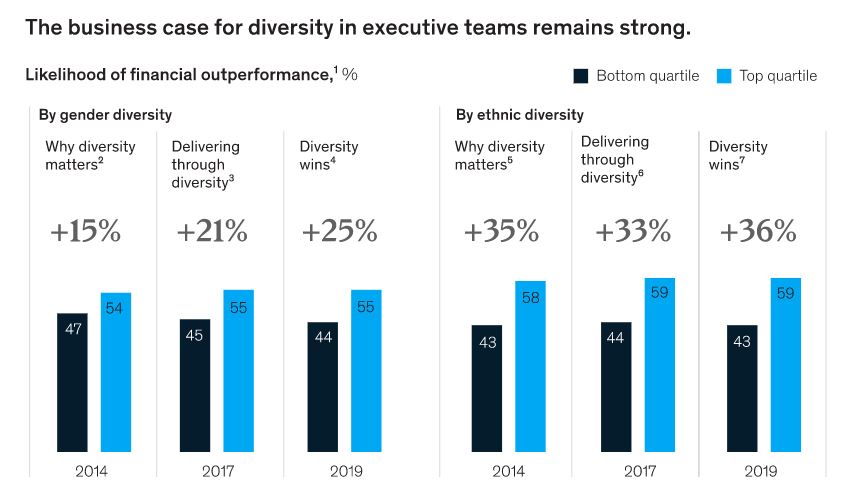
It has been proven that ethnically diverse companies perform 36% better than companies that are not. We’ll dive into that stat in a minute, but first, some important definitions and distinctions when thinking about a DEI recruiting strategy.
Diversity is the range of differences that make people unique, both seen and unseen. (Be mindful that diversity includes not only race and gender, but age, ethnicity, sexual orientation, physical disabilities, and neurodiversity).
Inclusion is an environment that engages multiple perspectives, different ideas, and individuals to define organizational policy and culture.
Remember, when you hire for diversity, you get the benefits of inclusion.
An important point according to Janet Stovall, Executive Communications Manager at UPS, in her TED talk. “Let’s be clear: diversity and inclusion are not the same things. Diversity is a numbers game. Inclusion is about impact. Companies can mandate diversity, but they have to cultivate inclusion.” Stovall is also clear that businesses can be a key force to dismantle racism.
McKinsey has done a series of studies on the topic of DEI and the latest study encompasses 15 countries and more than 1,000 large companies. This latest report, titled Diversity Wins shows that the relationship between diversity on executive teams and the likelihood of financial outperformance has strengthened over time.
McKinsey explored how different approaches to inclusion and diversity could have shaped the trajectories of the companies in their data set and found two critical factors: a systematic business-led approach to inclusion and diversity, and bold action on inclusion.
One Leader’s Story on Building a Diverse Organization
The business case for DEI is there, but it’s not always easy. I’d like to (anonymously) share the story of a friend of mine who was trying to increase diverse hiring his organization.
He was the head of AI software for products at a Fortune 500 company and specifically set out to hire more female engineers. He met with his managers and discussed ideas. He challenged his staff to look through LinkedIn for candidates. He spent one morning combing through LinkedIn and personally wrote 100 cold/semi-cold emails to prospects.
I think it’s important to note that he didn’t delegate it out. From this initial outreach, he received 35 responses, and he reached out personally to all. Then he interviewed and hired several of these women. After a period of one year, 20% of his team were women – from less than 5% – and the percentages were still climbing.
A couple of things had to happen to make this work. He told his staff that they needed to get involved and invest in their networks – both college alumni networks and other networks of friends and past colleagues. He made it clear that hiring for diversity is key in jobs at every level. He also made sure that candidates met a diverse group of people within the company during interviews. His staff was taught to follow up with every candidate personally. These may seem like small things, but they were game changers for both the new employees and the organization’s depth.
Unfortunately, there is bad news here. Two years after this initiative, there was a full reorganization and my friend parted ways with this company. The commitment to hiring for diversity was not sustained, the DEI focus faded within the organization, and progress was lost. I believe that the moral of this story is that enabling real change takes both time and commitment, and awareness is only the first step.
Beyond the Rooney Rule
The “Rooney Rule” – a diversity initiative started by the National Football League that calls for interviewing minority candidates for top jobs – has been adopted by corporate America, but experts believe it hasn’t made much of an impact.
As companies release detailed information about the diversity of their workforces, the data shows that women and people of color are well-represented in the lowest rungs of many company workforces, but there’s often little representation in leadership roles and board positions. When companies adopt a Rooney Rule, they’re pledging to add at least one candidate to their interview pool to increase gender and racial diversity, but that’s usually not enough to foster real change.
To make a meaningful impact, hiring managers should aim to interview a slate of candidates that’s 30% diverse, according to Alina Polonskaia, global leader of the D&I practice at executive recruiter Korn Ferry. Companies could also set a standard of having their executive ranks mirror the gender and race breakdown of the usually much-more-diverse entry-level workforce. In addition, employers should also use the same diversity standards they are applying for new hires to people being considered for promotions.
How Diversity can be Your Superpower
Let’s take a look at a study focused on hiring for B2B sales roles. This study by Forrester, commissioned by Outreach, confirms it is time for us all to commit to diversity, equity, and inclusion. Since sellers are the first point of contact for a company, sales reps must represent the world around them, and organizations must commit to DEI or risk losing revenue and talent.
Sales leaders understand the need for diverse teams; 67% of respondents say it’s important for their team to represent the world around them. However, although sales respondents in North America say DEI is important, they are not ranking DEI efforts over other priorities. Respondents ranked almost every other sales leadership skill before DEI. Yet, customers are demanding diversity now.
60% of respondents stated that diversity within their sales team has contributed to their teams’ success.
82% predict that the racial or ethnic diversity of their sales team will be equally or more important in the next two years.
72% believe that DEI will play an equally important or more important role in business decisions in the next two years.
They conclude that companies with strong DEI practices have better-performing sales teams, including higher forecasts, higher conversion rates, and higher sales attainment.
How to Walk the Walk
The Inclusion Solution blog points out, “it’s not just about introducing shiny new initiatives and hiring the first head of DEIBJ (diversity, equity, inclusion, belonging, and justice) — it’s about displaying a real, sustainable commitment to these efforts through financial and human resources deployed over time… not just when the cameras are rolling and the topic is trending.”
To that end, here are some strategies and ideas on how to walk the walk and incorporated diversity in your hiring to reap the benefits of inclusivity. Some are tactical tips, others are broader, more strategic initiatives gathered from the reports, experts, and sources mentioned in this blog.
Focus on developing an equitable talent process, purposely create diverse and inclusive teams, and create development programs for under-represented groups. (Korn Ferry)
When conducting campus recruiting, think beyond Ivy League schools and schools you may be personally connected to, and consider Minority-Serving Institutions (MSIs) (Excelencia in Education)
A “work from anywhere” environment can foster diversity hires. In an all-virtual environment, there are very few limitations in terms of where to find talent. (Bloomberg)
Challenge your definitions of “professionalism” and “leadership” within your organization – and then hire and promote diverse leaders. (Mac’s List)
Broaden your lens on DE&I, including embracing neurodiversity. One big benefit of an inclusive work culture is that it fosters diversity of thought, different approaches to work, innovation, and creativity. (Deloitte)
Provide education around and try to use inclusive language. (Mac’s List)
Training is a good start, but mature organizations do more. Leaders need to model inclusive behavior, and the organization as a whole needs to value and measure progress toward DEI goals. (Forrester)
Strengthen leadership accountability and capabilities for inclusion and diversity (I&D). Companies should place their core-business leaders and managers at the heart of the I&D effort—beyond the HR function or employee resource-group leaders. (McKinsey)
Enable equality of opportunity through fairness and transparency. Deploy analytics tools to show that promotions, pay processes, and the criteria behind them, are transparent and fair. (McKinsey)
If companies want to do a better job of retaining diverse talent, they can’t go back to “business as usual.” It’s time to make work more equitable, and while flexibility is not the panacea, it is a step in the right direction. (Harvard Business Review)
Workers overall want to feel like their boss cares about them. Gen Z wants a culture built on mental health and wellness. (LinkedIn)
Flexibility is increasingly prized, particularly by underrepresented groups. Leaders who hope to retain top talent and maintain diversity must act swiftly and deliberately to counter the forces of proximity bias. (i.e., if managers spend most of their time working in the office, that is likely to lead to a double standard of valuing employees who also come into the office). (Future Forum)
Continue pushing the conversation forward, even if you don’t have all the answers. DEI strategy is an essential element of building a strong business that is able to attract and retain great talent and connect with a diverse customer base. (Forrester)
As you search out new talent, there are a lot of nuances that you need to consider. Your HR team may have guidelines, and you may want to “go with your gut” in terms of what is right, but there are many factors and issues involved. Educate yourself and become an agent for change, dedicating the time and commitment necessary to foster inclusivity for all.
As we enter the new year, HR managers and CEOs face a wake-up call. Employee recruitment and retention are major priorities for so many businesses this year, with companies unable to fill positions as we face continued uncertainty with COVID and the Great Resignation – now also being termed the Great Reshuffle.
The most recent statistics from the U.S. labor department said there were 10.6 million job openings at the end of November 2021 and 6.9 million unemployed people – 1.5 jobs per unemployed person. The number of “quits” hit a new high of 4.5 million in November. An article in The Guardian explains, “Quitting, most economists will tell you, is usually an expression of optimism. And yet, 2021’s quits happened against a larger economic picture that remains difficult to interpret with confidence.”
Some of the reasons people are quitting their jobs, according to USA Today and The Guardian, include:
Retirement – Most of the 5 million people who have left the labor force since the start of the pandemic are over 55 and have retired – early or naturally.
Career or industry switching – Others are switching careers or industries, for example, from restaurants and hotels to technology and warehousing, leaving some sectors with lots of openings and fewer candidates to fill them. Not surprisingly, given the stress on educators over the past two years, teachers are most likely to leave the labor force as compared to their counterparts in other industries.
Work-life balance – Thirteen percent of workers said they quit because their jobs didn’t provide work-life balance.
Care insecurity – Related to work-life balance, mothers with college degrees and telework-compatible jobs were more likely to exit the labor force and more likely to be on leave than women without children. One of the underlying reasons is an unequal distribution of labor at home and a critical degree of burnout contributing to “care insecurity.” Care insecurity is defined as uncertainty about daycare and school schedules that are unpredictably interrupted by periods of quarantine prompted by exposure to COVID.
The short-term outlook for the labor market suggests workers are likely to continue to have considerable bargaining power in 2022, says Indeed in its 2022 Labor Market Outlook report. But interestingly, job seekers remain hesitant. Active job search – that is, people taking specific steps to land work, like responding to job ads – hasn’t budged since the summer.
Where does all of this leave employers as they seek to recruit solid candidates to fill open positions?
Recruiting During a Time of Resentment
From the conversations I’ve had with friends, family, and colleagues recently, businesses that are hiring aren’t doing themselves any favors. Too many companies are approaching recruiting without empathy making it difficult to recruit good people. At the same time, prospective employees are hesitant and may have negative experiences with previous employers. Maybe it’s time for HR Managers to take a step back and look at their hiring processes.
You’re essentially recruiting during a time of resentment. People are disheartened, they’re tired, they’re sick of COVID, and at times sick from COVID. They may be working in an industry, such as healthcare, teaching, hospitality, or retail, where they are on the front lines every day and are looking for something different and less stressful. On the other hand, many office workers have the advantage of being able to work remotely, but that has its challenges as well. Are they being supported and mentored? Are they learning and growing? If this is going to be the new normal – rather than just a phase to get through – are you fully invested in making it successful?
New recruits will be precious resources in your company. Do you understand how to communicate effectively and listen to their thoughts and ideas?
5 Tips forHiring and Retaining Employees with Empathy
Here’s a collection of tips for hiring with empathy. I believe that companies who approach their hiring process this way demonstrate to recruits that they support their employees and provide a positive work environment. Empathy then needs to be reflected in the workplace to retain your talent.
Stop Ghosting Prospects
Maybe this should be common sense, but it’s not. If a candidate has taken the time to interview with you, they at least deserve a response – positive or negative. And a candidate who may not be right for a specific position today may be worth connecting with in the future, so keep that door open. Although many companies are using recruiting technology to automate the hiring process, we need to remember that there are real people behind each resume.
Fifty-two percent of job hunters say a lack of response from employers is their biggest frustration, according to Websolutions. In the current hiring environment, candidates have higher expectations for proactive, transparent, and frequent communications from employers. This needs to be communicated from the heads of HR to all the hiring managers involved in the process. If your current screening process is handled by a bot, you could be losing out to great people including referrals from current employees.
2. Prioritize Soft Skills
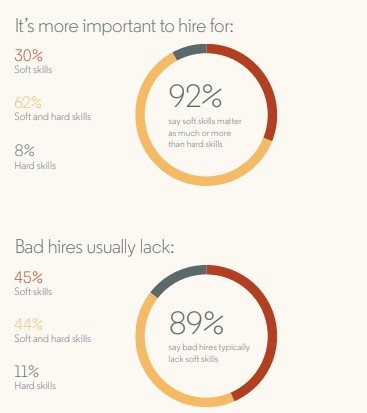
LinkedIn’s Global Talent Trends survey shows that bad hires are almost never a matter of hard skills alone. Prioritize soft skills – such as creativity, persuasion, collaboration, adaptability, and time management – in your hiring process. Although hard skills certainly matter, most hiring and firing decisions come down to soft skills.
Part of the issue is that soft skills are more difficult to evaluate than hard skills. You can reasonably determine if a programmer has the right coding skills, or a translator has the right language skills, to perform adequately in their jobs. However, identifying poor soft skills is much harder, which is why this is often discovered too late, after a hire has been made.
Source: LinkedIn
3. Fully support Flexibility and Remote Work
Pre-pandemic, businesses expected that in five years 38% of their remote workforce would be fully remote, while today they expect 58% to be fully remote in five years, says Upwork in its Future Workforce report.
Career Builder adds that 35% of job seekers say they will turn down an offer if the employer does not offer a remote work option. The pandemic has forced the issue of remote work and flexible work schedules, making it a priority for employees. As companies consider return-to-the-office policies, they must realize there has been a mindset shift for many employees, and flexibility is now valued more than ever. It may be better for business too.
An Airtasker survey shows on average, remote employees work 1.4 more days every month, or 16.8 more days every year, than those who work in an office – and on workdays, they spend more time getting things done. Many workers are more productive and less stressed in a work-from-home environment since there is no commute, less water cooler talk, and more opportunity to fit exercise into their daily routine.
Source: Airtasker
4. Hire People You want to Coach
As a certified, professional coach, I spend time coaching people on energy leadership, and how you “show up” truly matters. Are you hiring people who will show up with an positive attitude and a mindset to think out of the box, bring all their creative skills, and work as a team?
Companies need to look at their interviewing process in a couple of ways. Are they looking to find the perfect candidate, or can they hire for aptitude and attitude? If they can identify the right aptitude and attitude, will the company culture embrace that and provide the training to help them grow? You may want to map out your hiring process from the humanistic viewpoint.
5. Listen to People to Retain Them
Once you’ve hired good people, you need to work hard to keep them. According to a recent Fast Company article, 2022 will be a key year for companies to live up to their promises to employees, or risk losing them. The best way to retain workers includes listening to their needs, accommodating their different work styles, and addressing inequities.
One member of the Fast Company Impact Council, Angie Klein, CEO of Visible, predicts, “We’re going to see a pretty big shift from talking about The Great Resignation to ‘The Great Retention,’ with [companies] focused on doing what it takes to keep talent. Employees aren’t really leaving because they’re unsatisfied—some are—but because they want to see what’s out there at a time when it seems far less risky to do so. Putting in proactive-retention measures while ensuring that we manage to drive meaning and purpose—there will be a heavy focus in retention like we have never seen before in corporate America.”
One employee retention tool that is gaining popularity is the “Stay Interview,” where a manager sits down with an employee to explore what it takes them to stay at the company. Ideally, these are regularly occurring conversations, built on a foundation of trust, where the employer doesn’t only focus on the job, but the individual’s professional and life goals.
Conclusion
Recruiting and retention are always challenging, but our current environment makes it even more so. However, I don’t believe the number of jobs out there is the reason you can’t find good people. I believe the primary issue is that companies are not putting the proper emphasis on recruiting and retaining talent, including a humanistic approach.
To find the right people, you may want to look at your processes and see if you can create a more empathetic way to attract and keep the best people.
As a coach and a mentor, I’m often asked for advice from job seekers. We are in a unique job market right now, a recent survey by Bankrate shows that 55% of Americans anticipate looking for a new job over the next year. This phenomenon has been nicknamed the Great Resignation by media outlets.
In response to the pandemic, “there have been a lot of epiphanies and reckonings that have occurred … with respect with how we’re prioritizing ultimately our values, and of course how work fits into that,” says Mark Hamrick, senior economic analyst at Bankrate, the company that conducted the research. Americans are prioritizing flexible work arrangements, higher pay, and job security in their search.
Flexibility is now the fastest-rising job priority in the U.S., according to a poll of more than 5,000 LinkedIn members. Working parents want to adjust their hours to suit their parenting schedules, single people want the freedom to change cities, while still keeping the same employer. Freedom and personal control within a job feel like much more vital priorities.
And yet, there hasn’t been much change in the hiring and recruiting process. As companies look to fill roles, there are too few people for open positions. Hiring managers and staff are investing more of their own time and paying recruiters, but jobs remain open. It’s time to shake up the process and hire for aptitude and then invest in training good people.
According to the Bureau of Labor Statistics, job openings surged to an all-time high of 10.1 million at the end of June, outnumbering the 8.7 million unemployed individuals. Given these stats, you would think that companies would be trying hard to connect with job seekers and make the right fit to fill these open positions. But companies and hiring managers need to think outside the box and expand their horizons. Are you actively looking to recruit women who have taken a break from the workforce with flexibility and daycare options? Are you proactively reaching out to diverse talent sourcing and recruiting associations? Have you considered making your educational requirements less stringent to open the pool of candidates to those with relevant life experience? Are you considering the value of older candidates who can bring years of knowledge and mentorship to the position?
Rather than stick to the way your company has always done things, focus on aptitude, empathy, and coachability. Here are some insightful questions that should prompt real conversations about success that can be accomplished if the company and candidate end up working together.
Tell me about an achievement that you are proud of – either personal or professional – and what you did to make that happen. This is very open ended and lets the candidate demonstrate goals and success.
In your research on our company, what is something you found that we could change or do differently to be more successful? This will let the candidate know you are open to their input and will may uncover some new ideas from a fresh perspective.
How do you think you can make a difference in our organization? Again, it gives the candidate a chance to show big picture thinking and define what success could look like.
What skills are you working on improving, and how do you plan to get there? The opposite of the “weakness” question, this is a positive spin on skill development and opportunities, and shows if someone is a lifelong learner.
Do you feel that you would be a good cultural fit here? If not, what could we do differently? This can start discussions on diversity and supporting all employees. Although some candidates may not feel comfortable opening up, if the interviewer lets the candidate know they are striving to be inclusive, it may go a long way.
An interview shouldn’t be an interrogation or include tricks or puzzles to solve to make it to the next level. Adam Grant, organizational psychologist at Wharton, recently wrote an article for The Wall Street Journal, titled, The Real Meaning of Freedom at Work, in which he states, “For several generations, we’ve organized our lives around our work. Our jobs have determined where we make our homes, when we see our families and what we can squeeze in during our downtime. It might be time to start planning our work around our lives.”
As you are recruiting to fill open roles in your organization, do so with the goal of truly assessing the fit of this person for this role and your organization – and do so with an open mind toward hiring for aptitude.
Have you ever finished a riveting book and realized that the plot, characters, and setting have left an indelible mark on your being? That is how I will always remember the Martin Trust Center for MIT Entrepreneurship – the people, energy, and ideas will forever imprint the fabric of my life.
When I joined the Trust Center nearly six years ago, I blogged about Disciplined Entrepreneurship – the framework we use for the entrepreneurship program at MIT’s Trust Center based on the book by Bill Aulet, the Center’s Managing Director. One of the ideas that resonated with me then, and continues to do so, is that “ideas mean nothing without execution.”
Reflecting on the past six years, I realize that my time at MIT was about more than a job, it was about the execution of entrepreneurship. It was a chance to shape the lives of aspiring entrepreneurs who had big dreams and ideas to change the world for the better and help them to shape and execute those ideas into concrete plans. At the Trust Center, we like to say that MIT’s student entrepreneurs tackle the world’s big problems, and it was exciting to help make that happen.
Here’s the synopsis of how I landed at the Trust Center, and filled many roles, ultimately becoming the Director of MIT delta v, as well as an Entrepreneur-in-Residence and a lecturer at the MIT Sloan School of Management on entrepreneurship topics.
In 2014, I had completed my doctorate in work-based learning at the University of Pennsylvania’s Chief Learning Officer program, and I wasn’t sure what my next step should be. I had the option to get back into the corporate world and focus on business analytics, but instead decided to pursue a role in education. I was hired by MIT as an Entrepreneur-in-Residence and to help lead the student venture accelerator program, which is now known as delta v. From there, my role has expanded to teaching entrepreneurship classes, spearheading global programs, and becoming a spokesperson and thought leader representing MIT’s entrepreneurship initiatives.
This was definitely something new and different for me, and I had to push myself out of my comfort zone and embrace the challenge. The results achieved have certainly been beyond what I could have anticipated six years ago, including the expansion of the Trust Center – both physically and via online with Orbit, growing delta v both in size and in scope, partnerships with other universities, and instituting a flagship program to support the mental health of entrepreneurs. There were also many awards and accolades along the way, both personally and for the program.
But I’m not here to toot my own horn … I want to sincerely thank the whole team at the Trust Center for their support, teamwork, and camaraderie over the years – our group is quite the entrepreneurial talent tree. I’d also like to thank all the students who I was able to work with and mentor on their entrepreneurial journeys. Your enthusiasm and bright light made the hard parts of this job rewarding and worthwhile.
For those of you who are rethinking your own career situation, after the past year this may be exactly the right time to open yourself up to new experiences and find that that your next chapter was better than your last. I am leaving a job I love for the unknown – of course, this is a risk, but as an entrepreneur you bet on yourself, and make the choice to wake up with a “wow” in terms of what is going to happen today.
For me, this is the time to move beyond what has become well-loved and comfortable, and to take a leap into the next chapter – the fourth in my career. First, I was an engineer who moved up through the executive ranks. Second, I focused on startups, leading two companies to successful exits. Third, was my move into academia at MIT by leveraging my startup experience. And, for the fourth chapter, I’m not 100% sure what it will be yet, but stay tuned – that is the exciting part!
Wisdom from the Women Who Support MIT’s Entrepreneurs
Today, November 19, is Women’s Entrepreneurship Day, a day celebrating and encouraging female entrepreneurship. Our student venture accelerator program, delta v, has launched some amazing female entrepreneurs – and our historical data show us that the women-led delta v companies surpass our very impressive overall stat that 3 of every 4 delta v startups are still operating. At MIT, our goal is to support all our entrepreneurs and make them as successful as possible. That is why we are thrilled when we hear feedback like the quote below – it shows us that we are succeeding in our support of diverse entrepreneurs, and neutralizing any implicit biases.
“In the Trust Center, gender, age, race, culture, even hierarchy, are invisible. It’s the only space I’ve ever walked into where all that baggage was truly left at the door. This almost disorienting sense of equality allows for a re-imagining of identity.” Joan Kelly, delta v entrepreneur and CEO of Abound
For the entire month of November, we’re profiling some of our women entrepreneurs, faculty, and Trust Center staff on our Instagram feed (@eshipMIT) with the tag #WEMatMIT (which stands for Women’s Entrepreneur Month at MIT). Follow the feed and be inspired!
Today, the Martin Trust Center for MIT Entrepreneurship celebrates Women’s Entrepreneurship Day by focusing on the women at MIT who support all of our entrepreneurs, and sharing their wisdom.
Here is our lineup of stellar women supporting MIT’s entrepreneurship community and their responses to our questions on entrepreneurship. As I reflect on the contributions of these women, it is evident that the strong entrepreneurial ecosystems at MIT did not just materialize – they are nurtured, fostered, and improved upon by these individuals. They all bring a focused passion to their roles – with a lack of ego, they meet students where they are on their journeys to become entrepreneurs and help them flourish.
What advice can you share with aspiring entrepreneurs?
“Just start! Usually that first step is the hardest one. If you just start you will see that anyone can get started. Figure out what that first step is and do it. And if your first step was to make a PowerPoint, nice job doing that first step, but now get out of PowerPoint and talk to humans!!” – Kit Hickey
“Admit what you don’t know. Share your idea and take every opportunity to learn from those around you. This isn’t always a comfortable way for talented, high performers to operate. But it is critical. Rather than always looking for validation of your ideas, look for evidence that reveals weaknesses in your hypotheses.” – Megan Mitchell
“Seek a broad range of advisors, mentors, colleagues – diversity in terms of age, gender, experience, outlook on life and don’t limit it to people you think you align with – so that you are challenged to move beyond your comfort zone.” – Lesley Millar-Nicholson
“Follow your intuition and do what you feel is right. Women have stronger emotional intelligence, use this to make appropriate decisions and follow through with persistence.” – Karen Golmer
“Remain open-minded to what you learn through research. Approach research with curiosity, rather than an opportunity to reinforce and validate your current assumptions. Embrace surprising results and be ready to go back to the drawing board and adapt your solutions to a deeper understanding of the problem you’re looking to solve.” – Jinane Abounadi
“The outcome of any entrepreneurial endeavor is extremely uncertain, so you should be really excited about the journey. And surround yourself with people you like and respect, because you’ll be spending a lot of time together!” – Carly Chase
What do you believe female entrepreneurs need to do more of/better/differently to be successful?
“Unfortunately, we still need to have incredibly thick skin because the industry is not yet as equitable as it should be. Given the inequities, we’ve got to support and stick up for one another, in both small and big ways.” – Carly Chase
“Recognize that there are fewer female-backed startup companies, fewer women on Boards of companies, fewer patent holding female scientists – but don’t let that be a hurdle. In fact, find those who have or are those things – and learn from them, what inspires them, what tricks and tools have they created to achieve what they have achieved.” – Lesley Millar-Nicholson
“Really examine what YOU want out of your entrepreneurial journey. We spend so much of our lives being told what we should be, it is a challenge to break away from that and define what success is for you. Success for you may be completely different than what success means for your classmate, and that’s OK. By actually defining success for yourself, you can have a much more meaningful, impactful and enjoyable career.” – Kit Hickey
“Female entrepreneurs need to own their space, their knowledge, and their brilliance. Women have to be deliberate in the words they use when they speak about their experience and their ventures. Please don’t say, ‘If the pilot is successful, we will…” Come from an affirmative position. Trade that language for something more like: “Following our successful pilot, we will…” – Megan Mitchell
“Speak up more often (males don’t wait for their turn to speak ) – so don’t wait to be asked, offer up your opinions, experience, insight and do it in a thoughtful and measured way – so people are keen to listen.” – Lesley Millar-Nicholson
Female entrepreneurs need to work together and hold one another accountable when they see another not owning her own power. Women working together will elevate all.” – Megan Mitchell
“Own your ‘imposter syndrome’ and don’t let it come an excuse to demonstrate your knowledge, passion and capabilities – in fact, challenge that feeling by speaking up.” – Lesley Millar-Nicholson
“Don’t back down, instead listen with respect and learn about other perspectives. When feeling blocked or ignored, don’t speak louder to be heard – try a different approach.” – Karen Golmer
“Try not to take it personally when you hit a roadblock, or your initial ideas get rejected. Be confident in your talent and your ability to overcome hurdles and challenges. Use a network of caring mentors to get honest feedback and be open to listening and growing in the process.” – Jinane Abounadi
How do you, personally, keep inspired and moving forward?
“I look for and accept the challenges that appear – one at a time. When I end up in a conflict or uncomfortable situation, I use humor to diffuse the tension and redirect to move forward.” – Karen Golmer
“For me, the inspiration at his phase of my career comes from stepping back and hearing about stories of other amazing women that have worked hard and persevered to make a difference. I felt so inspired when I heard that there was a woman scientist (Ozlem Tureci) behind the [COVID-19] Pfizer vaccine. In my role, I see the potential of so many of our brilliant female students (undergrad or graduate) to make significant impact in the future and I will feel proud to have been part of their journey.” – Jinane Abounadi
“I love engaging with people – the passion, diversity and new ideas at MIT keep me inspired every day. Every day I learn from a student, and I love it! Being at a place where you continue to learn, can engage with amazing people, and have the autonomy to solve hard problems you are interested in, is what I love about being an EIR at MIT.” – Kit Hickey
“It is the entrepreneurs, their individual stories and passion that inspire me and keep me moving forward. Each entrepreneur has a story that connects them to the problem they are trying to solve. Often that story is deeply personal and offers me insights not only into who they are as individuals, but also the worlds in which they come from.” – Megan Mitchell
“Recognizing that I am part of a community and my contribution (or lack of it) has impact on others and what they can or cannot achieve because of my actions.” – Lesley Millar-Nicholson
“Building businesses from scratch is an incredibly difficult, gritty, and uncomfortable experience that forces you to grow in ways you didn’t even know you needed to! I’m addicted to not only the constant growth I personally get from being an entrepreneur, but also to the people who it attracts – they are the most exciting people in the world to be working alongside.” – Carly Chase
Conclusion
At MIT, our definition of entrepreneurship has evolved from a focus on startups to an entrepreneurial mindset – we see entrepreneurship as a skillset and a way of operating. We need entrepreneurial attributes in all our organizations – whether it is within a big company, a small company, or a university environment. These women bring that entrepreneurial mindset to their roles in helping curious entrepreneurs in corporate environments, ready-to-go entrepreneurs, and amplifiers in their communities. They cover the developing world, emerging markets, and corporate innovation. We live in a changing world with changing needs, and students need to test and adapt their entrepreneurial skills. Thank you to Jinane, Carly, Karen, Kit, Lesley, and Megan for your invaluable guidance to MIT’s student entrepreneurs! As we all work together at MIT, we see all boats rise which is what makes the MIT community an amazing ecosystem.
This summer, MIT’s delta v accelerator program for student entrepreneurs was adapted as a virtual experience. Although this called for a flexibility and creativity all around, one of the benefits was that we were able to virtually connect with some amazing speakers.
Our Founder’s Talk Series let us hear about journeys of successful entrepreneurs, the challenges they’ve had to face, and their advice for our students. This year, we were lucky enough to hear from: Eleanor Carey, an Australian adventurer who gave an inspiring talk relating to the realities of entrepreneurship; George Petrovas, a serial entrepreneur who shared his founder journey; John Belizaire, CEO of Soluna, who spoke about leadership; Perry Cohen, Founder and Executive Director of The Venture Out Project who spoke about his journey; and Ed Baker, Investor, Entrepreneur, and Growth Specialist, previously with Uber and Facebook, who talked to students on scaling their businesses.
We concluded the series by speaking with Hayley Sudbury, founder and CEO of WERKIN, a company that raises the visibility of underrepresented talent. What Hayley and her team are doing at WERKIN is extremely important because although people talk about diversity and inclusion in companies, they don’t always know what to do about it. Here’s a short recap of what we learned from Hayley during her Founder’s Talk.
Overlapping Boundaries between Work and Life
Hayley commented that the boundaries between work and life have formally collapsed since March 2020 when the pandemic hit, and we all went remote. But also, there’s a bit of a trend toward moving back to our true humanity of who we are as people and the businesses we want to build to create change.
As an Aussie Brit, openly gay, tech, female CEO, Hayley jokes that she seems to tick a few boxes around “different.” She comments that getting a more diverse mix of founders will help create change in the world.
Driving Forces for Founding WERKIN
From her job at large bank managing a £ 50 billion balance sheet, Hayley notes she looked around and realized, there were no women above her, and there were certainly no gay women.
Even for the most extroverted types, it’s important to be able to see the version of yourself in life, as you look to create an aspirational pathway for your career or the businesses that you’re building. For Hayley, this was a real motivation to kind of get out and do something different.
Creating Inclusivity and Belonging at Scale for Business
WERKIN is very much focused on helping companies create inclusion and belonging at scale. The name comes from “We Are Kin” – and is dedicated to building a kinship and community within a workplace, helping employees feel visible and supported every day.
With the death of George Floyd earlier this year, there is a greater global awareness that we’re operating in a world where not all is equal. Race is a very important conversation that’s being had right now. This has opened up a broader conversation around consumers demanding more from companies – both companies we work for, and companies that we want to purchase from. Whoever we are, and whatever our lived experience or background is, how we choose to spend our money creates power.
Millennials, particularly, make decisions around wanting to work for a purpose-led organization. They expect more. They expect organizations to not only talk about being equal and fair and transparent, they demand that they are. And they’re looking for the data to kind of back that up as well.
WERKIN has been on a mission for quite a long time around helping organizations create this and inclusion and belonging. But now it feels like there’s much more of a sense of urgency and importance. CEOs are realizing if you really want a different result, you must do different things, and this year has really tipped the balance.
It Started with Mentoring
The seed for WERKIN starting with mentoring and sponsorship, which essentially go hand-in-hand. It’s the stuff that people do for you. It’s the doors that get opened. It’s the connection that someone makes for you to a colleague. It’s those small actions.
So, we looked at ways to democratize this idea of access to the right people, so that you’re visible, and the traditional “having beers in the pub” is not the only way to build rapport. WERKIN was created help that accessibility be open and available to more people.
We then leveraged technology to manage and measure these programs and demonstrate ROI. For us, it is very much a data play, as we create this digital standard for inclusion and belonging.
Love Your Customers, Not Your Product.
Falling in love with your product is a very easy thing to happen. You can see the pain point, for example, but if you fall into the trap of being product-first, not customer-first, it’s very easy to miss the real opportunity to create change.
At WERKIN, we think about how we want to change someone’s journey inside an organization so that they are seen, they are heard, they are visible to a larger percentage of the population. But not only that, they have a clear pathway to accelerate through to the highest levels that are, obviously, economically beneficial for that individual, but also allow them to influence the outcome of the organization.
Embrace the Most Exciting Time in our Lifetimes
While it may look terrifying from an economic outlook, if you’re in the business of building new ways to do things, this is probably the most exciting time in our lifetimes. Both from a change in civil rights, equality, and the move towards shutting down this very separate life we had between work and life, and actually coming back to our humanity. This means businesses that are purpose-driven, sustainability-focused, forward-looking, tech-enabled and changing the way we work, are all presented with massive opportunities right now.
The entrepreneurial journey is certainly a roller coaster ride – enjoy it!
















 Trish Cotter