Many of today’s early-career professionals are struggling. They’ve worked through a pandemic; they’ve embraced work from home (WFH) and may now be facing a return to the office (RTO) or hybrid model. Although working from home has many benefits, employees who are just starting their careers miss out on the support, training, informal mentorship, and camaraderie that were once a normal part of corporate life.
In my last blog post on preparing our next generation of corporate leaders, I explored the shifts in traditional employment and how many companies no longer provide scaffolding for their employees to learn and grow. I offered 11 strategies for employers to improve employee satisfaction, engagement, and development to foster a more engaged and loyal workforce.
Yet, this responsibility doesn’t solely rest on the shoulders of employers. Ultimately, employees are responsible for managing their own careers, particularly if their current company doesn’t provide a lot of support.
The following strategies can be used by all early-career professionals to take ownership of their careers and successfully navigate advancement and job satisfaction:
1. Enhance Your Networking Skills
Leverage Existing Contacts: Contact college friends, family, and colleagues to rekindle connections and explore opportunities.
Expand Your Network: Attend industry events, join professional associations, and engage in online forums related to your field.
Informational Interviews: Schedule meetings with people in roles you aspire to. Ask about their career paths, challenges, and advice for joining similar positions.
2. Develop and Utilize a Personal Brand
Build an Online Presence: Update your LinkedIn profile with your accomplishments and skills. Ask for LinkedIn recommendations to share on your profile. Share relevant content and engage with posts to increase your visibility.
Showcase Your Skills: Create a personal website or portfolio if applicable. Highlight projects, achievements, and skills that make you stand out.
3. Stay Informed About Industry Trends
Set Up Alerts: Use tools like Google Alerts to keep track of developments in your field or industry.
Follow Industry Leaders: Keep up with thought leaders and organizations in your sector through social media and industry publications.
4. Document Your Achievements
Maintain a Log: Regularly update a document with your accomplishments, skills developed, and project contributions. This can help you during performance reviews or job interviews. Create a folder and save those “kudos” emails.
Create Impact Statements: Quantify your achievements with specific metrics (e.g., increased sales by X%, reduced costs by Y%).
5. Seek Continuous Learning and Development
Enroll in Courses: Take advantage of online courses, certifications, or workshops to enhance your skills and make yourself more marketable. Ask your manager what professional development courses they would recommend that the company will fund.
Stay Updated: Learn new tools, technologies, and methodologies relevant to your industry.
6. Evaluate and Explore New Opportunities
Set Career Goals: Define what you want in your next role, whether it’s higher pay, more responsibility, or better work-life balance.
Apply Strategically: When exploring new job opportunities, target roles that align with your career goals and offer growth potential.
7. Communicate Effectively with Your Current Employer
Request Feedback: Regularly seek feedback from supervisors to understand areas for improvement and express your interest in taking on more responsibilities.
Discuss Career Development: Talk with your manager about your career aspirations and seek guidance on achieving them within the company.
8. Consider Freelancing or Consulting
Explore Side Projects: If feasible, undertake freelance work or consulting projects to build experience, expand your network, and discover new career paths.
Diversify Income Streams: Freelancing can offer financial flexibility and open new professional opportunities.
9. Maintain Work-Life Balance
Set Boundaries: Ensure a healthy balance between work and personal life to avoid burnout and maintain job satisfaction.
Engage in Hobbies: Pursue interests outside of work to stay motivated and keep a positive outlook on your career.
By combining these strategies, employees can effectively navigate their career paths, find new opportunities, and achieve greater job satisfaction.
Other suggestions or strategies that have worked for you? Please add them to the comments!
We’re in the midst of graduation season—a time of excitement and anticipation as students leave behind the classroom and start to shape their futures. One trend I’m seeing is that new college graduates are investigating options for entrepreneurship directly out of college, before committing to full-time corporate roles.
A recent HBR article confirms what I’ve seen. It cites a Global University Entrepreneurial Spirit Students’ Survey (GUESSS) of 267,000 undergraduate and graduate students that revealed around 11% of students already own and run businesses. At least 18% of students wished to become entrepreneurs right after graduation and another 32% expressed interest in transitioning into entrepreneurship within five years of their graduation. The study also shows that investments in early-stage startups have increased from $72.8 billion in 2017 to $208 billion in 2021.
If you’ve ever had an idea to start your own business, it might be an ideal time to pursue that passion (especially, while you are still used to living on ramen as you work on getting funding!). Consider this period of your life as an opportunity to explore and to see if entrepreneurship is a viable option for you. At a time when there is so much chaos in the world, doing your own thing can give you back control.
This summer, I’ll be teaching at an entrepreneurship program designed by Dalhousie and the University of Calgary called Lab2Market Launch. This 12-week summer accelerator brings together members of the entrepreneurial ecosystem from across Canada to turn ideas into viable businesses. In the past, I served as the Director of MIT’s delta v accelerator program, another summer program which is the capstone entrepreneurship experience for MIT students – both are excellent programs to help propel entrepreneurs. And along with these formal programs, there are a host of resources for people who want to explore entrepreneurship – check out this post about thriving as an entrepreneur, and see the links at the end.
As new graduates increasingly turn to entrepreneurship, the landscape of post-graduation career choices is rapidly evolving. This trend has been bolstered by a combination of technological advancements, changing economic conditions, and a growing desire for personal fulfillment and flexibility in career paths. Many prospective entrepreneurs are driven by the appeal of launching startups that align with their passions and the promise of greater autonomy compared to traditional corporate jobs.
Entrepreneurship Advice for New Graduates
For new graduates, exploring entrepreneurship offers several advantages. It provides a hands-on learning experience that can be more dynamic and varied than the structured environment of a corporate job. Starting a business can also foster critical skills such as resilience, problem-solving, and leadership.
However, it is crucial to recognize the challenges, particularly in securing funding. To gain an overview of the types of funding available, check out this article on 8 sources of start-up financing. Traditional funding avenues might be less accessible for entrepreneurs who are just starting out, prompting graduates to explore alternative sources like crowdfunding, government grants, incubator, and startup accelerator programs.
Members of Forbes’ Young Entrepreneur Council, also share their experiences and some solid advice in this Forbes article, including:
Create a business plan
Hustle and network in order to succeed
Picture your business like a workhorse
Listen to what your customers need
Focus on a niche market
Talk to those who have done it
Ask how you can help
Think long term
Ditch perfectionism
Invest in yourself
Not surprisingly, several of these pieces of advice align with the 24-steps to a successful startup that we teach at MIT with the Disciplined Entrepreneurship approach (you can read a short overview here), or check out the newly updated Disciplined Entrepreneurship book and the new Startup Tactics book by MIT’s Bill Aulet and Paul Cheek.
Impact of Mentors, Coaches, and Educators on Entrepreneurs
One thing I would stress is to make sure that you establish a strong connection with a mentor or coach – someone who can help keep you on track and provide support and guidance during your entrepreneurial journey. Established entrepreneurs can play a pivotal role by mentoring new graduates, offering insights and resources to navigate the complexities of starting a business. Coaches can help inspire you to achieve peak performance. As a certified Energy Leadership coach, I coach entrepreneurs on how they can harness their own unique energy and become a better leader. Having that mentor or coach who is separate from the day-to-day workings of your startup is a wonderful way to gain perspective as an entrepreneur.
In addition – for those who are still in school – educators are increasingly adapting their curricula to emphasize entrepreneurial skills, such as innovation, digital literacy, and strategic thinking. Incorporating real-world projects and case studies can bridge the gap between theoretical knowledge and practical application, better preparing students for entrepreneurial endeavors. Today, there are more than 5,000 entrepreneurship courses are offered in two-year and four-year institutions, according to the Kauffman Foundation, and more than 150 institutions in the U.S. allow students to major in entrepreneurship, according to Best Colleges. This is more than triple the number from two decades ago.
My Perspective
As someone deeply embedded in the entrepreneurial ecosystem, I see this shift towards entrepreneurship as an immediate path after graduation as both a challenge and an opportunity. The influx of young, innovative minds into entrepreneurship can drive significant advancements across various industries. However, it is vital to provide the right support systems to ensure their success. Mentorship programs, comprehensive entrepreneurship education, and access to diverse funding options are essential components of this support.
Moreover, fostering a mindset that embraces failure as a learning opportunity is crucial. New graduates should be encouraged to take calculated risks, understanding that setbacks are part of the entrepreneurial journey. This perspective not only builds resilience but also fosters a culture of continuous improvement and innovation.
Conclusion
The trend of new graduates exploring entrepreneurship before starting corporate jobs may signify a shift in career trajectories and workplace dynamics. By supporting these budding entrepreneurs through mentorship and coaching, education, and access to resources, we can harness their potential to drive innovation and economic growth. As educators, entrepreneurs, and thought leaders, it is our responsibility to guide and nurture this new generation, helping them navigate the challenges and seize the opportunities that lie ahead.
If you are interested in learning more about coaching sessions for entrepreneurs, please reach out at patriciacotter76@gmail.com.
You bring your unique energy to how you show up each day – at home, at work, and generally in life.
This is especially important for leaders – both entrepreneurs running startups and managers leading teams in corporate enterprises. As a leader, you knowingly or unknowingly influence others, and this presents the opportunity to inspire and motivate your team.
When you show up with your best energy, you can encourage your team to recognize and harness their own energy, feel a greater sense of purpose, and get more done with much less effort and stress. So, let’s delve into more detail on Energy Leadership.
Energy Leadership
“Energy is contagious; either you affect people or infect people,” says bestselling author and businessman, T. Harv Eker. When you realize how many people you interact with each day, you begin to realize how powerful your personal energy is.
The interesting thing about energy is that it can be both anabolic and catabolic. Both energy levels serve you daily, depending upon your lived experiences. Here is a brief overview of each:
Anabolic energy is associated with a constructive buildup force and less stress. With anabolic energy, it is easier to focus on solutions and tap creativity and experience for a complete and conscious view of situations. People have more access to this energy, with less judgment and less fear about themselves or situations – anabolic energy is essentially constructive, fueling, healing, and growth oriented. A leader with anabolic energy is collaborative, fuels creativity and productivity.
Catabolic energy, on the other hand, tends to distract you and pull your focus away from what you are doing. It is typically draining, resisting, and contracting energy. Yet, it serves the important purpose of self-protection, especially when experiencing uncomfortable situations. A leader with catabolic energy can use this energy in a time crunch or dangerous situations to address a particular situation. However, catabolic energy can be depleting and stress levels raised so the longer term effects are not positive. Think of it as being in continual fight or flight mode.
In practice, a catabolic leader and anabolic leader may look like the following:
Neither type of energy is good nor bad, but an ambidextrous leader can adapt to the situation to create a better result.
The first step is to understand your personal Energy Leadership profile. This is done through an attitudinal assessment and can be used as a starting point to uncover how your energy can be harnessed to reach your goals and help you to lead more effectively.
So, how do you assess your current Energy Leadership?
The Energy Leadership Index (ELI) assessment tool, developed by the Institute for Professional Excellence in Coaching (iPEC) measures your unique energy profile. Through a series of 84 questions, the ELI reveals the percentage of each energy level you experience under normal circumstances and how your energy manifests under stress.
The 7 Levels of Energy
There are seven energy levels, each with a thought, emotion, and action attached. Daily, you may operate on just a couple of levels or many, but this tool focuses on understanding where you are.
Your individual results of the ELI assessment come in a sample like the chart below. This represents your average energy presentation under normal circumstances and under stress.
Everyone has a different ELI, which uniquely reflects their lived experiences. Through the debrief with an ELI Practitioner, you bring an awareness of how you show up. In the debrief, you go through your particular energy levels and find experiences that serve you well and others that do not. The tool’s power is recognizing your level and the ability to change the level and gain a better experience. The ELI tool, which can be used with individuals or teams, has a low entry bar, and it could pay significant dividends for leaders.
New Working Styles Benefit from Energy Leadership
The new normal of remote, hybrid, and in-person working styles has brought challenges for leaders. We are currently at a crossroads where workers value the flexibility of work from home options, but in many companies, management is dictating a return to the office, or hybrid approach. This puts a lot of pressure on team leaders. As mentioned in a previous blog post, speaker, author, and facilitator Priya Parker talks about gathering with intention for meetings (or classes), along with bringing an energy that meets the needs of the situation. If you are responsible for gathering and communicating with your team, consider your intention and your energy; the benefits could be significant.
How skillfully can you lead daily? An Energy Leadership approach will identify where you can adjust to having more experiences that better serve you and your clients, and it extends beyond the realm of work to your family and loved ones as well.
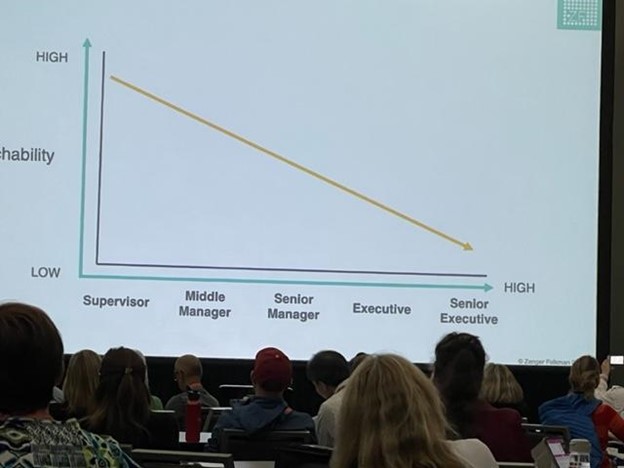
In one of the sessions at ATD ‘23 by Zenger Folkman, it was discussed that with more experienced leaders, coachability decreases. (Yes, that says “Coachability” on the left axis, my camera skills attest to capturing this during a live session!) Senior leaders have been through a lot of training and I suggest the ELI assessment as a tool that could provide new insights into how they are leading today.
In summary, embracing Energy Leadership can inspire peak performance from individual employees and transform the culture of organizations. A key element to Energy Leadership is that we are all leaders, every day, in every area of our lives. Energy Leadership can help individuals skillfully lead when interacting with others.
In May, I traveled to San Diego to present at the Association of Talent Development’s ATD ’23 conference which featured over 250 sessions to educate and inspire professionals in the talent development field.
This is a terrific conference for Learning and Development (L&D) leaders to share insights, research, and best practices, and when my colleague Rita B. Allen, and I learned our presentation was accepted for the conference, we were thrilled. (Rita, author of Personal Branding and founder of Rita B. Allen Associates, has presented at the conference before and says only a small percentage of submitted presentations are accepted, so this was music to our ears.)
Our session, titled Think Like an Entrepreneur: Foster Creativity in Your Organization, aimed to help L&D professionals take lessons from entrepreneurship and apply them to their organizations. This is different from the audiences of entrepreneurs I usually present to. With this audience, there is an opportunity to bring some frameworks that might help foster the entrepreneurial mindset in their organizations or unleash their inner entrepreneur. For that, I am grateful for the opportunity.
Since this message is something that we’d like to share more widely, I’ll be writing blog posts on the elements of our presentation, including disciplined entrepreneurship, an antifragile and entrepreneurial mindset, and energy leadership. Before I dive into those topics, however, I’d like to share four highlights of the conference – and positive messages that I walked away with. These are not in any particular order, other than they build on each other.
If you’re not already a fan of Adam Grant, he is an organizational psychologist at Wharton, a best-selling author, and the host of the TED podcast WorkLife. If you don’t follow Adam on social media, I suggest you start – his practical advice on work/life balance is a breath of fresh air. Adam hosted the opening general session, titled Think Again: The Power of Knowing What You Don’t Know. He covered a lot of ground, but three things stood out from his keynote:
Invitations into your network should be given to “disagreeable givers” — blunt people who aren’t afraid to tell you hard truths, but who also have your best interests at heart. An example for those familiar with the Ted Lasso TV series is Roy Kent.
“Unlearning” often focuses on making room for new learning. This lets you address things you are doing that are not servicing you or others. Adam explains it takes courage to unlearn. Unlearning requires the integrity to admit that you were wrong yesterday. Learning is how you evolve. Unlearning is how you keep up as the world evolves.
As an entrepreneur, Adam also discussed scientific thinking and its impact on startups. Thinking more like a scientist, having the ability to pivot, individuals with the humility and curiosity to search for information all support entrepreneurship success.
Facilitator, strategic advisor, and author Priya Parker presented on The Art of Gathering. Priya presented a new – at least new to me – way of thinking about how you hold meetings and gatherings. She spoke about how these gatherings should be intentional and benefit from setting expectations around the goals of the meeting, party, or gathering. The intent in the design is critical to ensure that both the host’s and guests’ experience is as intended.
This made me think about how I am designing my summer entrepreneurship classes with MIT/Dalhousie with specific learning content. I do focus on the experience for the students, but the classes are much more focused on the content. This talk offered me a fresh look at hosting and attending events from now on, putting some boundaries around what is acceptable. It works best if you are super-specific about the intention of a meeting (or another event) and specify what you intend to accomplish. Priya recommends starting with a strong opening and closing as opposed to covering logistics.
Known to the training community as “the trainer’s trainer,” Katrina Kennedy’s session was titled It’s All About Retrieval and discussed the retrieval of information. She explained that retrieval is more than just recall; retrieval is accomplished in a way that you have context for the information. Learning needs to be varied, spaced, and interleaved. The retrieval practice needs to focus on learning. How many times have you re-read material several times and still not been able to recall the information when it is required?
Rita B. Allen, Katrina Kennedy, and Trish Cotter
Retrieval in practice is what we refer to as “use it or lose it.” If you want to play a piece of music and it is difficult to start, the struggle to learn to play it is actually a “desirable difficult” process that helps you solidify the learning. This isn’t about repetition. It is about spacing and breaking up the learning. In the classes I teach, I use breakouts to discuss further and debrief concepts as well as games to reinforce learning. Still, this retrieval discussion brought both the unlearning and learning of new ways of teaching and the intention to gather for a class together. The most memorable experiences will be those in which you have “desirable difficulty.”
One personal highlight at the conference was the scholarly presentations of University of Pennsylvania Chief Learning Officer (CLO) doctorate graduates. I graduated from this program with an M.Ed. ’13 and Ed.D. ’14 and couldn’t be prouder! I wanted to give a shout out to these amazing presentations by my fellow Penn CLO grads:
Dr. Carol Henry (Implications for Practice: Behaviors and Competencies for Future Leadership Development Programs)
Dr. Jennifer Neumaier presented her dissertation: A Perspective Study on Cultural Conditions That Enable Social Learning.
Dr. Kandi Wiens, is a Senior Fellow and runs the master’s portion of the program at Penn, also presented the Ed.D. program and her research which will be out in her book due out next year, Burnout Immunity: How Emotional Intelligence Can Help You Build Resilience and Heal Your Relationship with Work. (Read her recent HBR article on Has Cynicism Infected Your Organization?)
If there was any concern that COVID slowed down the Penn CLO program, it was clear that this was not the case! Applications are up, the strength of diverse cohorts was showcased, and the quality of the research adding to the field of Learning and Development and other areas was on display at ATD ‘23.
In closing, post-COVID travel to a conference can often feel tougher than before, yet the amazing and energized professionals I met, and the concepts discussed at gatherings like this were worth the effort and can unexpectedly warm your heart.
People in today’s workforce face stress – and lots of it. Layoffs, quiet quitting, a general sense of pandemic fatigue, and recessionary pressures are hitting all of us.
For corporate leaders, this stress is multiplied. Leaders are dealing with teams that are unmotivated and exhausted. In some organizations, leaders need to cut positions and continue to drive the business forward with fewer resources. Paradoxically, in other companies, there are open positions that are difficult to fill, and existing team members are stretched thin.
Burnout is real, and whether your company is primarily working from home, returning to the office, or trying a hybrid model these days – you are likely facing challenges and trying to figure out what works best. (Of course, some industries such as healthcare never had the option to work from home and the stress of these workplaces can be off the charts.)
What can we do about it? This article is about Energy Leadership™ and how you can use your energy to show up every day as your best self.
What is Energy Leadership?
Your life experiences significantly impact how you perceive things. This affects your energy in different situations. Although you may not be aware of it, you may be realizing less than your full potential at work, at home, or in social situations.
Energy Leadership refers to both a particular and unique form of leadership, and to the process of leading energy so that it works for you, rather than against you. By learning and applying the principles and concepts of Energy Leadership, you can increase your ability to shift your own energy and the energy of those around you. When you do that, you will help inspire and motivate yourself and others, feel a greater sense of purpose, get more done with much less effort and stress, and constantly attract positive and powerful people and success to you.
If you manage people, an entire team, or a whole organization, your responsibility – and ability to influence the energy of that group – grows. Every interaction presents the opportunity to lead and have a positive impact on others. You not only need to show up with your best energy, but you need to motivate your team to recognize and harness their own energy.
That’s where Energy Leadership Coaching comes in.
How is Energy Leadership Coaching Different from Other Types of Coaching?
Many people are familiar with an executive coach, a career coach, or a life coach – Energy Leadership Coaching is different from all of these, yet it can help you with each of these aspects of your life.
Energy Leadership Coaching begins with an Energy Leadership Index (ELI) assessment, which applies a numerical value to the types of energy you experience in different situations. It is not a personality test; it is an attitudinal assessment. We use this assessment as a starting point, and coaching helps you identify where you believe you would like to spend more of your energy to gain the results you want.
You can work with a certified Energy Leadership coach, like me, with over 300 hours of coaching through iPEC, the Institute for Professional Excellence in Coaching. This will help uncover your unique energetic profile and your energetic stress reaction, and how they can be harnessed to reach your specific goals and potentially shift awareness and mindset.
What Types of Energy May be Affecting Me?
You lead with your energy. Everyone has a unique level of energy due to lived experiences. Whether you are a corporate leader or not, your energy is how you lead and influence your friends, family, and colleagues. Everyone has the potential to positively or negatively affect those around them.
As an overview, there are two main types of energy: anabolic and catabolic. Anabolic is typically thought of as constructive, fueling, healing, and growth-oriented energy. Catabolic is typically thought of as draining, resisting, and contracting energy, yet catabolic energy can be helpful for focusing and protecting us when experiencing uncomfortable situations.
Both types of energy serve a powerful purpose. And you determine how to use each type of energy appropriately, either with a thought or mindset, emotion, action, or inaction.
Who Benefits Most from Energy Leadership Coaching?
Anyone who wants insight into where they are spending their energy can benefit from Energy Leadership coaching. It can help you find areas where you can do more of what you want to do and develop strategies to improve energy-zapping situations.
Why is this Especially Well-Suited for Corporate Leaders and their Teams?
Executives have developed patterns over time and are often frustrated by certain situations without understanding why. Energy Leadership helps bring issues to the forefront to let you make changes if necessary. How you show up matters and all of the people you interact with – whether employees or family or friends – look at your actions more than your words. With Energy Leadership coaching, you can identify patterns and learn to model your actions to best harness your energy.
Can Energy Leadership Help to Build Better Relationships with Remote Teams?
Connections are so key, particularly in a remote situation. Leaders need to consider how they show up to their employees. Are your employees just listening to video calls on mute and not interacting? Are new employees feeling connected to the organization and their teams? You can create an atmosphere of learning, risk-taking, and opportunities with a foundation of trust and creativity. However, you must understand what motivates you and your employees.
Improving team dynamics so there is accountability and understanding can significantly improve performance – whether in a remote, in-person, or hybrid situation. A manager or executive who feels there are barriers in the way of the organization’s creativity and communication can use Energy Leadership to improve interactions. Any time individuals or teams can better understand what is getting in the way of success – and fix the issue — results in a win for everyone involved.
What are the Takeaways?
Energy Leadership can profoundly change your leadership style. It helps you to become more self-aware and realize what messages you are sending, and how you can change this dynamic or shift your leadership style to bring out the best in your team.
Interested in learning more about Energy Leadership Coaching?
Send me an email and I’d be happy to share more information.
It is with fond memories that I watched this year’s MIT delta v Demo Day presentations. Even though I was traveling out of the country, Demo Day generates the kind of enthusiasm and excitement that had me tuning in and watching the passion of these student entrepreneurs. (You can catch the replay of the Cambridge presentation here. The group also presented in San Francisco and New York City.)
MIT delta v Demo Day
Demo Day is an annual event that showcases the culmination of three months of work with the intensive delta v capstone educational accelerator program. Why am I so passionate about delta v? For five years I served as the director of this MIT program – a full immersion into a wide variety of innovative technologies and startups.
This year, watching from abroad, I saw a new cohort of entrepreneurs pitch their innovative and potentially world-changing companies to an audience of MIT students, mentors, friends, investors, and perhaps even customers. Kudos to Executive Director Paul Cheek, Jenny Larios Berlin, and Ben Soltoff, along with the entire Martin Trust Center staff for a successful Demo Day! Like any successful performance, there is an immense amount of hard work and preparation that goes into the final production. Like a proud parent, it was gratifying to pass the torch and see the program grow and move forward.
delta v 10-year Impact Study
In addition to celebrating this year’s delta v entrepreneurs, MIT just released an in-depth longitudinal study of the impact of delta v. I’d like to highlight some of the findings here to show how much this program has meant to the students and their startup companies, the MIT community, and to demonstrate the overall economic impact of the program.
The study was based on 10 cohorts of delta v students who comprised 181 teams. There were 692 participants during that time (67% were MIT students), and 322 of them (47%) responded to the survey. Some of the highlights include:
Survival Rate: Since its inception, 61% of delta v projects have become real companies that either continue to exist to this day or have been acquired. (For companies from the past five years of delta v, that number increases to 69%.)
Attractiveness to Investors: 63% of all the projects have resulted in companies that raised money.
Funding Attracted: The companies that have raised funding to date have totaled over $1 billion, and that continues to grow.
Founding Other Companies: Over 130 new additional companies have been created and raised an additional $2 billion beyond the companies started from the projects worked on in delta v.
Broader Entrepreneurship Communities: 68 (37.5%) of delta v startups were accepted into external, private/for-profit accelerators, including Y Combinator, TechStars, and Mass Challenge.
Connected Community: 83% of survey respondents say they are still in touch with their delta v cohort.
What’s Next for Me?
So, how can we help the next generation of entrepreneurs around the world be successful in their endeavors? Now that I’m working on the “fourth act” of my career, I’m working one-on-one with entrepreneurs and their startups in a consulting and coaching role.
These days I’m also traveling more for both pleasure and business. And, I’m working on an e-book resource on Global Entrepreneurship and Accelerator Programs around the World.
Interested in the e-book? Sign up here and I’ll send you a copy once it’s completed.
Hiring struggles endure as companies try to employ and retain the talent needed to grow their businesses. The Great Resignation (or Great Reshuffle) continues in many industries as people consider new post-pandemic options. While nearly 4.3 million people in the U.S. quit their jobs in January (2022), there were also 11.3 million job openings, according to the latest report from the U.S. Department of Labor. What does this mean for hiring?
In my last blog post, I wrote about how to lead with empathy in hiring and recruitment practices. Part of leading with empathy is to make sure our workplaces are representative of the society we live in by implementing effective diversity, equity, and inclusion (DEI) hiring practices. This post will explore how companies and hiring managers can help make an impact, even when talent may be scarce.
There is much lip service given to diversity, equity, and inclusion, and some companies are making strides, but many companies are not. This quote resonated with me as a goal for DEI initiatives:
“As a society, if we begin to shape our practices around how we treat people, how our work environments are structured, the Great Reshuffle will end,” states Gina Ganesh, VP of People and Culture at Florence Healthcare. Treating all people well is the right thing to do. And hiring diverse candidates drives real progress, including bottom-line business results.
Diversity Drives Business Results
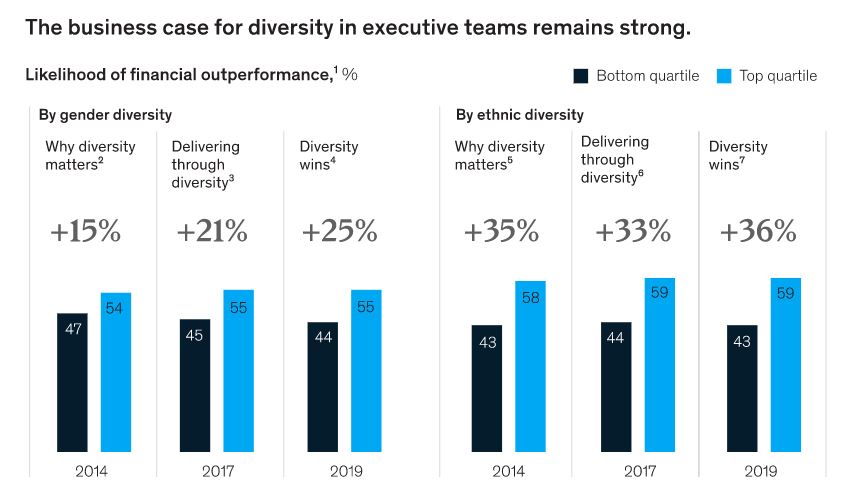
It has been proven that ethnically diverse companies perform 36% better than companies that are not. We’ll dive into that stat in a minute, but first, some important definitions and distinctions when thinking about a DEI recruiting strategy.
Diversity is the range of differences that make people unique, both seen and unseen. (Be mindful that diversity includes not only race and gender, but age, ethnicity, sexual orientation, physical disabilities, and neurodiversity).
Inclusion is an environment that engages multiple perspectives, different ideas, and individuals to define organizational policy and culture.
Remember, when you hire for diversity, you get the benefits of inclusion.
An important point according to Janet Stovall, Executive Communications Manager at UPS, in her TED talk. “Let’s be clear: diversity and inclusion are not the same things. Diversity is a numbers game. Inclusion is about impact. Companies can mandate diversity, but they have to cultivate inclusion.” Stovall is also clear that businesses can be a key force to dismantle racism.
McKinsey has done a series of studies on the topic of DEI and the latest study encompasses 15 countries and more than 1,000 large companies. This latest report, titled Diversity Wins shows that the relationship between diversity on executive teams and the likelihood of financial outperformance has strengthened over time.
McKinsey explored how different approaches to inclusion and diversity could have shaped the trajectories of the companies in their data set and found two critical factors: a systematic business-led approach to inclusion and diversity, and bold action on inclusion.
One Leader’s Story on Building a Diverse Organization
The business case for DEI is there, but it’s not always easy. I’d like to (anonymously) share the story of a friend of mine who was trying to increase diverse hiring his organization.
He was the head of AI software for products at a Fortune 500 company and specifically set out to hire more female engineers. He met with his managers and discussed ideas. He challenged his staff to look through LinkedIn for candidates. He spent one morning combing through LinkedIn and personally wrote 100 cold/semi-cold emails to prospects.
I think it’s important to note that he didn’t delegate it out. From this initial outreach, he received 35 responses, and he reached out personally to all. Then he interviewed and hired several of these women. After a period of one year, 20% of his team were women – from less than 5% – and the percentages were still climbing.
A couple of things had to happen to make this work. He told his staff that they needed to get involved and invest in their networks – both college alumni networks and other networks of friends and past colleagues. He made it clear that hiring for diversity is key in jobs at every level. He also made sure that candidates met a diverse group of people within the company during interviews. His staff was taught to follow up with every candidate personally. These may seem like small things, but they were game changers for both the new employees and the organization’s depth.
Unfortunately, there is bad news here. Two years after this initiative, there was a full reorganization and my friend parted ways with this company. The commitment to hiring for diversity was not sustained, the DEI focus faded within the organization, and progress was lost. I believe that the moral of this story is that enabling real change takes both time and commitment, and awareness is only the first step.
Beyond the Rooney Rule
The “Rooney Rule” – a diversity initiative started by the National Football League that calls for interviewing minority candidates for top jobs – has been adopted by corporate America, but experts believe it hasn’t made much of an impact.
As companies release detailed information about the diversity of their workforces, the data shows that women and people of color are well-represented in the lowest rungs of many company workforces, but there’s often little representation in leadership roles and board positions. When companies adopt a Rooney Rule, they’re pledging to add at least one candidate to their interview pool to increase gender and racial diversity, but that’s usually not enough to foster real change.
To make a meaningful impact, hiring managers should aim to interview a slate of candidates that’s 30% diverse, according to Alina Polonskaia, global leader of the D&I practice at executive recruiter Korn Ferry. Companies could also set a standard of having their executive ranks mirror the gender and race breakdown of the usually much-more-diverse entry-level workforce. In addition, employers should also use the same diversity standards they are applying for new hires to people being considered for promotions.
How Diversity can be Your Superpower
Let’s take a look at a study focused on hiring for B2B sales roles. This study by Forrester, commissioned by Outreach, confirms it is time for us all to commit to diversity, equity, and inclusion. Since sellers are the first point of contact for a company, sales reps must represent the world around them, and organizations must commit to DEI or risk losing revenue and talent.
Sales leaders understand the need for diverse teams; 67% of respondents say it’s important for their team to represent the world around them. However, although sales respondents in North America say DEI is important, they are not ranking DEI efforts over other priorities. Respondents ranked almost every other sales leadership skill before DEI. Yet, customers are demanding diversity now.
60% of respondents stated that diversity within their sales team has contributed to their teams’ success.
82% predict that the racial or ethnic diversity of their sales team will be equally or more important in the next two years.
72% believe that DEI will play an equally important or more important role in business decisions in the next two years.
They conclude that companies with strong DEI practices have better-performing sales teams, including higher forecasts, higher conversion rates, and higher sales attainment.
How to Walk the Walk
The Inclusion Solution blog points out, “it’s not just about introducing shiny new initiatives and hiring the first head of DEIBJ (diversity, equity, inclusion, belonging, and justice) — it’s about displaying a real, sustainable commitment to these efforts through financial and human resources deployed over time… not just when the cameras are rolling and the topic is trending.”
To that end, here are some strategies and ideas on how to walk the walk and incorporated diversity in your hiring to reap the benefits of inclusivity. Some are tactical tips, others are broader, more strategic initiatives gathered from the reports, experts, and sources mentioned in this blog.
Focus on developing an equitable talent process, purposely create diverse and inclusive teams, and create development programs for under-represented groups. (Korn Ferry)
When conducting campus recruiting, think beyond Ivy League schools and schools you may be personally connected to, and consider Minority-Serving Institutions (MSIs) (Excelencia in Education)
A “work from anywhere” environment can foster diversity hires. In an all-virtual environment, there are very few limitations in terms of where to find talent. (Bloomberg)
Challenge your definitions of “professionalism” and “leadership” within your organization – and then hire and promote diverse leaders. (Mac’s List)
Broaden your lens on DE&I, including embracing neurodiversity. One big benefit of an inclusive work culture is that it fosters diversity of thought, different approaches to work, innovation, and creativity. (Deloitte)
Provide education around and try to use inclusive language. (Mac’s List)
Training is a good start, but mature organizations do more. Leaders need to model inclusive behavior, and the organization as a whole needs to value and measure progress toward DEI goals. (Forrester)
Strengthen leadership accountability and capabilities for inclusion and diversity (I&D). Companies should place their core-business leaders and managers at the heart of the I&D effort—beyond the HR function or employee resource-group leaders. (McKinsey)
Enable equality of opportunity through fairness and transparency. Deploy analytics tools to show that promotions, pay processes, and the criteria behind them, are transparent and fair. (McKinsey)
If companies want to do a better job of retaining diverse talent, they can’t go back to “business as usual.” It’s time to make work more equitable, and while flexibility is not the panacea, it is a step in the right direction. (Harvard Business Review)
Workers overall want to feel like their boss cares about them. Gen Z wants a culture built on mental health and wellness. (LinkedIn)
Flexibility is increasingly prized, particularly by underrepresented groups. Leaders who hope to retain top talent and maintain diversity must act swiftly and deliberately to counter the forces of proximity bias. (i.e., if managers spend most of their time working in the office, that is likely to lead to a double standard of valuing employees who also come into the office). (Future Forum)
Continue pushing the conversation forward, even if you don’t have all the answers. DEI strategy is an essential element of building a strong business that is able to attract and retain great talent and connect with a diverse customer base. (Forrester)
As you search out new talent, there are a lot of nuances that you need to consider. Your HR team may have guidelines, and you may want to “go with your gut” in terms of what is right, but there are many factors and issues involved. Educate yourself and become an agent for change, dedicating the time and commitment necessary to foster inclusivity for all.
As a coach and a mentor, I’m often asked for advice from job seekers. We are in a unique job market right now, a recent survey by Bankrate shows that 55% of Americans anticipate looking for a new job over the next year. This phenomenon has been nicknamed the Great Resignation by media outlets.
In response to the pandemic, “there have been a lot of epiphanies and reckonings that have occurred … with respect with how we’re prioritizing ultimately our values, and of course how work fits into that,” says Mark Hamrick, senior economic analyst at Bankrate, the company that conducted the research. Americans are prioritizing flexible work arrangements, higher pay, and job security in their search.
Flexibility is now the fastest-rising job priority in the U.S., according to a poll of more than 5,000 LinkedIn members. Working parents want to adjust their hours to suit their parenting schedules, single people want the freedom to change cities, while still keeping the same employer. Freedom and personal control within a job feel like much more vital priorities.
And yet, there hasn’t been much change in the hiring and recruiting process. As companies look to fill roles, there are too few people for open positions. Hiring managers and staff are investing more of their own time and paying recruiters, but jobs remain open. It’s time to shake up the process and hire for aptitude and then invest in training good people.
According to the Bureau of Labor Statistics, job openings surged to an all-time high of 10.1 million at the end of June, outnumbering the 8.7 million unemployed individuals. Given these stats, you would think that companies would be trying hard to connect with job seekers and make the right fit to fill these open positions. But companies and hiring managers need to think outside the box and expand their horizons. Are you actively looking to recruit women who have taken a break from the workforce with flexibility and daycare options? Are you proactively reaching out to diverse talent sourcing and recruiting associations? Have you considered making your educational requirements less stringent to open the pool of candidates to those with relevant life experience? Are you considering the value of older candidates who can bring years of knowledge and mentorship to the position?
Rather than stick to the way your company has always done things, focus on aptitude, empathy, and coachability. Here are some insightful questions that should prompt real conversations about success that can be accomplished if the company and candidate end up working together.
Tell me about an achievement that you are proud of – either personal or professional – and what you did to make that happen. This is very open ended and lets the candidate demonstrate goals and success.
In your research on our company, what is something you found that we could change or do differently to be more successful? This will let the candidate know you are open to their input and will may uncover some new ideas from a fresh perspective.
How do you think you can make a difference in our organization? Again, it gives the candidate a chance to show big picture thinking and define what success could look like.
What skills are you working on improving, and how do you plan to get there? The opposite of the “weakness” question, this is a positive spin on skill development and opportunities, and shows if someone is a lifelong learner.
Do you feel that you would be a good cultural fit here? If not, what could we do differently? This can start discussions on diversity and supporting all employees. Although some candidates may not feel comfortable opening up, if the interviewer lets the candidate know they are striving to be inclusive, it may go a long way.
An interview shouldn’t be an interrogation or include tricks or puzzles to solve to make it to the next level. Adam Grant, organizational psychologist at Wharton, recently wrote an article for The Wall Street Journal, titled, The Real Meaning of Freedom at Work, in which he states, “For several generations, we’ve organized our lives around our work. Our jobs have determined where we make our homes, when we see our families and what we can squeeze in during our downtime. It might be time to start planning our work around our lives.”
As you are recruiting to fill open roles in your organization, do so with the goal of truly assessing the fit of this person for this role and your organization – and do so with an open mind toward hiring for aptitude.
Have you ever finished a riveting book and realized that the plot, characters, and setting have left an indelible mark on your being? That is how I will always remember the Martin Trust Center for MIT Entrepreneurship – the people, energy, and ideas will forever imprint the fabric of my life.
When I joined the Trust Center nearly six years ago, I blogged about Disciplined Entrepreneurship – the framework we use for the entrepreneurship program at MIT’s Trust Center based on the book by Bill Aulet, the Center’s Managing Director. One of the ideas that resonated with me then, and continues to do so, is that “ideas mean nothing without execution.”
Reflecting on the past six years, I realize that my time at MIT was about more than a job, it was about the execution of entrepreneurship. It was a chance to shape the lives of aspiring entrepreneurs who had big dreams and ideas to change the world for the better and help them to shape and execute those ideas into concrete plans. At the Trust Center, we like to say that MIT’s student entrepreneurs tackle the world’s big problems, and it was exciting to help make that happen.
Here’s the synopsis of how I landed at the Trust Center, and filled many roles, ultimately becoming the Director of MIT delta v, as well as an Entrepreneur-in-Residence and a lecturer at the MIT Sloan School of Management on entrepreneurship topics.
In 2014, I had completed my doctorate in work-based learning at the University of Pennsylvania’s Chief Learning Officer program, and I wasn’t sure what my next step should be. I had the option to get back into the corporate world and focus on business analytics, but instead decided to pursue a role in education. I was hired by MIT as an Entrepreneur-in-Residence and to help lead the student venture accelerator program, which is now known as delta v. From there, my role has expanded to teaching entrepreneurship classes, spearheading global programs, and becoming a spokesperson and thought leader representing MIT’s entrepreneurship initiatives.
This was definitely something new and different for me, and I had to push myself out of my comfort zone and embrace the challenge. The results achieved have certainly been beyond what I could have anticipated six years ago, including the expansion of the Trust Center – both physically and via online with Orbit, growing delta v both in size and in scope, partnerships with other universities, and instituting a flagship program to support the mental health of entrepreneurs. There were also many awards and accolades along the way, both personally and for the program.
But I’m not here to toot my own horn … I want to sincerely thank the whole team at the Trust Center for their support, teamwork, and camaraderie over the years – our group is quite the entrepreneurial talent tree. I’d also like to thank all the students who I was able to work with and mentor on their entrepreneurial journeys. Your enthusiasm and bright light made the hard parts of this job rewarding and worthwhile.
For those of you who are rethinking your own career situation, after the past year this may be exactly the right time to open yourself up to new experiences and find that that your next chapter was better than your last. I am leaving a job I love for the unknown – of course, this is a risk, but as an entrepreneur you bet on yourself, and make the choice to wake up with a “wow” in terms of what is going to happen today.
For me, this is the time to move beyond what has become well-loved and comfortable, and to take a leap into the next chapter – the fourth in my career. First, I was an engineer who moved up through the executive ranks. Second, I focused on startups, leading two companies to successful exits. Third, was my move into academia at MIT by leveraging my startup experience. And, for the fourth chapter, I’m not 100% sure what it will be yet, but stay tuned – that is the exciting part!
Wisdom from the Women Who Support MIT’s Entrepreneurs
Today, November 19, is Women’s Entrepreneurship Day, a day celebrating and encouraging female entrepreneurship. Our student venture accelerator program, delta v, has launched some amazing female entrepreneurs – and our historical data show us that the women-led delta v companies surpass our very impressive overall stat that 3 of every 4 delta v startups are still operating. At MIT, our goal is to support all our entrepreneurs and make them as successful as possible. That is why we are thrilled when we hear feedback like the quote below – it shows us that we are succeeding in our support of diverse entrepreneurs, and neutralizing any implicit biases.
“In the Trust Center, gender, age, race, culture, even hierarchy, are invisible. It’s the only space I’ve ever walked into where all that baggage was truly left at the door. This almost disorienting sense of equality allows for a re-imagining of identity.” Joan Kelly, delta v entrepreneur and CEO of Abound
For the entire month of November, we’re profiling some of our women entrepreneurs, faculty, and Trust Center staff on our Instagram feed (@eshipMIT) with the tag #WEMatMIT (which stands for Women’s Entrepreneur Month at MIT). Follow the feed and be inspired!
Today, the Martin Trust Center for MIT Entrepreneurship celebrates Women’s Entrepreneurship Day by focusing on the women at MIT who support all of our entrepreneurs, and sharing their wisdom.
Here is our lineup of stellar women supporting MIT’s entrepreneurship community and their responses to our questions on entrepreneurship. As I reflect on the contributions of these women, it is evident that the strong entrepreneurial ecosystems at MIT did not just materialize – they are nurtured, fostered, and improved upon by these individuals. They all bring a focused passion to their roles – with a lack of ego, they meet students where they are on their journeys to become entrepreneurs and help them flourish.
What advice can you share with aspiring entrepreneurs?
“Just start! Usually that first step is the hardest one. If you just start you will see that anyone can get started. Figure out what that first step is and do it. And if your first step was to make a PowerPoint, nice job doing that first step, but now get out of PowerPoint and talk to humans!!” – Kit Hickey
“Admit what you don’t know. Share your idea and take every opportunity to learn from those around you. This isn’t always a comfortable way for talented, high performers to operate. But it is critical. Rather than always looking for validation of your ideas, look for evidence that reveals weaknesses in your hypotheses.” – Megan Mitchell
“Seek a broad range of advisors, mentors, colleagues – diversity in terms of age, gender, experience, outlook on life and don’t limit it to people you think you align with – so that you are challenged to move beyond your comfort zone.” – Lesley Millar-Nicholson
“Follow your intuition and do what you feel is right. Women have stronger emotional intelligence, use this to make appropriate decisions and follow through with persistence.” – Karen Golmer
“Remain open-minded to what you learn through research. Approach research with curiosity, rather than an opportunity to reinforce and validate your current assumptions. Embrace surprising results and be ready to go back to the drawing board and adapt your solutions to a deeper understanding of the problem you’re looking to solve.” – Jinane Abounadi
“The outcome of any entrepreneurial endeavor is extremely uncertain, so you should be really excited about the journey. And surround yourself with people you like and respect, because you’ll be spending a lot of time together!” – Carly Chase
What do you believe female entrepreneurs need to do more of/better/differently to be successful?
“Unfortunately, we still need to have incredibly thick skin because the industry is not yet as equitable as it should be. Given the inequities, we’ve got to support and stick up for one another, in both small and big ways.” – Carly Chase
“Recognize that there are fewer female-backed startup companies, fewer women on Boards of companies, fewer patent holding female scientists – but don’t let that be a hurdle. In fact, find those who have or are those things – and learn from them, what inspires them, what tricks and tools have they created to achieve what they have achieved.” – Lesley Millar-Nicholson
“Really examine what YOU want out of your entrepreneurial journey. We spend so much of our lives being told what we should be, it is a challenge to break away from that and define what success is for you. Success for you may be completely different than what success means for your classmate, and that’s OK. By actually defining success for yourself, you can have a much more meaningful, impactful and enjoyable career.” – Kit Hickey
“Female entrepreneurs need to own their space, their knowledge, and their brilliance. Women have to be deliberate in the words they use when they speak about their experience and their ventures. Please don’t say, ‘If the pilot is successful, we will…” Come from an affirmative position. Trade that language for something more like: “Following our successful pilot, we will…” – Megan Mitchell
“Speak up more often (males don’t wait for their turn to speak ) – so don’t wait to be asked, offer up your opinions, experience, insight and do it in a thoughtful and measured way – so people are keen to listen.” – Lesley Millar-Nicholson
Female entrepreneurs need to work together and hold one another accountable when they see another not owning her own power. Women working together will elevate all.” – Megan Mitchell
“Own your ‘imposter syndrome’ and don’t let it come an excuse to demonstrate your knowledge, passion and capabilities – in fact, challenge that feeling by speaking up.” – Lesley Millar-Nicholson
“Don’t back down, instead listen with respect and learn about other perspectives. When feeling blocked or ignored, don’t speak louder to be heard – try a different approach.” – Karen Golmer
“Try not to take it personally when you hit a roadblock, or your initial ideas get rejected. Be confident in your talent and your ability to overcome hurdles and challenges. Use a network of caring mentors to get honest feedback and be open to listening and growing in the process.” – Jinane Abounadi
How do you, personally, keep inspired and moving forward?
“I look for and accept the challenges that appear – one at a time. When I end up in a conflict or uncomfortable situation, I use humor to diffuse the tension and redirect to move forward.” – Karen Golmer
“For me, the inspiration at his phase of my career comes from stepping back and hearing about stories of other amazing women that have worked hard and persevered to make a difference. I felt so inspired when I heard that there was a woman scientist (Ozlem Tureci) behind the [COVID-19] Pfizer vaccine. In my role, I see the potential of so many of our brilliant female students (undergrad or graduate) to make significant impact in the future and I will feel proud to have been part of their journey.” – Jinane Abounadi
“I love engaging with people – the passion, diversity and new ideas at MIT keep me inspired every day. Every day I learn from a student, and I love it! Being at a place where you continue to learn, can engage with amazing people, and have the autonomy to solve hard problems you are interested in, is what I love about being an EIR at MIT.” – Kit Hickey
“It is the entrepreneurs, their individual stories and passion that inspire me and keep me moving forward. Each entrepreneur has a story that connects them to the problem they are trying to solve. Often that story is deeply personal and offers me insights not only into who they are as individuals, but also the worlds in which they come from.” – Megan Mitchell
“Recognizing that I am part of a community and my contribution (or lack of it) has impact on others and what they can or cannot achieve because of my actions.” – Lesley Millar-Nicholson
“Building businesses from scratch is an incredibly difficult, gritty, and uncomfortable experience that forces you to grow in ways you didn’t even know you needed to! I’m addicted to not only the constant growth I personally get from being an entrepreneur, but also to the people who it attracts – they are the most exciting people in the world to be working alongside.” – Carly Chase
Conclusion
At MIT, our definition of entrepreneurship has evolved from a focus on startups to an entrepreneurial mindset – we see entrepreneurship as a skillset and a way of operating. We need entrepreneurial attributes in all our organizations – whether it is within a big company, a small company, or a university environment. These women bring that entrepreneurial mindset to their roles in helping curious entrepreneurs in corporate environments, ready-to-go entrepreneurs, and amplifiers in their communities. They cover the developing world, emerging markets, and corporate innovation. We live in a changing world with changing needs, and students need to test and adapt their entrepreneurial skills. Thank you to Jinane, Carly, Karen, Kit, Lesley, and Megan for your invaluable guidance to MIT’s student entrepreneurs! As we all work together at MIT, we see all boats rise which is what makes the MIT community an amazing ecosystem.














 Trish Cotter