A Bold Journey

Living life boldly means exposing yourself to all sorts of risk – risk of loss, risk of criticism and judgement, risk of mental, emotional, or physical distress. It’s no wonder, so many of us are raised to not live boldly, to not take risks, to not push ourselves to reach our highest potential.  

Bold Journey, an online magazine, asks people to share the story of their lives and how they got to where they are today. Their mission is to create a space for all of us to learn from each other. They recently reached out to profile my bold journey – the interview is shared below.

Trish, thank you so much for joining us today. Let’s jump right into something we’re really interested in hearing about from you – being the only one in the room. So many of us find ourselves as the only woman in the room, the only immigrant or the only artist in the room, etc. Can you talk to us about how you have learned to be effective and successful in situations where you are the only one in the room like you?
I began my career in the chemical industry, initially working in the lab and later as an engineer running a plating line. I was often the only woman in meetings, in the manufacturing area, and at lunch. My upbringing with six brothers (and two sisters) and playing team sports prepared me for that experience. As the only female, I was frequently offered training programs aimed at increasing diversity. Early in my career, my boss would joke that I went to another facility for lunch because there were more women, and he was right. I did feel lonely and excluded at times, but being the only female also brought unique opportunities. The support, mentorship, and sponsorship I received from men far outweighed the challenges I faced.

Thanks, so before we move on maybe you can share a bit more about yourself?

I am currently in the fourth stage of my career. I started as an engineer making circuit boards and gradually expanded to building various computer components and ultimately overseeing comprehensive product testing. Moving laterally within the company proved to be a transformative experience, allowing me to work with new people in a management role and learn skills and techniques I would call upon for years – this was the second stage of my career.

In my third stage, I ventured into academia, teaching entrepreneurship at MIT and spearheading its capstone accelerator, delta v. This experience was exceptional, immersing me in cutting-edge technology daily and mentoring students eager to make a positive impact on the world. It also provided opportunities to research entrepreneurial ventures globally (check out my free ebook on Start-up Accelerator Programs Around the World).

I continue to collaborate with MIT in the fourth stage of my career, contributing to partner programs in entrepreneurship education. Additionally, I focus on entrepreneurship and energy coaching through my own business. This work has been particularly inspiring, enabling me to help clients maximize their positive impact through enhanced focus and joy in their lives.

There is so much advice out there about all the different skills and qualities folks need to develop in order to succeed in today’s highly competitive environment and often it can feel overwhelming. So, if we had to break it down to just the three that matter most, which three skills or qualities would you focus on?

My career success is significantly attributed to the invaluable mentorship and sponsorship I received, which provided me with a solid foundation of technical, leadership, and personal skills. Several mentors offered training opportunities, and sponsors recommended I transition into the executive ranks. Without their support, I don’t believe my career would have been as successful.

A mentor encouraged me to explore opportunities in the startup realm, a decision that proved to be highly rewarding. I played a pivotal role in the remarkable growth of two startups, helping the first grow to over $100M, and the second to over $225M before it was acquired by IBM.

At MIT, I dedicated my tenure to sharing my entrepreneurship experience and preparing students to excel in business. Over six years, I worked with a fantastic team to teach and develop the skills of student entrepreneurs. Our energy coaching program empowered them to understand their professional presence better and take control of their business and career. We also introduced a mental health aspect into the entrepreneurial journey, a focus that was previously absent. I co-authored an article for HBR about this program titled, “Passion for Your Startup Doesn’t Have to Mean Constant Stress.” This investment in the mental health of entrepreneurs has created a more resilient generation of business leaders ready to face the challenges of the outside world.

We’ve all got limited resources, time, energy, focus, etc. – so if you had to choose between going all in on your strengths or working on areas where you aren’t as strong, what would you choose?

A well-rounded approach will serve you well. Some skills that I’ve developed include the ability to take risks, a strong work ethic, and being a good listener.

I never considered myself a risk taker until my dad, who had been with an employer forever, asked why I was changing jobs. My reason was that there was so much more in the world to learn. I moved from making computers to testing them, using them, monitoring them, and analyzing data. This wasn’t a wild risk, but the shift from large companies to startups was viewed as one. However, as the companies got smaller, I had more control and impact.

I knew that no one would outwork me, and I surrounded myself with a great group of people in a culture I crafted. In this environment, work was recognized, teams were rewarded, and customers received value from our products. I also knew I needed to get comfortable with being uncomfortable, learning from intelligent people who had clever ways to solve problems, regardless of their position.

A learning mindset serves you well. Good listening skills help you zero in on the root cause of issues rather than revisiting them repeatedly. As an entrepreneur, you’re not just taking risks; you’re mitigating them every day. The key is to surround yourself with intelligent and creative people who can build a team where – even if we miss – we win by learning together.

The original article was published in Bold Journey here: “Meet Dr. Trish Cotter.”
Thank you for the opportunity!


Gen Z Entrepreneurship: Influencing or Innovating?

As we move deeper into the 21st century, Generation Z is emerging as a force to be reckoned with in the world of entrepreneurship. Born between the late 1990s and early 2010s, Gen Zers are redefining the future of work, balancing traditional jobs with side hustles, and actively building their own businesses.

The Rise of the Creator Economy

One of the key elements of Gen Z entrepreneurship is the rise of the creator economy. Influencers and content creators have become a dominant force, leveraging their online presence to build successful businesses. CBS News reports that 86% of young Americans aspire to become social media influencers, to as it offers earning potential far beyond traditional paths.

Kylie Jenner, for example, became the youngest self-made billionaire thanks to her successful beauty brand, Kylie Cosmetics. Gen Z entrepreneurs understand the importance of authenticity and have cultivated strong relationships with their audiences, providing them with a unique advantage when building businesses.

Gen Z’s affinity for the digital world is a driving force behind their success. They are digital natives who have grown up with social media, which allows them to easily navigate the online landscape. This has helped them build personal brands and monetize their influence through partnerships, sponsored content, and merchandise sales – The Social Standard and Go Daddy both share profiles of Gen Z entrepreneurs who have made it big as influencers and creators.

However, in my view, being an influencer alone is not enough to create real innovation. I believe the focus on personal branding and the rapid pace of content creation is limiting the depth of exploration into entrepreneurial ventures that address pressing global challenges.

What Sets Gen Z Apart?

Gen Z views entrepreneurship differently than past generations. For one thing, the entrepreneurial landscape has changed, with lower barriers to entry for starting a business, and different views on what is important. Business Insider discusses some of these differences, including:

  • Ease of Starting a Business: Thanks to accessible technology and platforms like Shopify, starting a business has never been easier. What once took months and significant capital to launch can now be accomplished in a matter of days.
  • Data-Driven Decision-Making: Gen Z entrepreneurs utilize data analysis tools to make informed decisions about their businesses. This helps them streamline operations and focus on the big picture.
  • Personal Branding: The concept of personal branding is a strategic necessity for many of this generation’s startups. Gen Zers understand the importance of building a strong personal brand to attract opportunities and partnerships.
  • Acceptance of Differences: Gen Z values inclusivity and diversity, which informs their approach to business and innovation.
  • Kinder, More Socially Responsible Entrepreneurs: Gen Z entrepreneurs are concerned about social issues, the environment, and helping their communities.

The Side Hustle becomes a Necessity

While Gen Z entrepreneurs have numerous advantages, they also face challenges. Many young people juggle multiple side hustles due to financial pressures and the desire for control over their time. This can lead to burnout and the need for balance.

In today’s economy, many Gen Zers feel that a side hustle is necessary for their generation to afford the lifestyle that their parents have attained. Data from the Bureau of Labor Statistics shows that the number of people working multiple full-time jobs has trended up in recent years and hit an all-time high in August 2022, with Gen Z leading the way. A survey by Paychex found that about half of Gen Z are employed at two or more places, as compared with other generations.

Deloitte’s 2022 Gen Z and Millennial Survey found that a third of Gen Z respondents worry about the cost of living above all other concerns, 45% live paycheck-to-paycheck, and more than a quarter said they doubt they’ll retire comfortably. And a Freddie Mac survey found that about 34% of responding Gen Zers said they didn’t think they’d ever be able to afford to buy a house.

Often the side hustle becomes a main hustle, creating necessity-based entrepreneurs versus innovation-based entrepreneurs. In fact, McKinsey postulates that in this economy—in which Gen Z faces higher-than-average inflation, student debt, credit card debt, and high housing costs—Gen Zers are actually looking for nothing more than relatively stable paychecks (rather than chasing the side hustle).

Can Gen Z Change the World?

The big question remains: Can Gen Z entrepreneurs change the world? If the current trends continue, Gen Z’s pursuit of entrepreneurship could lead to tremendous growth and innovation. They have the potential to create disruptor-type companies that challenge traditional industries and bring fresh perspectives to long-standing problems.

However, business failure rates remain high with 50% of small businesses failing within five years according to the Small Business Administration, and not all ventures will succeed. Nevertheless, Gen Z’s ability to adapt, innovate, and leverage digital tools gives them a fighting chance.

Let’s look at the type of innovative ideas that are coming out of places like MIT, and how these startup success stories can influence the upcoming generation of entrepreneurs.

Innovation-based Startups

In my former role as the Executive Director of MIT’s Martin Trust Center for Entrepreneurship, I was very fortunate to work closely with some of the smartest young entrepreneurs in the world.

I saw firsthand how innovation-based startups can succeed with access to proven frameworks, mentorship, and resources that support building impactful ventures. By guiding students from ideation to execution, the center helps transform groundbreaking ideas into successful startups that can address significant global challenges.

Here are a few of the innovation-based startups that I personally worked with as they made their way through delta v – MIT’s capstone program for entrepreneurship.

  • Biobot Analytics analyzes sewage with molecular technologies and AI to provide early warning of population health threats across the globe.
  • Podimetrics develops medical technologies such as the SmartMat, which helps monitor foot health in diabetic patients to prevent complications like foot ulcers.
  • Ori has invented an entirely new type of apartment—one that radically improves the resident experience in smaller spaces by using sophisticated engineering and design.
  • Infinite Cooling’s mission is to develop the cooling tower of the future. They help industrial plants have safer, more reliable, and more sustainable cooling towers by optimizing thermal performance and eliminating cooling tower plumes.​
  • Bloomer Tech focuses on developing smart wearable technology specifically designed for women’s health, such as bras with embedded sensors to monitor heart health.

Innovation-based startups focus on solving significant global challenges through advanced technology and research. These startups prioritize creating groundbreaking solutions to complex problems in health, environment, and other critical fields.

In contrast, entrepreneurial ventures centered around influencers and content creators often revolve around personal branding and monetizing online presence through partnerships and merchandise sales. While both types of entrepreneurship involve creativity and a desire to succeed, innovation-based startups typically involve deep research and development, long-term planning, venture capital fundraising, and a focus on sustainable impact, whereas influencer ventures are often more focused on immediate audience engagement and revenue generation.

As we look to the future, one thing is clear: Generation Z is not content with the status quo. They are ready to take on the world. And, although not every entrepreneur can attend programs like those offered at MIT, I urge today’s generation of entrepreneurs to aim high. Use the resources you have – whether it is taking classes, reading books and articles, finding a mentor, or working with an entrepreneurship coach – and use this information to explore the difference you can make in the world.

The Second Lieutenant Advantage: Embracing Collaboration in Entrepreneurship

Not everyone aspires to be the leader. Some individuals find genuine fulfillment in supporting their teams — stepping into the limelight when necessary, and gracefully stepping back when it’s time for others to shine. In the fast-paced world of entrepreneurship, where the prevailing stereotype often emphasizes the leader persona, there is immense value in fostering a collaborative environment where everyone’s contributions are recognized.

The Happiness in the Shadows

For some, the limelight can be daunting. I, for one, appreciate having my moments but find satisfaction in letting others take center stage. It’s not about avoiding responsibility or lacking ambition; it’s about finding happiness, acceptance, and humility in being part of a team where everyone’s efforts contribute to the collective success.

When I watched the CBS News video, “Sidemen, Backups, and Understudies: Playing in the Shadows,” it really resonated with me. I encourage you to take a few minutes and watch it. The segment features Mark Rivera, Billy Joel’s sideman and saxophone player; retired baseball catcher Erik Kratz, who spent 11 seasons with 14 different major league organizations; and Kayla Pecchioni, a Broadway understudy who often steps into the shoes of the star. These professionals play in the background or are called up when the stars aren’t available — and they all embrace their position as #2.

These very accomplished individuals understand the importance of their role and talent and a humility that allows them to shine even when they’re not number one. One thing that stood out to me was their “team first” attitude. They work just as hard as the superstars to be the best that they can be for the team.

Rivera explains he’s been the frontman, and he feels he has a much better gig now. Katz comments that the lesson is about finding contentment built on a foundation of humility and gratitude. While Pecchioni talks about looking for glimmers and being appreciative of the everyday. While we may not know their names, these team players help ensure their organizations are successful.

The Desire to Belong

In today’s entrepreneurial landscape, people are increasingly seeking to be part of something bigger than themselves. While not everyone can, or wants to, assume a leadership role, we are more dependent than ever on individuals who can step up when needed. However, it’s crucial to do a better job of recognizing and appreciating these contributors beyond just the top leadership echelon.

Entrepreneur magazine advises how leaders can foster a sense of belonging in the workplace, and how this helps employees feel free to be their authentic, true selves, which makes it easier to show up, engage with others, create solutions, and perform well.

In a study cited in the article, a high sense of belonging among employees was strongly linked with a 56% increase in job performance, a 50% decrease in risk of leaving, and a 75% reduction in sick days. For a company of 10,000 people, this could mean annual savings of more than $52 million.

Social belonging is a fundamental need. Entrepreneurial leaders need to remind themselves that the hard-working team members who may be playing in the shadows need to feel included, and as leaders, they should proactively create a workplace of belonging for everyone.

Creating a Culture of Recognition

Not everyone can be a general; not everyone can be a second lieutenant. However, everyone can be recognized for their unique contributions. The key lies in acknowledging the diverse roles within a team and ensuring that each person’s efforts are valued.

When I worked as the executive director of MIT’s Martin Trust Center for Entrepreneurship, I was involved in almost every aspect of the Trust Center and the delta v accelerator, which is the capstone entrepreneurial experience for students at MIT. However, although I was not the face of theCenter or the program, I was the “glue” that held it together. For me, this was a role I preferred, and it gave me the opportunity to make the team and the delta v program shine.

I also played a similar “second lieutenant” role at startups that I helped to grow. I realized that providing direction and support, and letting others lead when necessary, yielded better results than anyone had projected.

Being “on” all the time can be exhausting for some of us. By surrounding ourselves with a collaborative team, we not only get to experience our moments of success but also share in the success of others. This sense of camaraderie builds a strong team spirit and reinforces the notion that everyone is supported. However, the leaders in the organization must recognize all the behind-the-scenes people that are essential to their success.

Balancing Ambition and Contentment to Gain a Sense of Fulfillment

Many individuals today seek better balance in their lives. It’s not a lack of ambition or a fear of challenges; rather, it’s a conscious choice to find happiness in what they do and contribute to a collaborative effort. Recognizing and motivating teams is now more critical than ever, especially in a hybrid work environment where face-to-face workplace connections are not as strong since daily interactions may be limited.

A sense of fulfillment at work goes beyond a mere paycheck. It’s about having the opportunity to step into the limelight, share achievements with the team, and then step back and continue contributing. A culture of mutual respect, where individuals rotate in and out of the spotlight, fosters a positive and supportive work environment.

Another interesting perspective is to look at how different generations view leadership and management positions. According to an article in Business Insider, many Gen Zers are saying “no thanks” to promotions because they feel that doing more work to get promoted is not worth the pay or the accompanying stress.

Work-life balance has become a bigger part of the conversation for this newest generation in the workforce, and bosses need to think about what other incentives might entice Gen Z (born from 1997 onward). Meaningful work, career development, mentorship, transparency, caring leadership, and an entrepreneurial culture are all factors that may motivate Gen Zers more than a bigger paycheck or a promotion.

In any generation, embracing the concept of allowing oneself to learn from others is pivotal. Observing and enabling the growth of team members allows for collective progress. It’s about moving away from the notion that everyone should constantly be climbing the corporate ladder and, instead, recognizing the potential for growth within the existing environment.

Conclusion

In the ever-evolving landscape of entrepreneurship, it’s time to break free from the misconception that success is synonymous with leadership. The strength of being a second lieutenant lies in recognizing the power of collaboration, appreciating diverse contributions, and fostering a culture where everyone can shine. In the hybrid world of work, where connections are not as visible, creating an environment that values every individual’s role is not just a strategic move; it’s a necessity for sustained success.

When Entrepreneurship and Antifragility Collide

Think like an entrepreneur to cultivate creativity and innovation in your role.

As a learning and development (L&D) professional, you may not think of yourself as an entrepreneur, but embracing an entrepreneurial mindset can help you foster creativity and innovation in your organization. Understanding how you can encourage an antifragile approach to deal with internal forces as challenges arise within your company is essential. Connect that to how you show up in your job and how it affects both your own effectiveness as well as co-workers’ effectiveness.

What it is

The pursuit of entrepreneurship in the context of an existing organization is often called corporate entrepreneurship or intrapreneurship – whether it is a for-profit corporation, a not-for-profit organization, a government agency, or any other type of company.

Corporate entrepreneurship is a method used to develop new businesses, products, services, or processes inside of an existing organization to create value and generate new revenue growth through entrepreneurial thought and action. People who see themselves as corporate entrepreneurs are the engines of growth within a company; they are often corporate leaders or develop into leadership roles.

L&D professionals are well positioned to harness their intrinsic entrepreneurial skills to create value in their organizations given their roles entail working with both internal customers and a variety of other stakeholders. Further, the skills, knowledge, and ability L&D practitioners possess can help them solve corporate problems by thinking like an entrepreneur.

How it works

Here’s an example: The operations team at a small technology company in the data analytics space had a major problem – the startup competed against industry giants such as IBM. As the old saying goes, “Nobody ever got fired for buying IBM.” The team leader needed to figure out how the company could compete and get the attention of prospects to have them take the leap of faith to buy from a smaller, unproven vendor.

Operations team members assessed the skills, knowledge, and abilities in terms of how they could take an entrepreneurial approach to solve that problem. The team identified the company’s customers and their compelling needs. Because people were tired of waiting on hold and dealing with multiple customer service representatives who couldn’t solve their problems, the startup began taking a customer-centric approach. The team figured out that one way it could differentiate was by gearing all its operational decisions toward how to best serve the customer and provide an excellent customer experience.

The operations team simplified the process for the customer – from being able to always talk to a knowledgeable person to easy, one-page contracts – which helped the business succeed. As the company grew from a startup to a more established business, customers still valued and encouraged the founders’ entrepreneurial spirit and mindset. The happy ending to this story is that IBM acquired the company after seeing the value it provided to customers.

Guidelines

As corporate entrepreneurs start activating their ideas, they should aim small so that if they succeed, they can build on that success; if they miss, they may learn even more from that experience, which will help in the future.

Corporate entrepreneurs should also look to cultivate an antifragile mindset, a concept taken from Nassim Nicholas Taleb’s book Antifragile. His premise is that many things in life benefit from stress, disorder, volatility, and turmoil — they not only gain from chaos but need it to survive and flourish. To be antifragile, individuals must bend but be strong enough not to break.

In a talk by GE Ventures CEO Sue Siegel to entrepreneurs at the Massachusetts Institute of Technology, she said, “The pace of change today is the slowest it will ever be.” People with an entrepreneurial and antifragile mindset can prepare themselves and their organizations for rapid change and disruption. They get stronger in the face of adversity.

Results

The outcomes of corporate entrepreneurship will be evident once individuals start thinking like an entrepreneur and moving forward with this mindset, which opens up a world of possibilities – such as IBM acquiring your startup business. Set a vision and create a team of people with credibility and a good understanding of the problem you are trying to solve.

One of the biggest obstacles is overcoming initial inertia. The do-nothing strategy tends to be easier for corporate employees than embracing change. To combat this, align yourself with employees who have a compelling reason to change, and educate them on how the new product or service or way of doing things will address their problem.

As Netflix co-founder Marc Randolph, states, “If you are unwilling to disrupt your business, there will always be someone willing to do it for you.” Demonstrate that you are able to stand in the storm and provide leadership as a change agent for your organization.

Checklist

  • What is the problem you are trying to solve? What benefits will it deliver to your customers?
  • Define the problem, quantify it. Can you do primary market research with open-ended questions to validate your hypothesis?
  • Come up with solutions. Does your solution solve a compelling need? Does it make monetary sense?
  • De-risk your solutions. How can these solutions be adopted by your prospects with a low risk to them?
  • Identify a team to help. Success is more likely when you are backed by a team. Entrepreneurship is not a solo sport!

Resources

Disciplined Entrepreneurship,Bill Aulet

Antifragile, Nassim Nicholas Taleb

An Introduction to Start-up Accelerators Around the World, Trish Cotter

Personal Branding and Marketing Yourself, Rita Balian Allen

About the authors

Patricia “Trish” Cotter is an entrepreneurship consultant and coach as well as a past director of MIT’s delta v student venture accelerator program;  patriciacotter76@gmail.com.

Rita Balian Allen is an executive coach focused on leadership development, management training and career development; rita@ritaballenassociates.com.

Note: This article is the property of ATD. It was published August 1, 2023 in TD Magazine:
https://www.td.org/magazines/td-magazine/when-entrepreneurship-and-antifragility-collide

What is Disciplined Entrepreneurship? A Short Overview for the Uninitiated.

When I recently presented at the Association of Talent Development’s ATD ’23 conference, our session was focused on how to Think Like an Entrepreneur and Foster Creativity in Your Organization. This was geared to help learning & development (L&D) professionals take lessons from entrepreneurship and apply them to their organizations.

One of the topics that we touched upon was Disciplined Entrepreneurship. The Disciplined Entrepreneurship approach was such an important and ingrained part of the entrepreneurship program at MIT, that I had to step back and realize that this was new information to most of the ATD ’23 attendees. (In fact, I’m currently preparing materials to teach Disciplined Entrepreneurship content via a partnership between MIT and Dalhousie University in Nova Scotia.) 

Since I had a lot of follow up questions on Disciplined Entrepreneurship, I thought I’d give a little more background on the approach and how it works in this blog post. Disciplined Entrepreneurship – or DE as we like to call it – is an approach to help you think about how you start to get your product or service to move forward.

This methodology assists the start of an entrepreneurship journey, and Bill Aulet, Managing Director of The Martin Trust Center for MIT Entrepreneurship, has documented this in his Disciplined Entrepreneurship book.  This is a great place to start if you are looking for an accessible and methodical approach to entrepreneurship. (Plus, the illustrations are fantastic!)

Source: Disciplined Entrepreneurship

The focus is that entrepreneurship can be broken down into 24 steps based on six themes. The discipline comes in by following these steps.

Six Major Themes of Entrepreneurship

As you’ll see in the DE map, the themes are color-coded. The six themes are:

  1. Who is your customer?
  2. What can you do for your customer?
  3. How does your customer acquire your product?
  4. How do you make money off your product?
  5. How do you design and test (prototype) your product? and
  6. How do you scale your business?

(This process does not include sales, sales tactics, marketing, raising capital, team building, etc. but if you are thinking about a venture this is a good place to start.)

De-Risking Your Venture

A disciplined approach focuses on de-risking the venture by understanding your customer’s needs and providing value, so they become paying customers. It will help you establish your business and understand how customers are going to find you (along with where you will find your customers). You also need to thoroughly understand how you will make money (renewals, add-ons, etc.).

The book takes you takes you through important steps that are often overlooked – like hypothesis testing and concept validation. It also talks about how you need to focus on designing a prototype or minimum viable product (MVP), as well as how you are going to scale.

People think it is risky to be an entrepreneur. Yet, as discussed in the ATD23 session, an entrepreneur is adaptable and willing to focus on a core group of customers to build the business rather than trying to be everything to everyone.

How do you start?

Start with the first theme—what problem are you solving and for whom? You need to move from concept through qualitative interviews (talk to humans), then quantitative research if required. Find a core group with a message that resonates and a problem you can solve; this is problem research.  

If you start with an open-ended question about what you do on a typical day? Ask open-ended questions (Tell me more? What about that product or service that is going well? What is not? etc.). There is a free e-book online called Talking to Humans by Giff Constable that can help with this. This is a process that continually refines and tests your hypotheses. Your primary market research (PMR) will help you understand your potential customers’ pain points.

Giff also has a book (another short read) called Testing with Humans.  At the end of the problem research, if customers didn’t mention the problem that you are building or providing a solution to, then move on to others, and if you can’t find your core, you may want to revisit your core assumptions.

Once you have a core that has the compelling problem then work with that set to review potential solutions. You then will move to what value they will achieve from your solution so you can gauge purchase intent.  

As you explore entrepreneurship further, make sure you are thinking from a global perspective. My ebook on Startup Accelerator Programs Around the World can help entrepreneurs find accelerator resources, with a focus outside the US.

This blog post presents a quick overview of Disciplined Entrepreneurship that gives a little more information that was possible in my session, but there are many resources for you to delve into further.  For those looking for ideas and ways to potentially introduce entrepreneurship ideas into their corporation, there is a short blog explaining the four models of corporate entrepreneurship and a more in-depth article from MIT on the four models.

More Entrepreneurship Resources

For further reading, viewing, or participation, here are some additional resources on entrepreneurship:

A New Resource for Global Entrepreneurs

In my mind, entrepreneurs are the “grittiest” types of people around – I’ve been one and I’ve taught entrepreneurship to hundreds of students through the entrepreneurship programs at MIT, including my five years as the director of MIT’s delta v student venture accelerator program, which launches student start-ups into the real world.

“The harder the challenge, the more it builds you up,” explains Leslie Feinzaig, founder and managing director of the Graham & Walker Venture Fund, when discussing the recent Silicon Valley Bank collapse. “The best entrepreneurs I know will face a hundred insurmountable obstacles – and come back for the 101st because they actively believe that with enough time and opportunity, they will come out victorious.”

If this is your mindset, my new ebook was written for you. It is a resource for entrepreneurs as they face challenges unique to start-up founders.

As more people become entrepreneurs, they claim ownership of their future and help to drive the economy of their own country – and potentially global economies as well. Start-up companies fuel world economies and have created a $6.4 trillion start-up economy.

Exploring Start-Up Accelerator Programs Worldwide

During the time I spent at the Martin Trust Center for MIT Entrepreneurship, I was fully immersed in a wide variety of innovative technologies and start-ups – including working with students who had come to MIT from all over the world. I also traveled to various countries to present and share our insights on entrepreneurship and to gain knowledge from programs abroad. And while there are many programs to support entrepreneurs in the United States, I realized that start-up founders from other countries have fewer resources available to guide them.

That planted a seed in my mind to create a guide for entrepreneurs who may be exploring ways to start their own businesses, especially in countries outside the U.S. In my current role as an entrepreneurship consultant and coach, I’ve taken on a project to develop this resource. I also hope this ebook serves as a resource for global accelerators, governments, and other stakeholders as well.

Global Venture Funding Activity

According to data compiled by Crunchbase, global venture funding in 2022 totaled $445 billion — 35% lower as compared to 2021, but $100 billion more than invested in 2020. Regionally, the U.S. secures most of this investment at nearly 50%, followed by China (10%), the U.K. (6%), and India (5%) based on Dealroom data.

Some entrepreneurs may think that they need to be in the United States because of the amount of investment money here, but we’re seeing more money flow to other regions as well. Today, there are lots of options for entrepreneurs globally. Often, students I worked with at MIT realized they needed more time to get the required product fit and build the company with customer feedback. The growth of accelerators worldwide provides options if they decide to leave the U.S. and grow their companies in another part of the world – whether it is their home country or a region that is a good launching pad for their product or service. This growth of accelerators, government support, and growing entrepreneurial communities worldwide can provide entrepreneurs with this needed support.

Diversity, thought leadership, and collaboration all work together to make the global ecosystem of entrepreneurs a much richer place. I hope that the information I’ve collected about entrepreneurship around the world and how different countries support their entrepreneurs is helpful in your pursuits.

As a note, this ebook is NOT meant to be comprehensive – it is more of a directional guide. It does not cover all regions or all countries in any region. I also realize that entrepreneurial ecosystems are continuously evolving, so new information will always be coming to light. To that end, I’ve published this ebook under a Creative Commons license – I am open to other contributors who want to add to this resource from here – please feel free to reach out.

Take the Next Step to Entrepreneurship

If you are a student, an entrepreneur, an entrepreneur-to-be, or you work in an accelerator or government that is working to encourage entrepreneurship, I hope this ebook provides you with insight and resources to explore entrepreneurship further in a global sense!

Download the PDF ebook:

 An Introduction to Start-Up Accelerator Programs around the World

This free ebook was designed to be shared – you don’t even need to fill out any forms to gain access.

Celebrating Our Entrepreneurs


Photo credit: MIT

It is with fond memories that I watched this year’s MIT delta v Demo Day presentations. Even though I was traveling out of the country, Demo Day generates the kind of enthusiasm and excitement that had me tuning in and watching the passion of these student entrepreneurs. (You can catch the replay of the Cambridge presentation here. The group also presented in San Francisco and New York City.)

MIT delta v Demo Day

Demo Day is an annual event that showcases the culmination of three months of work with the intensive delta v capstone educational accelerator program. Why am I so passionate about delta v? For five years I served as the director of this MIT program – a full immersion into a wide variety of innovative technologies and startups.

This year, watching from abroad, I saw a new cohort of entrepreneurs pitch their innovative and potentially world-changing companies to an audience of MIT students, mentors, friends, investors, and perhaps even customers. Kudos to Executive Director Paul Cheek, Jenny Larios Berlin, and Ben Soltoff, along with the entire Martin Trust Center staff for a successful Demo Day! Like any successful performance, there is an immense amount of hard work and preparation that goes into the final production. Like a proud parent, it was gratifying to pass the torch and see the program grow and move forward.

delta v 10-year Impact Study

In addition to celebrating this year’s delta v entrepreneurs, MIT just released an in-depth longitudinal study of the impact of delta v. I’d like to highlight some of the findings here to show how much this program has meant to the students and their startup companies, the MIT community, and to demonstrate the overall economic impact of the program.

The study was based on 10 cohorts of delta v students who comprised 181 teams. There were 692 participants during that time (67% were MIT students), and 322 of them (47%) responded to the survey. Some of the highlights include:

  • Survival Rate: Since its inception, 61% of delta v projects have become real companies that either continue to exist to this day or have been acquired. (For companies from the past five years of delta v, that number increases to 69%.)
  • Attractiveness to Investors: 63% of all the projects have resulted in companies that raised money.
  • Funding Attracted: The companies that have raised funding to date have totaled over $1 billion, and that continues to grow.
  • Founding Other Companies: Over 130 new additional companies have been created and raised an additional $2 billion beyond the companies started from the projects worked on in delta v.
  • Broader Entrepreneurship Communities: 68 (37.5%) of delta v startups were accepted into external, private/for-profit accelerators, including Y Combinator, TechStars, and Mass Challenge.
  • Connected Community: 83% of survey respondents say they are still in touch with their delta v cohort.

What’s Next for Me?

So, how can we help the next generation of entrepreneurs around the world be successful in their endeavors? Now that I’m working on the “fourth act” of my career, I’m working one-on-one with entrepreneurs and their startups in a consulting and coaching role.

These days I’m also traveling more for both pleasure and business. And, I’m working on an e-book resource on Global Entrepreneurship and Accelerator Programs around the World.

Interested in the e-book? Sign up here and I’ll send you a copy once it’s completed.

Leading with Empathy – A New Outlook on Hiring and Retention

As we enter the new year, HR managers and CEOs face a wake-up call. Employee recruitment and retention are major priorities for so many businesses this year, with companies unable to fill positions as we face continued uncertainty with COVID and the Great Resignation – now also being termed the Great Reshuffle.

The most recent statistics from the U.S. labor department said there were 10.6 million job openings at the end of November 2021 and 6.9 million unemployed people – 1.5 jobs per unemployed person. The number of “quits” hit a new high of 4.5 million in November. An article in The Guardian explains, “Quitting, most economists will tell you, is usually an expression of optimism. And yet, 2021’s quits happened against a larger economic picture that remains difficult to interpret with confidence.”

Some of the reasons people are quitting their jobs, according to USA Today and The Guardian, include:

  • Retirement – Most of the 5 million people who have left the labor force since the start of the pandemic are over 55 and have retired – early or naturally.
  • Career or industry switching – Others are switching careers or industries, for example, from restaurants and hotels to technology and warehousing, leaving some sectors with lots of openings and fewer candidates to fill them. Not surprisingly, given the stress on educators over the past two years, teachers are most likely to leave the labor force as compared to their counterparts in other industries.
  • Work-life balance – Thirteen percent of workers said they quit because their jobs didn’t provide work-life balance.
  • Care insecurity – Related to work-life balance, mothers with college degrees and telework-compatible jobs were more likely to exit the labor force and more likely to be on leave than women without children. One of the underlying reasons is an unequal distribution of labor at home and a critical degree of burnout contributing to “care insecurity.” Care insecurity is defined as uncertainty about daycare and school schedules that are unpredictably interrupted by periods of quarantine prompted by exposure to COVID.
  • Entrepreneurship – One-third of workers quit jobs to launch businesses. This may be either necessity- or innovation-based entrepreneurs.

The short-term outlook for the labor market suggests workers are likely to continue to have considerable bargaining power in 2022, says Indeed in its 2022 Labor Market Outlook report. But interestingly, job seekers remain hesitant. Active job search – that is, people taking specific steps to land work, like responding to job ads – hasn’t budged since the summer.

Where does all of this leave employers as they seek to recruit solid candidates to fill open positions?

Recruiting During a Time of Resentment

From the conversations I’ve had with friends, family, and colleagues recently, businesses that are hiring aren’t doing themselves any favors. Too many companies are approaching recruiting without empathy making it difficult to recruit good people. At the same time, prospective employees are hesitant and may have negative experiences with previous employers. Maybe it’s time for HR Managers to take a step back and look at their hiring processes.

You’re essentially recruiting during a time of resentment. People are disheartened, they’re tired, they’re sick of COVID, and at times sick from COVID. They may be working in an industry, such as healthcare, teaching, hospitality, or retail, where they are on the front lines every day and are looking for something different and less stressful. On the other hand, many office workers have the advantage of being able to work remotely, but that has its challenges as well. Are they being supported and mentored? Are they learning and growing? If this is going to be the new normal – rather than just a phase to get through – are you fully invested in making it successful?

New recruits will be precious resources in your company. Do you understand how to communicate effectively and listen to their thoughts and ideas?

5 Tips for Hiring and Retaining Employees with Empathy

Here’s a collection of tips for hiring with empathy. I believe that companies who approach their hiring process this way demonstrate to recruits that they support their employees and provide a positive work environment. Empathy then needs to be reflected in the workplace to retain your talent.

  1. Stop Ghosting Prospects

Maybe this should be common sense, but it’s not. If a candidate has taken the time to interview with you, they at least deserve a response – positive or negative. And a candidate who may not be right for a specific position today may be worth connecting with in the future, so keep that door open. Although many companies are using recruiting technology to automate the hiring process, we need to remember that there are real people behind each resume.

Fifty-two percent of job hunters say a lack of response from employers is their biggest frustration, according to Websolutions. In the current hiring environment, candidates have higher expectations for proactive, transparent, and frequent communications from employers. This needs to be communicated from the heads of HR to all the hiring managers involved in the process. If your current screening process is handled by a bot, you could be losing out to great people including referrals from current employees.

2. Prioritize Soft Skills

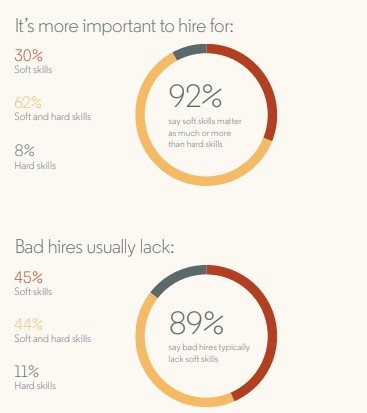
LinkedIn’s Global Talent Trends survey shows that bad hires are almost never a matter of hard skills alone. Prioritize soft skills – such as creativity, persuasion, collaboration, adaptability, and time management – in your hiring process. Although hard skills certainly matter, most hiring and firing decisions come down to soft skills.

 Part of the issue is that soft skills are more difficult to evaluate than hard skills. You can reasonably determine if a programmer has the right coding skills, or a translator has the right language skills, to perform adequately in their jobs. However, identifying poor soft skills is much harder, which is why this is often discovered too late, after a hire has been made.


Source: LinkedIn

3. Fully support Flexibility and Remote Work

Pre-pandemic, businesses expected that in five years 38% of their remote workforce would be fully remote, while today they expect 58% to be fully remote in five years, says Upwork in its Future Workforce report.

Career Builder adds that 35% of job seekers say they will turn down an offer if the employer does not offer a remote work option. The pandemic has forced the issue of remote work and flexible work schedules, making it a priority for employees. As companies consider return-to-the-office policies, they must realize there has been a mindset shift for many employees, and flexibility is now valued more than ever. It may be better for business too.

An Airtasker survey shows on average, remote employees work 1.4 more days every month, or 16.8 more days every year, than those who work in an office – and on workdays, they spend more time getting things done. Many workers are more productive and less stressed in a work-from-home environment since there is no commute, less water cooler talk, and more opportunity to fit exercise into their daily routine.


Source: Airtasker

4. Hire People You want to Coach

As a certified, professional coach, I spend time coaching people on energy leadership, and how you “show up” truly matters. Are you hiring people who will show up with an positive attitude and a mindset to think out of the box, bring all their creative skills, and work as a team?

Companies need to look at their interviewing process in a couple of ways. Are they looking to find the perfect candidate, or can they hire for aptitude and attitude? If they can identify the right aptitude and attitude, will the company culture embrace that and provide the training to help them grow? You may want to map out your hiring process from the humanistic viewpoint.

5. Listen to People to Retain Them

Once you’ve hired good people, you need to work hard to keep them. According to a recent Fast Company article, 2022 will be a key year for companies to live up to their promises to employees, or risk losing them. The best way to retain workers includes listening to their needs, accommodating their different work styles, and addressing inequities.

One member of the Fast Company Impact Council, Angie Klein, CEO of Visible, predicts, “We’re going to see a pretty big shift from talking about The Great Resignation to ‘The Great Retention,’ with [companies] focused on doing what it takes to keep talent. Employees aren’t really leaving because they’re unsatisfied—some are—but because they want to see what’s out there at a time when it seems far less risky to do so. Putting in proactive-retention measures while ensuring that we manage to drive meaning and purpose—there will be a heavy focus in retention like we have never seen before in corporate America.”

One employee retention tool that is gaining popularity is the “Stay Interview,” where a manager sits down with an employee to explore what it takes them to stay at the company. Ideally, these are regularly occurring conversations, built on a foundation of trust, where the employer doesn’t only focus on the job, but the individual’s professional and life goals.

Conclusion

Recruiting and retention are always challenging, but our current environment makes it even more so. However, I don’t believe the number of jobs out there is the reason you can’t find good people. I believe the primary issue is that companies are not putting the proper emphasis on recruiting and retaining talent, including a humanistic approach.

To find the right people, you may want to look at your processes and see if you can create a more empathetic way to attract and keep the best people.

Taking a Well-Deserved Break … and What I’ve Learned

Recently, I left my job at MIT, and I don’t have another job. As the Executive Director of the Martin Trust Center for MIT Entrepreneurship, my days (and many nights) were filled with activity – working with students, teaching, and shaping entrepreneurship education programs. All that has stopped, and I’ve taken time to be still, breathe, take stock, and think.

This time of reflection is providing me a much clearer view of what is possible—and realizing the big picture is even bigger than I thought. Quitting your job is not for everyone (and I am very fortunate that I’m in a position where I could do that), however, taking time to make room for other activities is something I highly recommend to everyone. Creating space to see that there are other opportunities, different ways to work, new skills to learn, and passions to embrace is enlightening. (My new passion is tennis! Who knew?)

I have had three acts thus far in my career. I held roles from engineer to executive in tech companies. Then, as an entrepreneur, I navigated two startups through to IPOs, and my third act was a career in academia teaching entrepreneurship in the classroom and through hands-on programs. Each transition had its moments where I said, “What did I get myself into?!” Yet, digging in and being open to learning proved to be rewarding in every case. I’ve had great rides with successful companies, enjoyed relationships with diverse and interesting colleagues, and embarked on learning experiences I could never have imagined. I have traveled the world, thrived in new environments, and have seen colleagues soar and cheered on their success. I’ve learned so much about people and how they think, work, celebrate, and come back from setbacks. It makes you realize that the people you work with truly can make or break any job experience.

As someone with many, varied job experiences, I’ve realized that experience is double-edged sword. On the one hand, you know how to do things, and perhaps you have even forgotten what others have not yet learned. However, experience also can leave you in a lane you know too well and prevent you from taking the risk of trying—and potentially failing—at new skills. When you are starting fresh, you know there will be new risks, new failures, and new experiences.

I am extremely fortunate to have enjoyed every job I’ve had, but I do realize my enjoyment of work is dependent on my own attitude and approach. Approaching each new role as a learning experience helps you get over the hurdles and enjoy the successes. I’ve worked with folks who had deep expertise but lacked some of the skills I have, and we ended up being a terrific team. I am fortunate to have friends from my very first job and from my most recent job, and I make a concerted effort to keep in touch with these people. My network—and talent tree—is something that was built organically with people I enjoy, and it makes a career so rewarding.

In my research findings for my doctorate, it wasn’t a real surprise that matching new graduates with seasoned employees in data analytics roles was a recipe for success. The veterans could contextualize situations for the students based on experience, and the recent graduates would apply that context to achieve a much more robust analysis. Later, my work at MIT included building mentorship programs and creating networking relationships between students, alumni, and startup founders. When I was no longer running these programs, I realized I needed to apply my networking and mentorship skills to myself as well.

Although I am a certified professional coach, it’s true that even coaches need a coach. If you want to do something different and are unsure about how to get there, working with a coach is a perfect way to figure out these decisions. I needed a coach to look at why I was working so hard; although I enjoyed the work and the people, it didn’t feel like it was enough for me at the time. My coach helped me realign my values and aspirations—something that had not been done for quite some time.

I have always been curious, optimistic, and a contributor, but I needed more balance, less commuting (yes, I still commuted through most of the pandemic!), and a good challenge to be passionate about. The first two were difficult to manage in my last job, but there was no lack of challenge, in fact, there were actually too many challenges! I spread myself so thin because I wanted to do everything and for everyone—and this led to an erosion in my passion for my job.

So, as I take time to reflect, I’m betting on myself and focusing on balance. Just creating the space to reflect has let me think about of all sorts of exciting things I can do next, both professionally and personally. I am enthusiastic about the future and approaching new challenges with the renewed energy that taking a break has given me. I hope my story inspires you to give yourself some space to think, reflect and renew!

On to the Next Chapter …

Moving on from MIT

Have you ever finished a riveting book and realized that the plot, characters, and setting have left an indelible mark on your being? That is how I will always remember the Martin Trust Center for MIT Entrepreneurship – the people, energy, and ideas will forever imprint the fabric of my life.

When I joined the Trust Center nearly six years ago, I blogged about Disciplined Entrepreneurship – the framework we use for the entrepreneurship program at MIT’s Trust Center based on the book by Bill Aulet, the Center’s Managing Director. One of the ideas that resonated with me then, and continues to do so, is that “ideas mean nothing without execution.”

Reflecting on the past six years, I realize that my time at MIT was about more than a job, it was about the execution of entrepreneurship. It was a chance to shape the lives of aspiring entrepreneurs who had big dreams and ideas to change the world for the better and help them to shape and execute those ideas into concrete plans. At the Trust Center, we like to say that MIT’s student entrepreneurs tackle the world’s big problems, and it was exciting to help make that happen.

Here’s the synopsis of how I landed at the Trust Center, and filled many roles, ultimately becoming the Director of MIT delta v, as well as an Entrepreneur-in-Residence and a lecturer at the MIT Sloan School of Management on entrepreneurship topics.

In 2014, I had completed my doctorate in work-based learning at the University of Pennsylvania’s Chief Learning Officer program, and I wasn’t sure what my next step should be. I had the option to get back into the corporate world and focus on business analytics, but instead decided to pursue a role in education. I was hired by MIT as an Entrepreneur-in-Residence and to help lead the student venture accelerator program, which is now known as delta v. From there, my role has expanded to teaching entrepreneurship classes, spearheading global programs, and becoming a spokesperson and thought leader representing MIT’s entrepreneurship initiatives.

This was definitely something new and different for me, and I had to push myself out of my comfort zone and embrace the challenge. The results achieved have certainly been beyond what I could have anticipated six years ago, including the expansion of the Trust Center – both physically and via online with Orbit, growing delta v both in size and in scope, partnerships with other universities, and instituting a flagship program to support the mental health of entrepreneurs. There were also many awards and accolades along the way, both personally and for the program.

But I’m not here to toot my own horn … I want to sincerely thank the whole team at the Trust Center for their support, teamwork, and camaraderie over the years – our group is quite the entrepreneurial talent tree. I’d also like to thank all the students who I was able to work with and mentor on their entrepreneurial journeys. Your enthusiasm and bright light made the hard parts of this job rewarding and worthwhile.

For those of you who are rethinking your own career situation, after the past year this may be exactly the right time to open yourself up to new experiences and find that that your next chapter was better than your last. I am leaving a job I love for the unknown – of course, this is a risk, but as an entrepreneur you bet on yourself, and make the choice to wake up with a “wow” in terms of what is going to happen today.

For me, this is the time to move beyond what has become well-loved and comfortable, and to take a leap into the next chapter – the fourth in my career. First, I was an engineer who moved up through the executive ranks. Second, I focused on startups, leading two companies to successful exits. Third, was my move into academia at MIT by leveraging my startup experience. And, for the fourth chapter, I’m not 100% sure what it will be yet, but stay tuned – that is the exciting part!