A Customized Learning Opportunity: Coaching in Executive Education

Coaching, in general, is best for those who are truly invested in transformation. When coaching is integrated into executive education programs, it can provide a premium and personalized experience that bridges the gap between theoretical concepts and practical application. Over the last few weeks, I have been coaching in a few of MIT Sloan’s Executive Education Programs.  And although coaching is not built into every executive education program, when personalized coaching is offered, it can provide a customized learning opportunity that guides participants on how to apply what they are learning to their own unique situation. This process not only enhances retention but also empowers executives to implement changes in their organizations with confidence.

For instance, a participant in an executive education program might work with a coach to develop a plan for implementing a new organizational change model after an in-class presentation.  The coach helps them tailor the model to their specific context, considering factors like company culture and team dynamics. This personalized guidance ensures that when the executive returns to work, they have a concrete, actionable plan ready to execute. Coaching also plays a crucial role in addressing specific challenges executives face in their roles. Whether it’s navigating team conflicts, finding their leadership voice, or developing new strategies, individualized support from a coach can make a significant difference. It’s about acquiring skills for the future and moving on to the next challenge with confidence and clarity.

I have participated in executive education programs at MIT, Northeastern, Babson, Harvard Business School, and the University of Pennsylvania that have profoundly impacted my skills and knowledge. My experience with these programs has taught me the value of technology, culture, leadership skills, and team dynamics. Each course has provided new tools and perspectives that I have applied to my work, constantly striving for personal and professional growth. Throughout my career, I have seen firsthand the transformative power of executive education, and in my current role coaching senior executives and entrepreneurs at MIT, I’ve experienced how a coaching element in executive education strengthens the entire program.

The Executive Coaching Experience

At its core, executive education is designed to equip leaders with the skills, knowledge, and insights necessary to navigate complex business challenges. Individuals and companies alike seek out these programs for various reasons—whether it’s to stay ahead of industry trends, prepare for organizational changes, or simply to gain a competitive edge. But beyond the curriculum and the esteemed faculty, I believe the real transformative power of executive education often lies in the coaching component.

Here are some real-world reactions I’ve encountered when coaching executives, and how I’ve been able to work with participants to help them gain value from the coaching experience:

  •  “You have my DISC and 360 Assessment [self-awareness tools used in coaching]. Tell me where I need to improve.” 
    When a participant approaches coaching like this, my response is that coaching is all about showing up with a critical eye for yourself and improving your performance overall. No coach can tell you exactly what you need to do, but coaching can help you unlock areas where you can grow as a leader.
  • “What I am learning in the classroom is great, but what I really need is help figuring out what I do next because the current situation at work is not working.” 
    This is where coaching can shine. When an executive realizes they can reinforce their classroom experience with customized work that applies to their specific situation, they are two steps ahead and can more effectively integrate their learnings into their organization.
  • “I am taking the class, and I don’t see anyone of my level that I can connect with.”
    Hearing this type of comment makes me think that an executive was recommended to the program and may not have made the decision to attend themselves. They have some work to do on their leadership style, and I would encourage a participant like this to be more open to what they can learn from others, as well as offering their expertise for others to learn from them. 

Coaching has been proven as an effective support mechanism for learning. Research indicates that traditional training methods are often insufficient for long-term retention and application of new knowledge.  However, active learning approaches, which include coaching, can dramatically improve retention. A 2022 study revealed that active learners retained 93.5% of information after one month, compared to 79% for passive learners. This underscores the importance of incorporating active learning strategies, such as coaching, into executive education.

Conclusion

Within the MIT Sloan Executive Education programs and my own coaching practice, I see the impact of coaching every day. Participants emerge from programs and coaching not just with new knowledge, but with a renewed sense of purpose and the confidence to tackle their most pressing challenges. The one-on-one aspect of coaching, combined with the collaborative team projects, creates a rich, engaging learning environment that truly transforms these leaders.

As we continue to navigate an increasingly complex business landscape, the role of coaching, whether in executive education, in corporations, or through self-discovery becomes more impactful.  By providing personalized support and fostering an environment of active learning, coaching helps executives retain and apply new knowledge, and drives meaningful change within their organizations. It’s an investment in the future success of these leaders and the success of their companies.

In addition to coaching for MIT Sloan’s Executive Education programs, I also provide one-on-one leadership and entrepreneurship coaching for individuals. If you are interested in learning more, please contact me at Patricia Cotter patriciacotter76@gmail.com.

A Bold Journey

Living life boldly means exposing yourself to all sorts of risk – risk of loss, risk of criticism and judgement, risk of mental, emotional, or physical distress. It’s no wonder, so many of us are raised to not live boldly, to not take risks, to not push ourselves to reach our highest potential.  

Bold Journey, an online magazine, asks people to share the story of their lives and how they got to where they are today. Their mission is to create a space for all of us to learn from each other. They recently reached out to profile my bold journey – the interview is shared below.

Trish, thank you so much for joining us today. Let’s jump right into something we’re really interested in hearing about from you – being the only one in the room. So many of us find ourselves as the only woman in the room, the only immigrant or the only artist in the room, etc. Can you talk to us about how you have learned to be effective and successful in situations where you are the only one in the room like you?

I began my career in the chemical industry, initially working in the lab and later as an engineer running a plating line. I was often the only woman in meetings, in the manufacturing area, and at lunch. My upbringing with six brothers (and two sisters) and playing team sports prepared me for that experience. As the only female, I was frequently offered training programs aimed at increasing diversity. Early in my career, my boss would joke that I went to another facility for lunch because there were more women, and he was right. I did feel lonely and excluded at times, but being the only female also brought unique opportunities. The support, mentorship, and sponsorship I received from men far outweighed the challenges I faced.

Thanks, so before we move on maybe you can share a bit more about yourself?

I am currently in the fourth stage of my career. I started as an engineer making circuit boards and gradually expanded to building various computer components and ultimately overseeing comprehensive product testing. Moving laterally within the company proved to be a transformative experience, allowing me to work with new people in a management role and learn skills and techniques I would call upon for years – this was the second stage of my career.

In my third stage, I ventured into academia, teaching entrepreneurship at MIT and spearheading its capstone accelerator, delta v. This experience was exceptional, immersing me in cutting-edge technology daily and mentoring students eager to make a positive impact on the world. It also provided opportunities to research entrepreneurial ventures globally (check out my free ebook on Start-up Accelerator Programs Around the World).

I continue to collaborate with MIT in the fourth stage of my career, contributing to partner programs in entrepreneurship education. Additionally, I focus on entrepreneurship and energy coaching through my own business. This work has been particularly inspiring, enabling me to help clients maximize their positive impact through enhanced focus and joy in their lives.

There is so much advice out there about all the different skills and qualities folks need to develop in order to succeed in today’s highly competitive environment and often it can feel overwhelming. So, if we had to break it down to just the three that matter most, which three skills or qualities would you focus on?

My career success is significantly attributed to the invaluable mentorship and sponsorship I received, which provided me with a solid foundation of technical, leadership, and personal skills. Several mentors offered training opportunities, and sponsors recommended I transition into the executive ranks. Without their support, I don’t believe my career would have been as successful.

A mentor encouraged me to explore opportunities in the startup realm, a decision that proved to be highly rewarding. I played a pivotal role in the remarkable growth of two startups, helping the first grow to over $100M, and the second to over $225M before it was acquired by IBM.

At MIT, I dedicated my tenure to sharing my entrepreneurship experience and preparing students to excel in business. Over six years, I worked with a fantastic team to teach and develop the skills of student entrepreneurs. Our energy coaching program empowered them to understand their professional presence better and take control of their business and career. We also introduced a mental health aspect into the entrepreneurial journey, a focus that was previously absent. I co-authored an article for HBR about this program titled, “Passion for Your Startup Doesn’t Have to Mean Constant Stress.” This investment in the mental health of entrepreneurs has created a more resilient generation of business leaders ready to face the challenges of the outside world.

We’ve all got limited resources, time, energy, focus, etc. – so if you had to choose between going all in on your strengths or working on areas where you aren’t as strong, what would you choose?

A well-rounded approach will serve you well. Some skills that I’ve developed include the ability to take risks, a strong work ethic, and being a good listener.

I never considered myself a risk taker until my dad, who had been with an employer forever, asked why I was changing jobs. My reason was that there was so much more in the world to learn. I moved from making computers to testing them, using them, monitoring them, and analyzing data. This wasn’t a wild risk, but the shift from large companies to startups was viewed as one. However, as the companies got smaller, I had more control and impact.

I knew that no one would outwork me, and I surrounded myself with a great group of people in a culture I crafted. In this environment, work was recognized, teams were rewarded, and customers received value from our products. I also knew I needed to get comfortable with being uncomfortable, learning from intelligent people who had clever ways to solve problems, regardless of their position.

A learning mindset serves you well. Good listening skills help you zero in on the root cause of issues rather than revisiting them repeatedly. As an entrepreneur, you’re not just taking risks; you’re mitigating them every day. The key is to surround yourself with intelligent and creative people who can build a team where – even if we miss – we win by learning together.

The original article was published in Bold Journey here: “Meet Dr. Trish Cotter.”
Thank you for the opportunity!

From Caps and Gowns to Startups: The Rising Trend of New Grads Choosing Entrepreneurship

We’re in the midst of graduation season—a time of excitement and anticipation as students leave behind the classroom and start to shape their futures. One trend I’m seeing is that new college graduates are investigating options for entrepreneurship directly out of college, before committing to full-time corporate roles.

A recent HBR article confirms what I’ve seen. It cites a Global University Entrepreneurial Spirit Students’ Survey (GUESSS) of 267,000 undergraduate and graduate students that revealed around 11% of students already own and run businesses. At least 18% of students wished to become entrepreneurs right after graduation and another 32% expressed interest in transitioning into entrepreneurship within five years of their graduation. The study also shows that investments in early-stage startups have increased from $72.8 billion in 2017 to $208 billion in 2021.

If you’ve ever had an idea to start your own business, it might be an ideal time to pursue that passion (especially, while you are still used to living on ramen as you work on getting funding!). Consider this period of your life as an opportunity to explore and to see if entrepreneurship is a viable option for you. At a time when there is so much chaos in the world, doing your own thing can give you back control.

This summer, I’ll be teaching at an entrepreneurship program designed by Dalhousie and the University of Calgary called Lab2Market Launch.  This 12-week summer accelerator brings together members of the entrepreneurial ecosystem from across Canada to turn ideas into viable businesses. In the past, I served as the Director of MIT’s delta v accelerator program, another summer program which is the capstone entrepreneurship experience for MIT students – both are excellent programs to help propel entrepreneurs. And along with these formal programs, there are a host of resources for people who want to explore entrepreneurship – check out this post about thriving as an entrepreneur, and see the links at the end.

As new graduates increasingly turn to entrepreneurship, the landscape of post-graduation career choices is rapidly evolving. This trend has been bolstered by a combination of technological advancements, changing economic conditions, and a growing desire for personal fulfillment and flexibility in career paths. Many prospective entrepreneurs are driven by the appeal of launching startups that align with their passions and the promise of greater autonomy compared to traditional corporate jobs.

Entrepreneurship Advice for New Graduates

For new graduates, exploring entrepreneurship offers several advantages. It provides a hands-on learning experience that can be more dynamic and varied than the structured environment of a corporate job. Starting a business can also foster critical skills such as resilience, problem-solving, and leadership.

However, it is crucial to recognize the challenges, particularly in securing funding. To gain an overview of the types of funding available, check out this article on 8 sources of start-up financing. Traditional funding avenues might be less accessible for entrepreneurs who are just starting out, prompting graduates to explore alternative sources like crowdfunding, government grants, incubator, and startup accelerator programs.

Members of Forbes’ Young Entrepreneur Council, also share their experiences and some solid advice in this Forbes article, including:

  • Create a business plan
  • Hustle and network in order to succeed
  • Picture your business like a workhorse
  • Listen to what your customers need
  • Focus on a niche market
  • Talk to those who have done it
  • Ask how you can help
  • Think long term
  • Ditch perfectionism
  • Invest in yourself

Not surprisingly, several of these pieces of advice align with the 24-steps to a successful startup that we teach at MIT with the Disciplined Entrepreneurship approach (you can read a short overview here), or check out the newly updated Disciplined Entrepreneurship book and the new Startup Tactics book by MIT’s Bill Aulet and Paul Cheek.

Impact of Mentors, Coaches, and Educators on Entrepreneurs

One thing I would stress is to make sure that you establish a strong connection with a mentor or coach – someone who can help keep you on track and provide support and guidance during your entrepreneurial journey. Established entrepreneurs can play a pivotal role by mentoring new graduates, offering insights and resources to navigate the complexities of starting a business. Coaches can help inspire you to achieve peak performance. As a certified Energy Leadership coach, I coach entrepreneurs on how they can harness their own unique energy and become a better leader. Having that mentor or coach who is separate from the day-to-day workings of your startup is a wonderful way to gain perspective as an entrepreneur.

In addition – for those who are still in school – educators are increasingly adapting their curricula to emphasize entrepreneurial skills, such as innovation, digital literacy, and strategic thinking. Incorporating real-world projects and case studies can bridge the gap between theoretical knowledge and practical application, better preparing students for entrepreneurial endeavors. Today, there are more than 5,000 entrepreneurship courses are offered in two-year and four-year institutions, according to the Kauffman Foundation, and more than 150 institutions in the U.S. allow students to major in entrepreneurship, according to Best Colleges. This is more than triple the number from two decades ago.

My Perspective

As someone deeply embedded in the entrepreneurial ecosystem, I see this shift towards entrepreneurship as an immediate path after graduation as both a challenge and an opportunity. The influx of young, innovative minds into entrepreneurship can drive significant advancements across various industries. However, it is vital to provide the right support systems to ensure their success. Mentorship programs, comprehensive entrepreneurship education, and access to diverse funding options are essential components of this support.

Moreover, fostering a mindset that embraces failure as a learning opportunity is crucial. New graduates should be encouraged to take calculated risks, understanding that setbacks are part of the entrepreneurial journey. This perspective not only builds resilience but also fosters a culture of continuous improvement and innovation.

Conclusion

The trend of new graduates exploring entrepreneurship before starting corporate jobs may signify a shift in career trajectories and workplace dynamics. By supporting these budding entrepreneurs through mentorship and coaching, education, and access to resources, we can harness their potential to drive innovation and economic growth. As educators, entrepreneurs, and thought leaders, it is our responsibility to guide and nurture this new generation, helping them navigate the challenges and seize the opportunities that lie ahead.

If you are interested in learning more about coaching sessions for entrepreneurs, please reach out at patriciacotter76@gmail.com.

Gen Z Entrepreneurship: Influencing or Innovating?

As we move deeper into the 21st century, Generation Z is emerging as a force to be reckoned with in the world of entrepreneurship. Born between the late 1990s and early 2010s, Gen Zers are redefining the future of work, balancing traditional jobs with side hustles, and actively building their own businesses.

The Rise of the Creator Economy

One of the key elements of Gen Z entrepreneurship is the rise of the creator economy. Influencers and content creators have become a dominant force, leveraging their online presence to build successful businesses. CBS News reports that 86% of young Americans aspire to become social media influencers, to as it offers earning potential far beyond traditional paths.

Kylie Jenner, for example, became the youngest self-made billionaire thanks to her successful beauty brand, Kylie Cosmetics. Gen Z entrepreneurs understand the importance of authenticity and have cultivated strong relationships with their audiences, providing them with a unique advantage when building businesses.

Gen Z’s affinity for the digital world is a driving force behind their success. They are digital natives who have grown up with social media, which allows them to easily navigate the online landscape. This has helped them build personal brands and monetize their influence through partnerships, sponsored content, and merchandise sales – The Social Standard and Go Daddy both share profiles of Gen Z entrepreneurs who have made it big as influencers and creators.

However, in my view, being an influencer alone is not enough to create real innovation. I believe the focus on personal branding and the rapid pace of content creation is limiting the depth of exploration into entrepreneurial ventures that address pressing global challenges.

What Sets Gen Z Apart?

Gen Z views entrepreneurship differently than past generations. For one thing, the entrepreneurial landscape has changed, with lower barriers to entry for starting a business, and different views on what is important. Business Insider discusses some of these differences, including:

  • Ease of Starting a Business: Thanks to accessible technology and platforms like Shopify, starting a business has never been easier. What once took months and significant capital to launch can now be accomplished in a matter of days.
  • Data-Driven Decision-Making: Gen Z entrepreneurs utilize data analysis tools to make informed decisions about their businesses. This helps them streamline operations and focus on the big picture.
  • Personal Branding: The concept of personal branding is a strategic necessity for many of this generation’s startups. Gen Zers understand the importance of building a strong personal brand to attract opportunities and partnerships.
  • Acceptance of Differences: Gen Z values inclusivity and diversity, which informs their approach to business and innovation.
  • Kinder, More Socially Responsible Entrepreneurs: Gen Z entrepreneurs are concerned about social issues, the environment, and helping their communities.

The Side Hustle becomes a Necessity

While Gen Z entrepreneurs have numerous advantages, they also face challenges. Many young people juggle multiple side hustles due to financial pressures and the desire for control over their time. This can lead to burnout and the need for balance.

In today’s economy, many Gen Zers feel that a side hustle is necessary for their generation to afford the lifestyle that their parents have attained. Data from the Bureau of Labor Statistics shows that the number of people working multiple full-time jobs has trended up in recent years and hit an all-time high in August 2022, with Gen Z leading the way. A survey by Paychex found that about half of Gen Z are employed at two or more places, as compared with other generations.

Deloitte’s 2022 Gen Z and Millennial Survey found that a third of Gen Z respondents worry about the cost of living above all other concerns, 45% live paycheck-to-paycheck, and more than a quarter said they doubt they’ll retire comfortably. And a Freddie Mac survey found that about 34% of responding Gen Zers said they didn’t think they’d ever be able to afford to buy a house.

Often the side hustle becomes a main hustle, creating necessity-based entrepreneurs versus innovation-based entrepreneurs. In fact, McKinsey postulates that in this economy—in which Gen Z faces higher-than-average inflation, student debt, credit card debt, and high housing costs—Gen Zers are actually looking for nothing more than relatively stable paychecks (rather than chasing the side hustle).

Can Gen Z Change the World?

The big question remains: Can Gen Z entrepreneurs change the world? If the current trends continue, Gen Z’s pursuit of entrepreneurship could lead to tremendous growth and innovation. They have the potential to create disruptor-type companies that challenge traditional industries and bring fresh perspectives to long-standing problems.

However, business failure rates remain high with 50% of small businesses failing within five years according to the Small Business Administration, and not all ventures will succeed. Nevertheless, Gen Z’s ability to adapt, innovate, and leverage digital tools gives them a fighting chance.

Let’s look at the type of innovative ideas that are coming out of places like MIT, and how these startup success stories can influence the upcoming generation of entrepreneurs.

Innovation-based Startups

In my former role as the Executive Director of MIT’s Martin Trust Center for Entrepreneurship, I was very fortunate to work closely with some of the smartest young entrepreneurs in the world.

I saw firsthand how innovation-based startups can succeed with access to proven frameworks, mentorship, and resources that support building impactful ventures. By guiding students from ideation to execution, the center helps transform groundbreaking ideas into successful startups that can address significant global challenges.

Here are a few of the innovation-based startups that I personally worked with as they made their way through delta v – MIT’s capstone program for entrepreneurship.

  • Biobot Analytics analyzes sewage with molecular technologies and AI to provide early warning of population health threats across the globe.
  • Podimetrics develops medical technologies such as the SmartMat, which helps monitor foot health in diabetic patients to prevent complications like foot ulcers.
  • Ori has invented an entirely new type of apartment—one that radically improves the resident experience in smaller spaces by using sophisticated engineering and design.
  • Infinite Cooling’s mission is to develop the cooling tower of the future. They help industrial plants have safer, more reliable, and more sustainable cooling towers by optimizing thermal performance and eliminating cooling tower plumes.​
  • Bloomer Tech focuses on developing smart wearable technology specifically designed for women’s health, such as bras with embedded sensors to monitor heart health.

Innovation-based startups focus on solving significant global challenges through advanced technology and research. These startups prioritize creating groundbreaking solutions to complex problems in health, environment, and other critical fields.

In contrast, entrepreneurial ventures centered around influencers and content creators often revolve around personal branding and monetizing online presence through partnerships and merchandise sales. While both types of entrepreneurship involve creativity and a desire to succeed, innovation-based startups typically involve deep research and development, long-term planning, venture capital fundraising, and a focus on sustainable impact, whereas influencer ventures are often more focused on immediate audience engagement and revenue generation.

As we look to the future, one thing is clear: Generation Z is not content with the status quo. They are ready to take on the world. And, although not every entrepreneur can attend programs like those offered at MIT, I urge today’s generation of entrepreneurs to aim high. Use the resources you have – whether it is taking classes, reading books and articles, finding a mentor, or working with an entrepreneurship coach – and use this information to explore the difference you can make in the world.

From Dream to Reality: How Women Can Thrive as Entrepreneurs

International Women’s Day is an occasion to shine a spotlight on gender equity issues around the world. When women embrace entrepreneurship, they can expand opportunities to forge their own path and reap the economic rewards. If you’ve thought about starting your own business – even part-time or as a side hustle – there is a supportive community to help you explore this option.

The theme of this year’s International Women’s Day (#IWD2024) is to Inspire Inclusion (#InspireInclusion). As explained on the IWD site, when we inspire others to understand and value women’s inclusion, we help to build a better world. And when women themselves are inspired to be included, there’s a sense of belonging, relevance, and empowerment.

One of the ways organizations and groups can inspire inclusion is through action in building women’s economic empowerment. According to Equality Now, full and equal economic participation by women would increase global GDP by more than a quarter, representing nearly $28 trillion of additional shared wealth being contributed to the worldwide economy every year.

Women Entrepreneurs by the Numbers

Women entrepreneurs are a force to be reckoned with. Here’s an excellent list of recent statistics on women entrepreneurs compiled by Luisa Zhou, some of which I’ve highlighted below:

  • 42% of all U.S. businesses are owned by women
  • Women-owned businesses have grown 114% in the last two decades
  • Startups with all-women teams only received 1.9% of venture capital funding
  • About half of all startups in the U.S. are founded by women
  • One-third of businesses worldwide are owned by women
  • Lower-income countries have the highest participation (55.6%) of young female entrepreneurs

Interestingly, one in six women globally reported an intention to start a business in the near future. The highest entrepreneurial intention rates were observed in low-income countries, where approximately 28% of women expressed intentions to start a business. For these women, entrepreneurship is a way to change their life circumstances.

Why do Women Start their own Businesses?

Among all entrepreneurs, there are various reasons why someone decides to start their own business. At MIT, I worked with many women-led startups and the reasons are often connected to a passion or an experience in the founder’s life. Alicia Cong Rodriguez’ grandmother died of a heart attack when she was only 13 years old. This fueled her personal mission to co-found Bloomer Tech, a company that makes a bra that monitors women’s heart health, as she explains in this CBS News profile.

Yet, worldwide, more than 70% of women reported job scarcity as the motive behind their startups, according to the Global Entrepreneurship Monitor (GEM) Women’s Entrepreneurship report ‘22/’23. It is interesting to note the differences between necessity-based entrepreneurs and innovation-based entrepreneurs. Women and minority entrepreneurs are often necessity-based entrepreneurs – starting their own business after losing a job, to supplement their income, or to gain flexibility to attend to other demands in their lives. This doesn’t take anything away from their entrepreneurship. In fact, in addition to economic gain, necessity-based entrepreneurs are often motivated when traditional labor options are insufficient to meet their needs and goals.

How to Explore Entrepreneurship

If you’re considering becoming an entrepreneur, now might be the perfect time to explore opportunities – even for an entrepreneurial side hustle. You don’t necessarily have to leave your current job (and regular paycheck and benefits) just yet, but taking some time to delve into entrepreneurship can be immensely rewarding. Start by conducting research and testing the waters to gauge the viability of your business idea.

Fortunately, there are a wealth of resources available within the entrepreneurial community to support you, including networks specifically geared towards women in business. Look into organizations and programs designed to assist female entrepreneurs, such as Women’s Business Centers (part of the U.S. Small Business Administration). Additionally, take advantage of events and workshops hosted by colleges and universities, where you can connect with fellow entrepreneurs and gain valuable insights from experienced speakers.

Conferences serve as vibrant hubs for entrepreneurs to connect with like-minded individuals. When selecting a conference to attend, you could choose one that may be geared toward entrepreneurs, or it could be focused on the industry where you want to start your business. After attending an event, are you thinking, “I could do that!”? By immersing yourself in the conference environment and connecting with others who share your vision, you can enrich your entrepreneurial journey and expand your network of supportive peers and mentors.

LinkedIn is also an invaluable tool for entrepreneurs. Take advantage of its vast network to connect with other entrepreneurs in your industry. Don’t hesitate to reach out and request an informational interview. Use this opportunity to gain insights into an entrepreneur’s journey – ask about how they got started, the challenges they faced, and any advice they have for breaking into the field.

Resources for Women Entrepreneurs around the Globe

One place to start researching entrepreneurial opportunities is with the ebook I created titled, “An Introduction to Start-up Accelerator Programs around the World,” a free guide for entrepreneurs who may be exploring ways to start their own businesses, especially in countries outside the U.S.

I’ve found that diversity, thought leadership, and collaboration all work together to make the ecosystem of entrepreneurs a much richer place. To that end, this ebook includes information about entrepreneurship around the world to show how different countries support their entrepreneurs with various programs and accelerators.

Boston-area Resources for Women Entrepreneurs

Closer to home, I’ve also included a list of local resources. Boston and Cambridge are renown for some of the world’s most prestigious universities and they support the Boston area’s unique entrepreneurial DNA for success. MIT even offers a free online course on Becoming an Entrepreneur.

Here are several resources and organizations in the Boston and Cambridge area. For other regional areas, search online to find local resources. 

The key message here is that you’re not alone on this journey – there are people and resources ready to support and guide you as you explore the world of entrepreneurship. So, take that first step, and embrace the possibilities that lie ahead!

In my current role as an entrepreneurship consultant and coach, I help entrepreneurs as they explore their options. Please feel free to reach out.

An Inside View: MIT’s Intense, Week-long Entrepreneurship Development Program

MIT beaver mascot

#MITEDP … IYKYK

OK, enough with the acronyms! But MIT’s Entrepreneurship Development Program (EDP) is one of those experiences that has that aura of “if you know, you know.”

It’s a week-long intensive entrepreneurship program run by MIT Sloan Executive Education, and this year MIT EDP included 76 participants representing 19 countries and 6 continents – and the individuals who attend become raving fans. This program is designed for aspiring entrepreneurs, corporate venture officers, startups, and those who would like to develop or strengthen a climate of entrepreneurship in their corporations, universities, and regions.

The entrepreneurial spirit runs high during the week. The days (and nights) are long as the teams of five to eight people create a tight bond while working together to create, identify, and evaluate new venture opportunities. Participants regularly describe MIT EDP as inspiring, enlightening, and even life changing. Here are a few comments posted on LinkedIn by this year’s attendees:

  • “An intense deep-dive into disciplined entrepreneurship and venture creation … Lots (!) of pivots, iterations and learnings from our primary market research led us to pitching a SaaS company focused on maximising athlete performance – not the idea we started with and far removed from my biotech day job, but I loved it! Lots of laughs along the way made for a great team spirit and an unforgettable experience. Now time to take the MIT mindset, energy and everything I’ve learned and apply it to mycoBiologics.”
    Fiona Rudkin, mycoBiologics Co-Founder and Managing Director
  • “I am honoured to return to MIT Sloan Executive Education alongside a cohort of ambitious entrepreneurs and founders on a mission to improve the world by accelerating high-growth businesses and creating high-skill jobs for the future.”
    Luis Ibarra, Founder & CEO at eCERTO

  • “When we arrived on day one, we were promised ‘the real thing.’ I nodded politely; it sounded an incredibly American thing to say. Having experienced it however, there’s something quite indescribable about being there … You talk about energy amplification, my Scottish friends will think I’ve gone all American on them, but I struggle to think of a better way of describing it.”
    Andrew Smith, Technical Director, distilling and cask management

  • “Let’s have an impact and solve the big world’s problems through entrepreneurship. Creativity is contagious! The world needs entrepreneurship!”
    David Desplaces, Director, VTLI at The Citadel

This year, my role at MIT EDP was as one of the judges, viewing the program from a different perspective than I have in the past. For three years, I was an instructor and facilitator for the Entrepreneurship Development Program, and it was always refreshing to work with seasoned professionals who are used to delivering results and can bring their life experiences to this program. (Here’s my post from 2020 which discusses some of the details of MIT EDP and its impact.)

My view as a judge was a bit different. Usually, I am involved in sausage making, this time, I was in a position to see how the finished sausage turned out. To take the analogy further, as a connoisseur versus a chef, I appreciated the outcomes of the continual learning process even more.

My perspective as an MIT EDP judge was framed by my own recent entrepreneurial experience. For the past year, I have been running a coaching business focused on energy leadership coaching. Although my prior experience includes navigating two startups through to IPOs, teaching Eship classes at MIT, and serving as director of delta v (MIT’s capstone program for entrepreneurship), applying the lessons of MIT EDP to your own business brings it all into sharp focus.

This time, I pressed a bit deeper to see how the teams thought about their businesses. If they were going to start with an idea, did they apply the key concepts of Disciplined Entrepreneurship to that idea? For example: Who are the first 10 beachhead customers you are going to target? Have you considered the burdened salaries of the team of engineers you are planning to hire? Does this technical solution deliver enough added value for customers over existing approaches to solve the problem?

In the course, the process of learning a concept, applying it, and reinforcing it through coaching is designed to simulate the experience of a startup company seeking funding. As participants are taught in the course, the judges want to understand the assumptions the groups made, and these teams were well prepared by the end of the week. A key concept that I use in energy coaching is “how you show up matters,” and these teams showed up with their best energy.

The final day of MIT EDP culminates in a competition that reflects the MIT “mens et manus” (mind and hand) approach to learning by providing both the theory and reinforcing it with the practical. Ideas in the competition ranged from Urgent Care AI to creating a plug for casks to monitor volume – the ideas were terrific, as was the demonstration in applying the concepts. A dozen teams competed with a 10-minute pitch and a 10-minute Q&A session in the first round. This was then narrowed down to four finalists. I’m not going to call out the winner here, because the stakes aren’t high, and I truly believe that winning is in learning and applying the process with a team you met less than a week before. (But, the lucky winners did get autographed galley copies of new entrepreneurship books from Paul Cheek and Bill Aulet.)

The MIT EDP program fosters entrepreneurial skills and an entrepreneurial mindset among participants, but the lessons apply across the board. Corporate leaders often need to be immersed in an experience where you are learning and applying new ideas in a team with people you just met. The EDP experience made me think of how this intense, immersive type of experience would be ideal for onboarding new employees, helping teams to gel faster, and accepting newer players and their ideas.

So, whether you had the opportunity to attend MIT EDP or not, I encourage you to take the plunge and be open to new experiences. Create a space where you can identify new opportunities, experience different ways to work, learn new skills, and embrace your passions.

If you’re an entrepreneur or corporate leader, and would like to learn more about how energy leadership coaching can help you to recognize your unique energy and harness it to lead more effectively, please reach out.

I hold coaching certifications from both iPEC and ICF.

The Second Lieutenant Advantage: Embracing Collaboration in Entrepreneurship

Not everyone aspires to be the leader. Some individuals find genuine fulfillment in supporting their teams — stepping into the limelight when necessary, and gracefully stepping back when it’s time for others to shine. In the fast-paced world of entrepreneurship, where the prevailing stereotype often emphasizes the leader persona, there is immense value in fostering a collaborative environment where everyone’s contributions are recognized.

The Happiness in the Shadows

For some, the limelight can be daunting. I, for one, appreciate having my moments but find satisfaction in letting others take center stage. It’s not about avoiding responsibility or lacking ambition; it’s about finding happiness, acceptance, and humility in being part of a team where everyone’s efforts contribute to the collective success.

When I watched the CBS News video, “Sidemen, Backups, and Understudies: Playing in the Shadows,” it really resonated with me. I encourage you to take a few minutes and watch it. The segment features Mark Rivera, Billy Joel’s sideman and saxophone player; retired baseball catcher Erik Kratz, who spent 11 seasons with 14 different major league organizations; and Kayla Pecchioni, a Broadway understudy who often steps into the shoes of the star. These professionals play in the background or are called up when the stars aren’t available — and they all embrace their position as #2.

These very accomplished individuals understand the importance of their role and talent and a humility that allows them to shine even when they’re not number one. One thing that stood out to me was their “team first” attitude. They work just as hard as the superstars to be the best that they can be for the team.

Rivera explains he’s been the frontman, and he feels he has a much better gig now. Katz comments that the lesson is about finding contentment built on a foundation of humility and gratitude. While Pecchioni talks about looking for glimmers and being appreciative of the everyday. While we may not know their names, these team players help ensure their organizations are successful.

The Desire to Belong

In today’s entrepreneurial landscape, people are increasingly seeking to be part of something bigger than themselves. While not everyone can, or wants to, assume a leadership role, we are more dependent than ever on individuals who can step up when needed. However, it’s crucial to do a better job of recognizing and appreciating these contributors beyond just the top leadership echelon.

Entrepreneur magazine advises how leaders can foster a sense of belonging in the workplace, and how this helps employees feel free to be their authentic, true selves, which makes it easier to show up, engage with others, create solutions, and perform well.

In a study cited in the article, a high sense of belonging among employees was strongly linked with a 56% increase in job performance, a 50% decrease in risk of leaving, and a 75% reduction in sick days. For a company of 10,000 people, this could mean annual savings of more than $52 million.

Social belonging is a fundamental need. Entrepreneurial leaders need to remind themselves that the hard-working team members who may be playing in the shadows need to feel included, and as leaders, they should proactively create a workplace of belonging for everyone.

Creating a Culture of Recognition

Not everyone can be a general; not everyone can be a second lieutenant. However, everyone can be recognized for their unique contributions. The key lies in acknowledging the diverse roles within a team and ensuring that each person’s efforts are valued.

When I worked as the executive director of MIT’s Martin Trust Center for Entrepreneurship, I was involved in almost every aspect of the Trust Center and the delta v accelerator, which is the capstone entrepreneurial experience for students at MIT. However, although I was not the face of theCenter or the program, I was the “glue” that held it together. For me, this was a role I preferred, and it gave me the opportunity to make the team and the delta v program shine.

I also played a similar “second lieutenant” role at startups that I helped to grow. I realized that providing direction and support, and letting others lead when necessary, yielded better results than anyone had projected.

Being “on” all the time can be exhausting for some of us. By surrounding ourselves with a collaborative team, we not only get to experience our moments of success but also share in the success of others. This sense of camaraderie builds a strong team spirit and reinforces the notion that everyone is supported. However, the leaders in the organization must recognize all the behind-the-scenes people that are essential to their success.

Balancing Ambition and Contentment to Gain a Sense of Fulfillment

Many individuals today seek better balance in their lives. It’s not a lack of ambition or a fear of challenges; rather, it’s a conscious choice to find happiness in what they do and contribute to a collaborative effort. Recognizing and motivating teams is now more critical than ever, especially in a hybrid work environment where face-to-face workplace connections are not as strong since daily interactions may be limited.

A sense of fulfillment at work goes beyond a mere paycheck. It’s about having the opportunity to step into the limelight, share achievements with the team, and then step back and continue contributing. A culture of mutual respect, where individuals rotate in and out of the spotlight, fosters a positive and supportive work environment.

Another interesting perspective is to look at how different generations view leadership and management positions. According to an article in Business Insider, many Gen Zers are saying “no thanks” to promotions because they feel that doing more work to get promoted is not worth the pay or the accompanying stress.

Work-life balance has become a bigger part of the conversation for this newest generation in the workforce, and bosses need to think about what other incentives might entice Gen Z (born from 1997 onward). Meaningful work, career development, mentorship, transparency, caring leadership, and an entrepreneurial culture are all factors that may motivate Gen Zers more than a bigger paycheck or a promotion.

In any generation, embracing the concept of allowing oneself to learn from others is pivotal. Observing and enabling the growth of team members allows for collective progress. It’s about moving away from the notion that everyone should constantly be climbing the corporate ladder and, instead, recognizing the potential for growth within the existing environment.

Conclusion

In the ever-evolving landscape of entrepreneurship, it’s time to break free from the misconception that success is synonymous with leadership. The strength of being a second lieutenant lies in recognizing the power of collaboration, appreciating diverse contributions, and fostering a culture where everyone can shine. In the hybrid world of work, where connections are not as visible, creating an environment that values every individual’s role is not just a strategic move; it’s a necessity for sustained success.

Finding Glimmers: How Entrepreneurs can Reframe and Reset with Small Moments of Joy

Think about the last time you saw the sky turn brilliant orange as you caught an unexpected glimpse of the sunset. Or maybe you smelled fresh brewed coffee when you came in from a brisk walk. Or patted a furry friend contentedly. These are all examples of “glimmers” – tiny, positive moments that have the potential to bring joy or happiness and promote mental well-being.

This use of the term was coined by Deb Dana, a licensed clinical social worker who specializes in complex trauma, in her 2018 book “The Polyvagal Theory in Therapy.” According to the Polyvagal Theory, glimmers activate the parasympathetic nervous system, promoting a state of calm and relaxation. Glimmers are often described as the opposite of triggers – they are personal to each individual and can be experienced with any of the senses. They spark ease, relaxation, safety, and connection.

In the high-stakes world of entrepreneurship, where stress and anxiety are constant companions, these moments of calm can be a game-changer.

The Power of Glimmers

Entrepreneurs often face immense challenges, from financial pressures to the uncertainty of the market. As an entrepreneur, the demands and pressures of launching and running a business can become all-consuming and can take a toll on your mental health. Plus, the culture of entrepreneurship celebrates working round the clock and always putting your startup first. A founder’s self-identity is often tied to the success of their startup, and as a result, entrepreneurs often experience loneliness, depression, and anxiety as they experience the ups and downs of startup life.

As entrepreneurs strive for success, it’s helpful to recognize and embrace this concept of glimmers — and how those small, uplifting moments may be able to positively impact the well-being and mental health of entrepreneurs.

Glimmers and Entrepreneurship

Incorporating the concept of glimmers into the entrepreneurial journey can positively affect mental health, and even perhaps, business success. Yes, it’s true that a glimmer is just a small moment, but it can let you reframe and reset a situation you are going through, and that self-awareness is a critical skill for entrepreneurs to learn.

When I held the role of executive director of MIT’s Martin Trust Center for Entrepreneurship, I worked with MIT Sloan MBA alumna Kathleen Stetson to debut the Entrepreneurial Confidence and Communication (E.C.C.) program at M.I.T.’s delta v accelerator.

This was the first comprehensive program to address mental health challenges in the start-up community and is outlined in this article in HBR. Our goal was to teach student founders and their team members tools to build greater self-awareness. Stress is inevitable in start-ups, but by learning how to manage that stress, the entrepreneurs could make better choices for themselves and their start-ups.

We taught MIT student entrepreneurs the tools and benefits of self-awareness, and the results were impressive. After taking part in the program, 93% of participants felt that a self-awareness practice could help entrepreneurs create more successful businesses. By the end of the summer-long program, 88% of student entrepreneurs had independently established their own regular, weekly meditation or mindfulness practice (vs. 21% before the program), despite heavy workloads and continual critical deadlines. The data affirms that self-awareness tools are useful in managing stress — and they can be taught.

Building upon that foundation, I believe that finding glimmers and using those moments as a pause for reflection and self-awareness can create a positive mental health break for entrepreneurs that can be easily incorporated into their daily routine.

Recognizing and Cultivating Glimmers

To harness the benefits of glimmers, entrepreneurs must first recognize and appreciate these small moments of positivity. It could be a compliment from a colleague, hearing a favorite song, or enjoying a piece of chocolate. The key is to be mindful and intentional about acknowledging and savoring these positive experiences.

Create a routine that allows for the acknowledgment of glimmers – you may even want to jot it down or take a picture. Plus, the more you look for glimmers, the more you’ll find them due to frequency bias. Whether it’s starting the day with a gratitude journal or taking short breaks to appreciate achievements, these intentional practices can contribute to a more positive and resilient entrepreneurial mindset.

In an article in USA Today, Amy Morin, a licensed clinical social worker and editor-in-chief of Verywell Mind, explains, “A little joy and some relaxation can reduce your emotional distress. And when your emotions go down, your logic goes up. That means you might be able to tackle a problem from a different angle because you see things a little differently.” This is certainly a benefit that entrepreneurs should embrace.

Glimmers for Resilience

Resilience is a key trait for entrepreneurs navigating the complexities of business. Glimmers can play a role in fostering resilience by providing moments of joy, hope, and accomplishment. In times of stress, recalling these positive moments can serve as a powerful coping mechanism, helping entrepreneurs bounce back from challenges with renewed energy and determination.

Think about tying glimmers to mindfulness, or as a reminder to practice meditation or breathing exercises. All of these tools to promote self-awareness can help you reset, reframe, and build resilience.

Conclusion

In the dynamic world of entrepreneurship, prioritizing mental health is not just a personal choice but a strategic necessity – yet one that is often ignored and overlooked in the entrepreneurial win-at-all-costs culture. Glimmers offer a unique and effective way to infuse positivity into the entrepreneurial journey, contributing to improved mental well-being which can support an entrepreneur’s success.

As entrepreneurs embark on their ventures, it’s crucial to embrace the power of glimmers, recognizing them as small ways to capture joy, and strengthen a resilient and thriving entrepreneurial spirit. By fostering a positive mental health culture and incorporating intentional practices, entrepreneurs can navigate the challenges of the startup landscape with a renewed sense of purpose and well-being.

The infographic below, from Neurodiversity Education Academy, gives more detail about glimmers and triggers.

How Are You Showing Up? A Primer on Energy Leadership

You bring your unique energy to how you show up each day – at home, at work, and generally in life.

This is especially important for leaders – both entrepreneurs running startups and managers leading teams in corporate enterprises. As a leader, you knowingly or unknowingly influence others, and this presents the opportunity to inspire and motivate your team.

This article will focus on Energy Leadership™, a concept I discussed in my presentation at the Association of Talent Development’s ATD ’23 conference on how to Think Like an Entrepreneur and Foster Creativity in Your Organization.

When you show up with your best energy, you can encourage your team to recognize and harness their own energy, feel a greater sense of purpose, and get more done with much less effort and stress. So, let’s delve into more detail on Energy Leadership.

Energy Leadership

“Energy is contagious; either you affect people or infect people,” says bestselling author and businessman, T. Harv Eker. When you realize how many people you interact with each day, you begin to realize how powerful your personal energy is.

The interesting thing about energy is that it can be both anabolic and catabolic. Both energy levels serve you daily, depending upon your lived experiences. Here is a brief overview of each:

  • Anabolic energy is associated with a constructive buildup force and less stress. With anabolic energy, it is easier to focus on solutions and tap creativity and experience for a complete and conscious view of situations. People have more access to this energy, with less judgment and less fear about themselves or situations – anabolic energy is essentially constructive, fueling, healing, and growth oriented. A leader with anabolic energy is collaborative, fuels creativity and productivity.
  • Catabolic energy, on the other hand, tends to distract you and pull your focus away from what you are doing. It is typically draining, resisting, and contracting energy. Yet, it serves the important purpose of self-protection, especially when experiencing uncomfortable situations. A leader with catabolic energy can use this energy in a time crunch or dangerous situations to address a particular situation. However, catabolic energy can be depleting and stress levels raised so the longer term effects are not positive. Think of it as being in continual fight or flight mode. 

In practice, a catabolic leader and anabolic leader may look like the following:

Neither type of energy is good nor bad, but an ambidextrous leader can adapt to the situation to create a better result.

The first step is to understand your personal Energy Leadership profile. This is done through an attitudinal assessment and can be used as a starting point to uncover how your energy can be harnessed to reach your goals and help you to lead more effectively.

So, how do you assess your current Energy Leadership?

The Energy Leadership Index (ELI) assessment tool, developed by the Institute for Professional Excellence in Coaching (iPEC) measures your unique energy profile. Through a series of 84 questions, the ELI reveals the percentage of each energy level you experience under normal circumstances and how your energy manifests under stress.

The 7 Levels of Energy

There are seven energy levels, each with a thought, emotion, and action attached.   Daily, you may operate on just a couple of levels or many, but this tool focuses on understanding where you are. 

Your individual results of the ELI assessment come in a sample like the chart below. This represents your average energy presentation under normal circumstances and under stress.

Everyone has a different ELI, which uniquely reflects their lived experiences. Through the debrief with an ELI Practitioner, you bring an awareness of how you show up. In the debrief, you go through your particular energy levels and find experiences that serve you well and others that do not. The tool’s power is recognizing your level and the ability to change the level and gain a better experience. The ELI tool, which can be used with individuals or teams, has a low entry bar, and it could pay significant dividends for leaders.

New Working Styles Benefit from Energy Leadership

The new normal of remote, hybrid, and in-person working styles has brought challenges for leaders. We are currently at a crossroads where workers value the flexibility of work from home options, but in many companies, management is dictating a return to the office, or hybrid approach. This puts a lot of pressure on team leaders. As mentioned in a previous blog post, speaker, author, and facilitator Priya Parker talks about gathering with intention for meetings (or classes), along with bringing an energy that meets the needs of the situation. If you are responsible for gathering and communicating with your team, consider your intention and your energy; the benefits could be significant.

How skillfully can you lead daily? An Energy Leadership approach will identify where you can adjust to having more experiences that better serve you and your clients, and it extends beyond the realm of work to your family and loved ones as well.

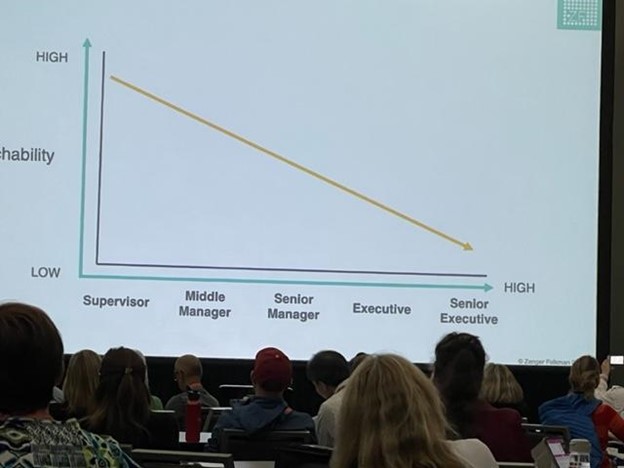
In one of the sessions at ATD ‘23 by Zenger Folkman, it was discussed that with more experienced leaders, coachability decreases. (Yes, that says “Coachability” on the left axis, my camera skills attest to capturing this during a live session!)  Senior leaders have been through a lot of training and I suggest the ELI assessment as a tool that could provide new insights into how they are leading today.  

In summary, embracing Energy Leadership can inspire peak performance from individual employees and transform the culture of organizations. A key element to Energy Leadership is that we are all leaders, every day, in every area of our lives. Energy Leadership can help individuals skillfully lead when interacting with others.

Further reading: Should I work with an Energy Leadership Coach?

Learn more at https://www.energyleadership.com/ or reach out to me at patriciacotter76@gmail.com or pcotter@mit.edu

When Entrepreneurship and Antifragility Collide

Think like an entrepreneur to cultivate creativity and innovation in your role.

As a learning and development (L&D) professional, you may not think of yourself as an entrepreneur, but embracing an entrepreneurial mindset can help you foster creativity and innovation in your organization. Understanding how you can encourage an antifragile approach to deal with internal forces as challenges arise within your company is essential. Connect that to how you show up in your job and how it affects both your own effectiveness as well as co-workers’ effectiveness.

What it is

The pursuit of entrepreneurship in the context of an existing organization is often called corporate entrepreneurship or intrapreneurship – whether it is a for-profit corporation, a not-for-profit organization, a government agency, or any other type of company.

Corporate entrepreneurship is a method used to develop new businesses, products, services, or processes inside of an existing organization to create value and generate new revenue growth through entrepreneurial thought and action. People who see themselves as corporate entrepreneurs are the engines of growth within a company; they are often corporate leaders or develop into leadership roles.

L&D professionals are well positioned to harness their intrinsic entrepreneurial skills to create value in their organizations given their roles entail working with both internal customers and a variety of other stakeholders. Further, the skills, knowledge, and ability L&D practitioners possess can help them solve corporate problems by thinking like an entrepreneur.

How it works

Here’s an example: The operations team at a small technology company in the data analytics space had a major problem – the startup competed against industry giants such as IBM. As the old saying goes, “Nobody ever got fired for buying IBM.” The team leader needed to figure out how the company could compete and get the attention of prospects to have them take the leap of faith to buy from a smaller, unproven vendor.

Operations team members assessed the skills, knowledge, and abilities in terms of how they could take an entrepreneurial approach to solve that problem. The team identified the company’s customers and their compelling needs. Because people were tired of waiting on hold and dealing with multiple customer service representatives who couldn’t solve their problems, the startup began taking a customer-centric approach. The team figured out that one way it could differentiate was by gearing all its operational decisions toward how to best serve the customer and provide an excellent customer experience.

The operations team simplified the process for the customer – from being able to always talk to a knowledgeable person to easy, one-page contracts – which helped the business succeed. As the company grew from a startup to a more established business, customers still valued and encouraged the founders’ entrepreneurial spirit and mindset. The happy ending to this story is that IBM acquired the company after seeing the value it provided to customers.

Guidelines

As corporate entrepreneurs start activating their ideas, they should aim small so that if they succeed, they can build on that success; if they miss, they may learn even more from that experience, which will help in the future.

Corporate entrepreneurs should also look to cultivate an antifragile mindset, a concept taken from Nassim Nicholas Taleb’s book Antifragile. His premise is that many things in life benefit from stress, disorder, volatility, and turmoil — they not only gain from chaos but need it to survive and flourish. To be antifragile, individuals must bend but be strong enough not to break.

In a talk by GE Ventures CEO Sue Siegel to entrepreneurs at the Massachusetts Institute of Technology, she said, “The pace of change today is the slowest it will ever be.” People with an entrepreneurial and antifragile mindset can prepare themselves and their organizations for rapid change and disruption. They get stronger in the face of adversity.

Results

The outcomes of corporate entrepreneurship will be evident once individuals start thinking like an entrepreneur and moving forward with this mindset, which opens up a world of possibilities – such as IBM acquiring your startup business. Set a vision and create a team of people with credibility and a good understanding of the problem you are trying to solve.

One of the biggest obstacles is overcoming initial inertia. The do-nothing strategy tends to be easier for corporate employees than embracing change. To combat this, align yourself with employees who have a compelling reason to change, and educate them on how the new product or service or way of doing things will address their problem.

As Netflix co-founder Marc Randolph, states, “If you are unwilling to disrupt your business, there will always be someone willing to do it for you.” Demonstrate that you are able to stand in the storm and provide leadership as a change agent for your organization.

Checklist

  • What is the problem you are trying to solve? What benefits will it deliver to your customers?
  • Define the problem, quantify it. Can you do primary market research with open-ended questions to validate your hypothesis?
  • Come up with solutions. Does your solution solve a compelling need? Does it make monetary sense?
  • De-risk your solutions. How can these solutions be adopted by your prospects with a low risk to them?
  • Identify a team to help. Success is more likely when you are backed by a team. Entrepreneurship is not a solo sport!

Resources

Disciplined Entrepreneurship,Bill Aulet

Antifragile, Nassim Nicholas Taleb

An Introduction to Start-up Accelerators Around the World, Trish Cotter

Personal Branding and Marketing Yourself, Rita Balian Allen

About the authors

Patricia “Trish” Cotter is an entrepreneurship consultant and coach as well as a past director of MIT’s delta v student venture accelerator program;  patriciacotter76@gmail.com.

Rita Balian Allen is an executive coach focused on leadership development, management training and career development; rita@ritaballenassociates.com.

Note: This article is the property of ATD. It was published August 1, 2023 in TD Magazine:
https://www.td.org/magazines/td-magazine/when-entrepreneurship-and-antifragility-collide