
The Second Lieutenant Advantage: Embracing Collaboration in Entrepreneurship

Not everyone aspires to be the leader. Some individuals find genuine fulfillment in supporting their teams — stepping into the limelight when necessary, and gracefully stepping back when it’s time for others to shine. In the fast-paced world of entrepreneurship, where the prevailing stereotype often emphasizes the leader persona, there is immense value in fostering a collaborative environment where everyone’s contributions are recognized.

The Happiness in the Shadows

For some, the limelight can be daunting. I, for one, appreciate having my moments but find satisfaction in letting others take center stage. It’s not about avoiding responsibility or lacking ambition; it’s about finding happiness, acceptance, and humility in being part of a team where everyone’s efforts contribute to the collective success.

When I watched the CBS News video, “Sidemen, Backups, and Understudies: Playing in the Shadows,” it really resonated with me. I encourage you to take a few minutes and watch it. The segment features Mark Rivera, Billy Joel’s sideman and saxophone player; retired baseball catcher Erik Kratz, who spent 11 seasons with 14 different major league organizations; and Kayla Pecchioni, a Broadway understudy who often steps into the shoes of the star. These professionals play in the background or are called up when the stars aren’t available — and they all embrace their position as #2.

These very accomplished individuals understand the importance of their role and talent and a humility that allows them to shine even when they’re not number one. One thing that stood out to me was their “team first” attitude. They work just as hard as the superstars to be the best that they can be for the team.

Rivera explains he’s been the frontman, and he feels he has a much better gig now. Katz comments that the lesson is about finding contentment built on a foundation of humility and gratitude. While Pecchioni talks about looking for glimmers and being appreciative of the everyday. While we may not know their names, these team players help ensure their organizations are successful.

The Desire to Belong

In today’s entrepreneurial landscape, people are increasingly seeking to be part of something bigger than themselves. While not everyone can, or wants to, assume a leadership role, we are more dependent than ever on individuals who can step up when needed. However, it’s crucial to do a better job of recognizing and appreciating these contributors beyond just the top leadership echelon.

Entrepreneur magazine advises how leaders can foster a sense of belonging in the workplace, and how this helps employees feel free to be their authentic, true selves, which makes it easier to show up, engage with others, create solutions, and perform well.

In a study cited in the article, a high sense of belonging among employees was strongly linked with a 56% increase in job performance, a 50% decrease in risk of leaving, and a 75% reduction in sick days. For a company of 10,000 people, this could mean annual savings of more than $52 million.

Social belonging is a fundamental need. Entrepreneurial leaders need to remind themselves that the hard-working team members who may be playing in the shadows need to feel included, and as leaders, they should proactively create a workplace of belonging for everyone.

Creating a Culture of Recognition

Not everyone can be a general; not everyone can be a second lieutenant. However, everyone can be recognized for their unique contributions. The key lies in acknowledging the diverse roles within a team and ensuring that each person’s efforts are valued.

When I worked as the executive director of MIT’s Martin Trust Center for Entrepreneurship, I was involved in almost every aspect of the Trust Center and the delta v accelerator, which is the capstone entrepreneurial experience for students at MIT. However, although I was not the face of theCenter or the program, I was the “glue” that held it together. For me, this was a role I preferred, and it gave me the opportunity to make the team and the delta v program shine.

I also played a similar “second lieutenant” role at startups that I helped to grow. I realized that providing direction and support, and letting others lead when necessary, yielded better results than anyone had projected.

Being “on” all the time can be exhausting for some of us. By surrounding ourselves with a collaborative team, we not only get to experience our moments of success but also share in the success of others. This sense of camaraderie builds a strong team spirit and reinforces the notion that everyone is supported. However, the leaders in the organization must recognize all the behind-the-scenes people that are essential to their success.

Balancing Ambition and Contentment to Gain a Sense of Fulfillment

Many individuals today seek better balance in their lives. It’s not a lack of ambition or a fear of challenges; rather, it’s a conscious choice to find happiness in what they do and contribute to a collaborative effort. Recognizing and motivating teams is now more critical than ever, especially in a hybrid work environment where face-to-face workplace connections are not as strong since daily interactions may be limited.

A sense of fulfillment at work goes beyond a mere paycheck. It’s about having the opportunity to step into the limelight, share achievements with the team, and then step back and continue contributing. A culture of mutual respect, where individuals rotate in and out of the spotlight, fosters a positive and supportive work environment.

Another interesting perspective is to look at how different generations view leadership and management positions. According to an article in Business Insider, many Gen Zers are saying “no thanks” to promotions because they feel that doing more work to get promoted is not worth the pay or the accompanying stress.

Work-life balance has become a bigger part of the conversation for this newest generation in the workforce, and bosses need to think about what other incentives might entice Gen Z (born from 1997 onward). Meaningful work, career development, mentorship, transparency, caring leadership, and an entrepreneurial culture are all factors that may motivate Gen Zers more than a bigger paycheck or a promotion.

In any generation, embracing the concept of allowing oneself to learn from others is pivotal. Observing and enabling the growth of team members allows for collective progress. It’s about moving away from the notion that everyone should constantly be climbing the corporate ladder and, instead, recognizing the potential for growth within the existing environment.

Conclusion

In the ever-evolving landscape of entrepreneurship, it’s time to break free from the misconception that success is synonymous with leadership. The strength of being a second lieutenant lies in recognizing the power of collaboration, appreciating diverse contributions, and fostering a culture where everyone can shine. In the hybrid world of work, where connections are not as visible, creating an environment that values every individual’s role is not just a strategic move; it’s a necessity for sustained success.

How Are You Showing Up? A Primer on Energy Leadership

You bring your unique energy to how you show up each day – at home, at work, and generally in life.

This is especially important for leaders – both entrepreneurs running startups and managers leading teams in corporate enterprises. As a leader, you knowingly or unknowingly influence others, and this presents the opportunity to inspire and motivate your team.

This article will focus on Energy Leadership™, a concept I discussed in my presentation at the Association of Talent Development’s ATD ’23 conference on how to Think Like an Entrepreneur and Foster Creativity in Your Organization.

When you show up with your best energy, you can encourage your team to recognize and harness their own energy, feel a greater sense of purpose, and get more done with much less effort and stress. So, let’s delve into more detail on Energy Leadership.

Energy Leadership

“Energy is contagious; either you affect people or infect people,” says bestselling author and businessman, T. Harv Eker. When you realize how many people you interact with each day, you begin to realize how powerful your personal energy is.

The interesting thing about energy is that it can be both anabolic and catabolic. Both energy levels serve you daily, depending upon your lived experiences. Here is a brief overview of each:

  • Anabolic energy is associated with a constructive buildup force and less stress. With anabolic energy, it is easier to focus on solutions and tap creativity and experience for a complete and conscious view of situations. People have more access to this energy, with less judgment and less fear about themselves or situations – anabolic energy is essentially constructive, fueling, healing, and growth oriented. A leader with anabolic energy is collaborative, fuels creativity and productivity.
  • Catabolic energy, on the other hand, tends to distract you and pull your focus away from what you are doing. It is typically draining, resisting, and contracting energy. Yet, it serves the important purpose of self-protection, especially when experiencing uncomfortable situations. A leader with catabolic energy can use this energy in a time crunch or dangerous situations to address a particular situation. However, catabolic energy can be depleting and stress levels raised so the longer term effects are not positive. Think of it as being in continual fight or flight mode. 

In practice, a catabolic leader and anabolic leader may look like the following:

Neither type of energy is good nor bad, but an ambidextrous leader can adapt to the situation to create a better result.

The first step is to understand your personal Energy Leadership profile. This is done through an attitudinal assessment and can be used as a starting point to uncover how your energy can be harnessed to reach your goals and help you to lead more effectively.

So, how do you assess your current Energy Leadership?

The Energy Leadership Index (ELI) assessment tool, developed by the Institute for Professional Excellence in Coaching (iPEC) measures your unique energy profile. Through a series of 84 questions, the ELI reveals the percentage of each energy level you experience under normal circumstances and how your energy manifests under stress.

The 7 Levels of Energy

There are seven energy levels, each with a thought, emotion, and action attached.   Daily, you may operate on just a couple of levels or many, but this tool focuses on understanding where you are. 

Your individual results of the ELI assessment come in a sample like the chart below. This represents your average energy presentation under normal circumstances and under stress.

Everyone has a different ELI, which uniquely reflects their lived experiences. Through the debrief with an ELI Practitioner, you bring an awareness of how you show up. In the debrief, you go through your particular energy levels and find experiences that serve you well and others that do not. The tool’s power is recognizing your level and the ability to change the level and gain a better experience. The ELI tool, which can be used with individuals or teams, has a low entry bar, and it could pay significant dividends for leaders.

New Working Styles Benefit from Energy Leadership

The new normal of remote, hybrid, and in-person working styles has brought challenges for leaders. We are currently at a crossroads where workers value the flexibility of work from home options, but in many companies, management is dictating a return to the office, or hybrid approach. This puts a lot of pressure on team leaders. As mentioned in a previous blog post, speaker, author, and facilitator Priya Parker talks about gathering with intention for meetings (or classes), along with bringing an energy that meets the needs of the situation. If you are responsible for gathering and communicating with your team, consider your intention and your energy; the benefits could be significant.

How skillfully can you lead daily? An Energy Leadership approach will identify where you can adjust to having more experiences that better serve you and your clients, and it extends beyond the realm of work to your family and loved ones as well.

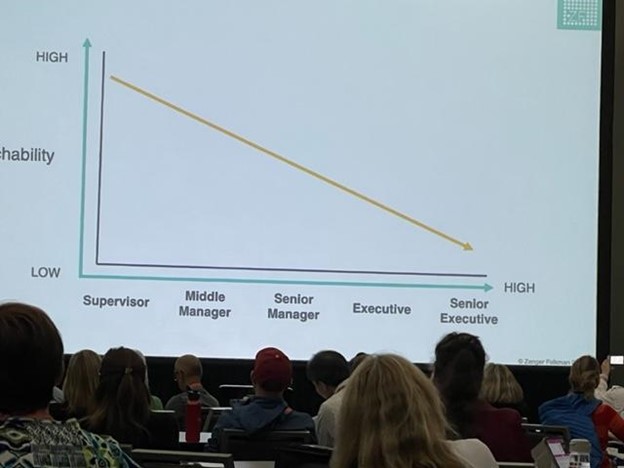
In one of the sessions at ATD ‘23 by Zenger Folkman, it was discussed that with more experienced leaders, coachability decreases. (Yes, that says “Coachability” on the left axis, my camera skills attest to capturing this during a live session!)  Senior leaders have been through a lot of training and I suggest the ELI assessment as a tool that could provide new insights into how they are leading today.  

In summary, embracing Energy Leadership can inspire peak performance from individual employees and transform the culture of organizations. A key element to Energy Leadership is that we are all leaders, every day, in every area of our lives. Energy Leadership can help individuals skillfully lead when interacting with others.

Further reading: Should I work with an Energy Leadership Coach?

Learn more at https://www.energyleadership.com/ or reach out to me at patriciacotter76@gmail.com or pcotter@mit.edu

When Entrepreneurship and Antifragility Collide

Think like an entrepreneur to cultivate creativity and innovation in your role.

As a learning and development (L&D) professional, you may not think of yourself as an entrepreneur, but embracing an entrepreneurial mindset can help you foster creativity and innovation in your organization. Understanding how you can encourage an antifragile approach to deal with internal forces as challenges arise within your company is essential. Connect that to how you show up in your job and how it affects both your own effectiveness as well as co-workers’ effectiveness.

What it is

The pursuit of entrepreneurship in the context of an existing organization is often called corporate entrepreneurship or intrapreneurship – whether it is a for-profit corporation, a not-for-profit organization, a government agency, or any other type of company.

Corporate entrepreneurship is a method used to develop new businesses, products, services, or processes inside of an existing organization to create value and generate new revenue growth through entrepreneurial thought and action. People who see themselves as corporate entrepreneurs are the engines of growth within a company; they are often corporate leaders or develop into leadership roles.

L&D professionals are well positioned to harness their intrinsic entrepreneurial skills to create value in their organizations given their roles entail working with both internal customers and a variety of other stakeholders. Further, the skills, knowledge, and ability L&D practitioners possess can help them solve corporate problems by thinking like an entrepreneur.

How it works

Here’s an example: The operations team at a small technology company in the data analytics space had a major problem – the startup competed against industry giants such as IBM. As the old saying goes, “Nobody ever got fired for buying IBM.” The team leader needed to figure out how the company could compete and get the attention of prospects to have them take the leap of faith to buy from a smaller, unproven vendor.

Operations team members assessed the skills, knowledge, and abilities in terms of how they could take an entrepreneurial approach to solve that problem. The team identified the company’s customers and their compelling needs. Because people were tired of waiting on hold and dealing with multiple customer service representatives who couldn’t solve their problems, the startup began taking a customer-centric approach. The team figured out that one way it could differentiate was by gearing all its operational decisions toward how to best serve the customer and provide an excellent customer experience.

The operations team simplified the process for the customer – from being able to always talk to a knowledgeable person to easy, one-page contracts – which helped the business succeed. As the company grew from a startup to a more established business, customers still valued and encouraged the founders’ entrepreneurial spirit and mindset. The happy ending to this story is that IBM acquired the company after seeing the value it provided to customers.

Guidelines

As corporate entrepreneurs start activating their ideas, they should aim small so that if they succeed, they can build on that success; if they miss, they may learn even more from that experience, which will help in the future.

Corporate entrepreneurs should also look to cultivate an antifragile mindset, a concept taken from Nassim Nicholas Taleb’s book Antifragile. His premise is that many things in life benefit from stress, disorder, volatility, and turmoil — they not only gain from chaos but need it to survive and flourish. To be antifragile, individuals must bend but be strong enough not to break.

In a talk by GE Ventures CEO Sue Siegel to entrepreneurs at the Massachusetts Institute of Technology, she said, “The pace of change today is the slowest it will ever be.” People with an entrepreneurial and antifragile mindset can prepare themselves and their organizations for rapid change and disruption. They get stronger in the face of adversity.

Results

The outcomes of corporate entrepreneurship will be evident once individuals start thinking like an entrepreneur and moving forward with this mindset, which opens up a world of possibilities – such as IBM acquiring your startup business. Set a vision and create a team of people with credibility and a good understanding of the problem you are trying to solve.

One of the biggest obstacles is overcoming initial inertia. The do-nothing strategy tends to be easier for corporate employees than embracing change. To combat this, align yourself with employees who have a compelling reason to change, and educate them on how the new product or service or way of doing things will address their problem.

As Netflix co-founder Marc Randolph, states, “If you are unwilling to disrupt your business, there will always be someone willing to do it for you.” Demonstrate that you are able to stand in the storm and provide leadership as a change agent for your organization.

Checklist

  • What is the problem you are trying to solve? What benefits will it deliver to your customers?
  • Define the problem, quantify it. Can you do primary market research with open-ended questions to validate your hypothesis?
  • Come up with solutions. Does your solution solve a compelling need? Does it make monetary sense?
  • De-risk your solutions. How can these solutions be adopted by your prospects with a low risk to them?
  • Identify a team to help. Success is more likely when you are backed by a team. Entrepreneurship is not a solo sport!

Resources

Disciplined Entrepreneurship,Bill Aulet

Antifragile, Nassim Nicholas Taleb

An Introduction to Start-up Accelerators Around the World, Trish Cotter

Personal Branding and Marketing Yourself, Rita Balian Allen

About the authors

Patricia “Trish” Cotter is an entrepreneurship consultant and coach as well as a past director of MIT’s delta v student venture accelerator program;  patriciacotter76@gmail.com.

Rita Balian Allen is an executive coach focused on leadership development, management training and career development; rita@ritaballenassociates.com.

Note: This article is the property of ATD. It was published August 1, 2023 in TD Magazine:
https://www.td.org/magazines/td-magazine/when-entrepreneurship-and-antifragility-collide