September 12 is Demo Day at MIT!

Demo Day 2015 It’s like the first day of school jitters magnified a thousand times … MIT’s Demo Day is coming September 12th!

What is Demo Day?

Demo Day is an event put on by the MIT Global Founders’ Skills Accelerator (MIT GFSA) and will showcase passionate and talented entrepreneurs at MIT and their innovative, potentially world-changing, companies.

On Demo Day, each of the groups that have been working in the accelerator will present their company to a live audience. As an Entrepreneur in Residence at MIT, this is my first time guiding students through the process, and we’ve certainly had an exciting summer. Some of the challenges the teams faced were moving from a concept to a real plan for a product or service, defining their beachhead market, determining costs and pricing, and figuring out how to clearly and succinctly present their ideas to the board.

Who will be presenting?

We can’t reveal the companies or their concepts until September 12th, but innovative ideas will be presented by 14 fantastic teams – with inspirations that cover everything from fitness to farming to fertilization. To whet your appetite, here’s a recap of inspiring startups from last year’s Demo Day.

As the premier university student accelerator in the world, the MIT GFSA provides a capstone educational opportunity for MIT student entrepreneurs and prepares them to hit “escape velocity” and launch their companies into the real world. We hope you can join us for this amazing event.

Yes, you can attend!

This event is open to the public! Last year, over a thousand people gathered to see the latest innovative companies presented.

Join us in the heart of MIT under the dome in 10-250. (Overflow space will be available where the presentations will be live streamed.) Demo Day is free; but, you do need to register in advance. Come and encourage our next generation of entrepreneurs in Boston! You can also watch the live stream from your computers. And, after the Boston event, we’re on to New York and San Francisco … I’ll keep you posted!

MIT Global Founders

Are you a Disciplined Entrepreneur?

Picture1_croppedAs some of my loyal blog readers know, I’ve recently started a new position as Entrepreneur-in-Residence at the Martin Trust Center for MIT Entrepreneurship.

I’m thrilled to have joined this incredible program at MIT, and have met some wonderful people, including the Center’s Managing Director Bill Aulet. Bill is also the author of a book called “Disciplined Entrepreneurship: 24 Steps to a Successful Startup.” I’ve enjoyed reading it and thought I would share some of the highlights.

In my mind, “disciplined” and “entrepreneur” – are two words that are seemingly in juxtaposition. Most of us think of entrepreneurs as brilliant people with lots of ideas flying around in their heads and innate entrepreneurial talent. We think that they get lucky – or, are at the right place at the right time – when they actually launch a business based on one of these ideas.

In his book, Bill asserts that entrepreneurship can be taught, and that intelligent, hardworking people can become successful entrepreneurs by following a systematic, disciplined approach to starting a new company.

The book is structured around six themes, and the 24 steps mentioned in the title each fall into one of these themes:

  • Who is your customer?
  • What can you do for your customer?
  • How does your customer acquire your product?
  • How do you make money off your product?
  • How do you design and build your product?
  • How do you scale your business?

Bill points out that while following the sequential steps, entrepreneurs will undoubtedly learn new information that will take you back to revise what you’ve done in previous steps. The graphic showing the steps is a wonderful curvy path with “go back” arrows reminiscent of the game Candy Land. This shows me that that wacky, yet brilliant entrepreneur is in there somewhere! Yet, I love that the steps give structure to the process of launching your own business.

I also really embrace the idea Bill sets forth in his book that “ideas mean nothing without execution.” If there was one nugget of advice that I would share with entrepreneurs, this would be it.

As an entrepreneur myself, I value the examples in every chapter, drawn from projects that Bill has worked on with MIT students. Bill uses these real-life examples to guides those with ideas, new technologies, or passion into channeling that energy into a viable business.

At MIT, I am currently taking 14 student-founder teams through the disciplined entrepreneur process in a program called Global Founders Skills Accelerator (GFSA) … I will let you know how it goes!

Does our Education System Benefit from Data-driven Decision Making?

THE Journal cover story on

THE Journal cover story on “The Power of Small Data”

Big data is everywhere. You may not expect it to impact how decisions are made in a kindergarten classroom, but big data and analytics are becoming more deeply engrained in the education system – even at the youngest grade levels

A recent article in THE Journal on “The Power of Small Data” asserts that in order to deliver personalized education, districts have to gather and share students’ statistics. The article goes on to explain how the strategic use of data can boost teaching and learning.

The author was kind enough to reach out to me to provide some context for this article. My dissertation for my doctorate in work-based learning at the University of Pennsylvania focused on “Analytics by Degree: The Dilemmas of Big Data Analytics in Lasting University/Corporate Partnerships.” I was able to share my insights in higher education, and also discuss how big data has a major impact on school systems at every level.

Here are some excerpts from the article, along with some of my additional thoughts and research on the topic:

I am seeing a renaissance in data collection in the education field, supported by new tools and technologies. “Recent technologies like big data, the Internet of Things, mobile apps and improved storage have made it possible to acquire, combine, store, analyze, interpret and report findings during any phase of data management.”

“The data repositories residing in disconnected, fragmented departments with little sharing have now been transformed into centralized, interrelated data systems to enable fast and efficient retrieval of interrelated data for quick and informed decision-making.”

However, leadership, based solely on data, will not be successful. Educational systems need to involve key players in the community, particularly the educators themselves, to listen and ascertain what is needed most.

As the article points out, analytics can have many positive uses in the school system, including:

  • Instant Feedback for Students and Parents
  • Formative Assessments that Help Students Grow
  • Using Data to Connect people

However, sadly sometimes educators are spending so much time gathering data (and posting it) that there is little time for instruction. We need to think of how technology, data collection and the onus on high test scores impacts our next generation.

“Data is not the problem. The problem is getting the data to the right people so it can be used…. Data only tells part of the story, and a lot of it is basic so it doesn’t provide the insights that teachers and schools need to pinpoint teaching and learning problems and identify the best ways to solve them.”

We need to ensure that the educators are involved in determining what is needed in terms of useful data, and that a balance is achieved between gathering and analyzing data and effectively teaching our students.

I encourage you to read the full article to learn more.

Colleges and T-Shaped Training: Build it and They Will Learn?

Though the idea of T-shaped management is gaining traction on American campuses, there are some important roadblocks along the way. Some of those roadblocks are ivy covered. In some ways, the relationship between colleges and major tech corporations is beginning to look a bit like ju jitsu. Ju jitsu, roughly translated, means that when you get pushed, pull, and when you get pulled, push.

fieldofdreamscorn-400In principle, most business colleges clearly want better partnerships with major corporations. Most colleges accept the importance of using business analytics, T-shaping their students, and embrace change when it comes to education, at least in concept. In reality, however, change seems to move at a glacial pace in the halls of higher learning.

In 2011, the president of New York University observed that monumental change in America was something “people love to talk about,” while also referring to universities as islands of stability in that sea of change: “(W)e should not lose sight of the fact that, of the 80 institutions that existed 500 years ago and still do, 75 are universities.”

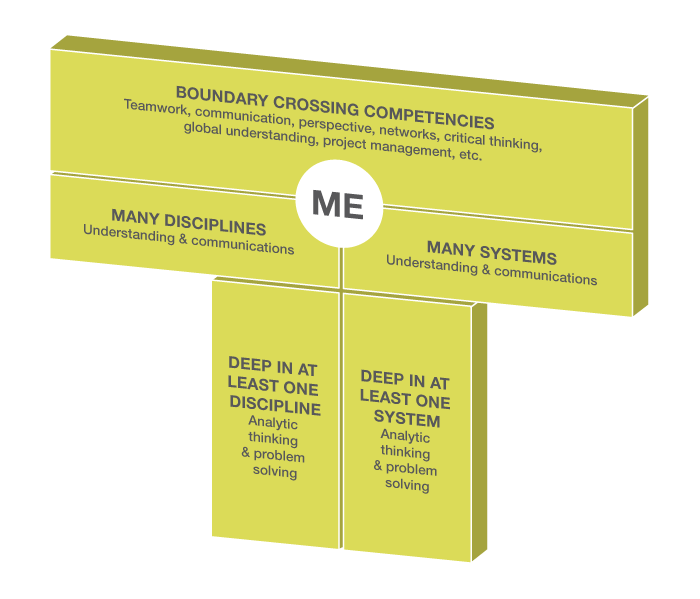
And while NYU’s president praised university longevity, he also said that academia continued to do some things badly, in the same old way, over and over again. Specifically, he noted universities still hadn’t come to grips with T-shaping their learning: “One thing the proprietary institutions do that is not a good thing is delivering an ‘I-shaped’ education (depth in one area) as opposed to a ‘T-shaped’ education (broad learning, with depth in one area).”

Academic resistance to T-shaped training often seems to be over matters of control, and fears about giving it up. It is true that the enormous potential influence of corporate technology giants, who are donating massive sums of money and expecting nothing less than drastic changes in what universities teach, cannot be overlooked.

The “Gates Effect”

While Bill and Melinda Gates are not the only major influence on university reforms, they are big enough to have a gravitational effect. In the context of their almost $500 million in donations to universities, this is to be expected. In a July, 2013 article, The Chronicle of Higher Education (which has also received Gates Foundation support) noted that the bulk of these donations (over $300 million) have come in since 2008. That’s a lot of money. And a lot of influence.

One example of how the Gates Effect is transforming the future of college education is seen in a sprawling ConAgra plant in Troy, Ohio. Employees there are participating in an Gates-funded program that awards college credits — not for conventional course work — but for mastering “core competencies.”

Working through the University of Southern New Hampshire and taking online course work, students are assessed in such areas as “logic, reasoning, and analysis,” which help the student solve real-world business problems.

Everyone seems to like the potential of this approach: except for entrenched college executives.

“Build it and they will learn”

In the movie Field of Dreams, the apparently crazy idea of turning a cornfield into a baseball field is justified based on the mantra, “Build it, and they will come.” The threat to American competitiveness, in terms of highly desirable T-shaped employee skills, is that there is a whole lot of T-building going on — elsewhere in the world. Until recently, Poland’s national education system was widely perceived as falling apart, regarded as suitable only for low-trained, low-tech, and low-paying jobs. This view changed with the successful adoption of innovative T-shaped education strategies there.

Interestingly enough, critics of the Gates approach have claimed the Gates Foundation is approaching the “problem” as something that “engineering” can measure (through technical algorithms) and fix . Yet the Gates Foundation seems to be hewing very closely to the Polish model of making T-shaped students. We know through example that it works. Confusing the necessity for a better, T-shaped core curriculum with the need to accurately measure that curriculum is confusing cause and effect.

The lesson for America from Poland is the benefit of every college developing a core curriculum that leverages that specific institution’s unique offerings in such a way to develop T-shaped skills. The shift from a traditional, “I” shaped curriculum to a T-shaped one is very much in evidence in what the Gates Foundation has done with the Southern University of New Hampshire. Whether crossing that “I” to get a “T” will happen in the next decade or not may rest on the influence of a new era of outside-the-box, dotcom entrepreneurs. Will it be enough for the U.S. to compete globally? Or will it be too little, too late? We shall see.

Innovating Education for Tomorrow: Some Takeways from #TSummit2014

One college president believes that the way to solve the education crisis lies not in the classroom, but within “innovation zones” that encourage experimentation and invite the prospect of failure as a pathway to success. That’s not something you hear every day among academics, is it?

what-is-t

The panelist spoke at IBM/Michigan State University #tsummit2014, held at IBM’s research center in Aladmen, California, which I had the pleasure of attending this year. Over 200 business leaders and higher education institutions attended to discuss skills for the 21st century.

A variety of thought-provoking panels, speakers and discussions made for an informative and entertaining conference. The focus was not on meeting today’s employment demands (a popular topic of discussion among parents and in the media), but on a longer-term view of producing students for the global economy of the future.

One of the event’s panels, which consisted of college presidents, provided for a lively, candid discussion on what is needed to prepare students for the economy of tomorrow. They all seemed to agree that education’s center of gravity will be outside the classroom, not in it.

One of the presidents described his vision of an “array of high impact learning experiences that are not defined exclusively by traditional measures or approaches.” As the president pointed out, we now have content available in formats “that don’t require it to be written in scrolls.” How best to take advantage of this?

According another panelist, there are only about 200 institutions in the U.S. today that reject more students than they accept. The vast majority of institutions are aggressively competing for students, and many of these students are not as well prepared for school as we would like them to be. To add to the problem, he said, there are now roughly 40 million American adults with some college credits, no degree and often a lot of debt. “This is a “debilitating trifecta,” he said. “You’ve got none of the things that we hold out as a promise.”

Despite the conventional wisdom, all in higher education are not merely whistling and twiddling their thumbs when it comes to confronting these important challenges. Some promising developments are under way. One is so the College for America Program at Southern New Hampshire University. Approved by the Department of Education in 2013, this is the first degree program in the country that is competency-base, offering a degree based not on credit hours or courses, but on direct assessment of student learning – a profound change.

SNHU President Paul LeBlanc said the program was inspired in part by Muhammad Yunus, a social entrepreneur who was awarded the Nobel Peace Prize for founding the Grameen Bank and pioneering the concepts of microcredit and microfinance.

In an interview for 60 Minutes, Yunus was asked how he came up with the idea of the bank. According to LeBlanc, “He said, I thought about what big banks do and I thought what would happen if I did the opposite. They lend to men. I’ll lend to women. They make you come to the bank. I’ll go out to the village. They only want to lend big amounts of money. I loan little amounts of money. They want a lot of interest. I’ll take a little. They require collateral. I won’t take any and I’m not and changed banking in a developing world.”

LeBlanc wondered what would happen if they asked the same sort of outside-the-box questions at SHNU. “Rather than using the credit hour in which time is fixed and learning is the variable, what if we could flip that? What if the university changed the business model? What if we went to a mentoring model? What if we could find other resource than text box for materials? What about the length of class?” The result was the College for America.

If a new hire can articulate and demonstrate their skills and knowledge through presentations, analysis and collaboration, is the end result a better predictor for success on the job than a high GPA? Time will tell, but we will need to follow up on the University of Pennsylvania Health Systems, Partners Healthcare System in Massachusetts, ConAgra Food and Dunkin Donuts, as all have signed on to support the College for America program.

Another college president made the point that we need a “different kind of innovator” now and in the future, one who understands complexity, a concept he said is completely overlooked in conventional engineering programs. A narrow, focused, nose-to-the-grindstone view of the world has resulted in countless innovations in the past, he said, but also countless unintended consequences. Climate change, for example.

T-shaped education is part of the solution, the president said, enabling students to span a variety of disciplines and have conversations with people in very different places right from the start. It’s easier to learn how to do that – to talk to people who are disciplinary experts in different fields — when you are young than it is when you are in mid-career, just as it’s easier to learn how speak Spanish if you’re five than when you’re 45. Students are “wet cement” when they’re young. So we need to consider educating within the T-shaped paradigm earlier, rather than later, he maintained.

Innovation isn’t just about thinking: it’s about doing

Another panelist defined innovation as the process of generating original ideas and insights that have value and then implementing them in a way that changes many peoples’ lives. Without implementation, he said, it’s not an innovation. It’s just a cool idea. A genuinely profound innovation is an innovation that changes the world so dramatically that you can’t remember what it was like before it happened. Electricity, the automobile, the airplane, the Internet, radio, and television are all such examples. They had an impact not merely because they were great ideas, but because people used them.

Last year, the president said, the percentage of bachelor’s degrees in the U.S. that were awarded to students studying engineering in any university – 4.5 percent, a declining market share. In Europe it’s about 12 percent. In Asia it’s about 30 percent. What are we going to do in ten years when the U.S. number drops to, say, one percent? In addition, the number of students who find what we define as “engineering attractive” is not great, he said. About half of all students who begin studying engineering last fall won’t graduate in engineering – a big hole in the pipeline. In addition, only 18 percent of the students who graduate in engineering are women, another big gap.

His university’s definition of an engineer is a person who envisions what has never been and does whatever it takes to make it happen. So how do we create great engineers? We have to change three things, according to this panelist. Who we teach in engineering – we’re teaching the wrong people. There are creative people out there. Have you heard of folks like Steve Jobs? Bill Gates? Creative people who started down the engineering path, and left. Why? Because the way we teach stifles creativity instead of encouraging it, he said. In addition, what we teach has to change, and how we teach it has to change. We’re using methods that are known to be fundamentally ineffective. “Otherwise,” he concluded, “we’re doing a great job.”