Gen Z Entrepreneurship: Influencing or Innovating?

As we move deeper into the 21st century, Generation Z is emerging as a force to be reckoned with in the world of entrepreneurship. Born between the late 1990s and early 2010s, Gen Zers are redefining the future of work, balancing traditional jobs with side hustles, and actively building their own businesses.

The Rise of the Creator Economy

One of the key elements of Gen Z entrepreneurship is the rise of the creator economy. Influencers and content creators have become a dominant force, leveraging their online presence to build successful businesses. CBS News reports that 86% of young Americans aspire to become social media influencers, to as it offers earning potential far beyond traditional paths.

Kylie Jenner, for example, became the youngest self-made billionaire thanks to her successful beauty brand, Kylie Cosmetics. Gen Z entrepreneurs understand the importance of authenticity and have cultivated strong relationships with their audiences, providing them with a unique advantage when building businesses.

Gen Z’s affinity for the digital world is a driving force behind their success. They are digital natives who have grown up with social media, which allows them to easily navigate the online landscape. This has helped them build personal brands and monetize their influence through partnerships, sponsored content, and merchandise sales – The Social Standard and Go Daddy both share profiles of Gen Z entrepreneurs who have made it big as influencers and creators.

However, in my view, being an influencer alone is not enough to create real innovation. I believe the focus on personal branding and the rapid pace of content creation is limiting the depth of exploration into entrepreneurial ventures that address pressing global challenges.

What Sets Gen Z Apart?

Gen Z views entrepreneurship differently than past generations. For one thing, the entrepreneurial landscape has changed, with lower barriers to entry for starting a business, and different views on what is important. Business Insider discusses some of these differences, including:

  • Ease of Starting a Business: Thanks to accessible technology and platforms like Shopify, starting a business has never been easier. What once took months and significant capital to launch can now be accomplished in a matter of days.
  • Data-Driven Decision-Making: Gen Z entrepreneurs utilize data analysis tools to make informed decisions about their businesses. This helps them streamline operations and focus on the big picture.
  • Personal Branding: The concept of personal branding is a strategic necessity for many of this generation’s startups. Gen Zers understand the importance of building a strong personal brand to attract opportunities and partnerships.
  • Acceptance of Differences: Gen Z values inclusivity and diversity, which informs their approach to business and innovation.
  • Kinder, More Socially Responsible Entrepreneurs: Gen Z entrepreneurs are concerned about social issues, the environment, and helping their communities.

The Side Hustle becomes a Necessity

While Gen Z entrepreneurs have numerous advantages, they also face challenges. Many young people juggle multiple side hustles due to financial pressures and the desire for control over their time. This can lead to burnout and the need for balance.

In today’s economy, many Gen Zers feel that a side hustle is necessary for their generation to afford the lifestyle that their parents have attained. Data from the Bureau of Labor Statistics shows that the number of people working multiple full-time jobs has trended up in recent years and hit an all-time high in August 2022, with Gen Z leading the way. A survey by Paychex found that about half of Gen Z are employed at two or more places, as compared with other generations.

Deloitte’s 2022 Gen Z and Millennial Survey found that a third of Gen Z respondents worry about the cost of living above all other concerns, 45% live paycheck-to-paycheck, and more than a quarter said they doubt they’ll retire comfortably. And a Freddie Mac survey found that about 34% of responding Gen Zers said they didn’t think they’d ever be able to afford to buy a house.

Often the side hustle becomes a main hustle, creating necessity-based entrepreneurs versus innovation-based entrepreneurs. In fact, McKinsey postulates that in this economy—in which Gen Z faces higher-than-average inflation, student debt, credit card debt, and high housing costs—Gen Zers are actually looking for nothing more than relatively stable paychecks (rather than chasing the side hustle).

Can Gen Z Change the World?

The big question remains: Can Gen Z entrepreneurs change the world? If the current trends continue, Gen Z’s pursuit of entrepreneurship could lead to tremendous growth and innovation. They have the potential to create disruptor-type companies that challenge traditional industries and bring fresh perspectives to long-standing problems.

However, business failure rates remain high with 50% of small businesses failing within five years according to the Small Business Administration, and not all ventures will succeed. Nevertheless, Gen Z’s ability to adapt, innovate, and leverage digital tools gives them a fighting chance.

Let’s look at the type of innovative ideas that are coming out of places like MIT, and how these startup success stories can influence the upcoming generation of entrepreneurs.

Innovation-based Startups

In my former role as the Executive Director of MIT’s Martin Trust Center for Entrepreneurship, I was very fortunate to work closely with some of the smartest young entrepreneurs in the world.

I saw firsthand how innovation-based startups can succeed with access to proven frameworks, mentorship, and resources that support building impactful ventures. By guiding students from ideation to execution, the center helps transform groundbreaking ideas into successful startups that can address significant global challenges.

Here are a few of the innovation-based startups that I personally worked with as they made their way through delta v – MIT’s capstone program for entrepreneurship.

  • Biobot Analytics analyzes sewage with molecular technologies and AI to provide early warning of population health threats across the globe.
  • Podimetrics develops medical technologies such as the SmartMat, which helps monitor foot health in diabetic patients to prevent complications like foot ulcers.
  • Ori has invented an entirely new type of apartment—one that radically improves the resident experience in smaller spaces by using sophisticated engineering and design.
  • Infinite Cooling’s mission is to develop the cooling tower of the future. They help industrial plants have safer, more reliable, and more sustainable cooling towers by optimizing thermal performance and eliminating cooling tower plumes.​
  • Bloomer Tech focuses on developing smart wearable technology specifically designed for women’s health, such as bras with embedded sensors to monitor heart health.

Innovation-based startups focus on solving significant global challenges through advanced technology and research. These startups prioritize creating groundbreaking solutions to complex problems in health, environment, and other critical fields.

In contrast, entrepreneurial ventures centered around influencers and content creators often revolve around personal branding and monetizing online presence through partnerships and merchandise sales. While both types of entrepreneurship involve creativity and a desire to succeed, innovation-based startups typically involve deep research and development, long-term planning, venture capital fundraising, and a focus on sustainable impact, whereas influencer ventures are often more focused on immediate audience engagement and revenue generation.

As we look to the future, one thing is clear: Generation Z is not content with the status quo. They are ready to take on the world. And, although not every entrepreneur can attend programs like those offered at MIT, I urge today’s generation of entrepreneurs to aim high. Use the resources you have – whether it is taking classes, reading books and articles, finding a mentor, or working with an entrepreneurship coach – and use this information to explore the difference you can make in the world.


The Second Lieutenant Advantage: Embracing Collaboration in Entrepreneurship

Not everyone aspires to be the leader. Some individuals find genuine fulfillment in supporting their teams — stepping into the limelight when necessary, and gracefully stepping back when it’s time for others to shine. In the fast-paced world of entrepreneurship, where the prevailing stereotype often emphasizes the leader persona, there is immense value in fostering a collaborative environment where everyone’s contributions are recognized.

The Happiness in the Shadows

For some, the limelight can be daunting. I, for one, appreciate having my moments but find satisfaction in letting others take center stage. It’s not about avoiding responsibility or lacking ambition; it’s about finding happiness, acceptance, and humility in being part of a team where everyone’s efforts contribute to the collective success.

When I watched the CBS News video, “Sidemen, Backups, and Understudies: Playing in the Shadows,” it really resonated with me. I encourage you to take a few minutes and watch it. The segment features Mark Rivera, Billy Joel’s sideman and saxophone player; retired baseball catcher Erik Kratz, who spent 11 seasons with 14 different major league organizations; and Kayla Pecchioni, a Broadway understudy who often steps into the shoes of the star. These professionals play in the background or are called up when the stars aren’t available — and they all embrace their position as #2.

These very accomplished individuals understand the importance of their role and talent and a humility that allows them to shine even when they’re not number one. One thing that stood out to me was their “team first” attitude. They work just as hard as the superstars to be the best that they can be for the team.

Rivera explains he’s been the frontman, and he feels he has a much better gig now. Katz comments that the lesson is about finding contentment built on a foundation of humility and gratitude. While Pecchioni talks about looking for glimmers and being appreciative of the everyday. While we may not know their names, these team players help ensure their organizations are successful.

The Desire to Belong

In today’s entrepreneurial landscape, people are increasingly seeking to be part of something bigger than themselves. While not everyone can, or wants to, assume a leadership role, we are more dependent than ever on individuals who can step up when needed. However, it’s crucial to do a better job of recognizing and appreciating these contributors beyond just the top leadership echelon.

Entrepreneur magazine advises how leaders can foster a sense of belonging in the workplace, and how this helps employees feel free to be their authentic, true selves, which makes it easier to show up, engage with others, create solutions, and perform well.

In a study cited in the article, a high sense of belonging among employees was strongly linked with a 56% increase in job performance, a 50% decrease in risk of leaving, and a 75% reduction in sick days. For a company of 10,000 people, this could mean annual savings of more than $52 million.

Social belonging is a fundamental need. Entrepreneurial leaders need to remind themselves that the hard-working team members who may be playing in the shadows need to feel included, and as leaders, they should proactively create a workplace of belonging for everyone.

Creating a Culture of Recognition

Not everyone can be a general; not everyone can be a second lieutenant. However, everyone can be recognized for their unique contributions. The key lies in acknowledging the diverse roles within a team and ensuring that each person’s efforts are valued.

When I worked as the executive director of MIT’s Martin Trust Center for Entrepreneurship, I was involved in almost every aspect of the Trust Center and the delta v accelerator, which is the capstone entrepreneurial experience for students at MIT. However, although I was not the face of theCenter or the program, I was the “glue” that held it together. For me, this was a role I preferred, and it gave me the opportunity to make the team and the delta v program shine.

I also played a similar “second lieutenant” role at startups that I helped to grow. I realized that providing direction and support, and letting others lead when necessary, yielded better results than anyone had projected.

Being “on” all the time can be exhausting for some of us. By surrounding ourselves with a collaborative team, we not only get to experience our moments of success but also share in the success of others. This sense of camaraderie builds a strong team spirit and reinforces the notion that everyone is supported. However, the leaders in the organization must recognize all the behind-the-scenes people that are essential to their success.

Balancing Ambition and Contentment to Gain a Sense of Fulfillment

Many individuals today seek better balance in their lives. It’s not a lack of ambition or a fear of challenges; rather, it’s a conscious choice to find happiness in what they do and contribute to a collaborative effort. Recognizing and motivating teams is now more critical than ever, especially in a hybrid work environment where face-to-face workplace connections are not as strong since daily interactions may be limited.

A sense of fulfillment at work goes beyond a mere paycheck. It’s about having the opportunity to step into the limelight, share achievements with the team, and then step back and continue contributing. A culture of mutual respect, where individuals rotate in and out of the spotlight, fosters a positive and supportive work environment.

Another interesting perspective is to look at how different generations view leadership and management positions. According to an article in Business Insider, many Gen Zers are saying “no thanks” to promotions because they feel that doing more work to get promoted is not worth the pay or the accompanying stress.

Work-life balance has become a bigger part of the conversation for this newest generation in the workforce, and bosses need to think about what other incentives might entice Gen Z (born from 1997 onward). Meaningful work, career development, mentorship, transparency, caring leadership, and an entrepreneurial culture are all factors that may motivate Gen Zers more than a bigger paycheck or a promotion.

In any generation, embracing the concept of allowing oneself to learn from others is pivotal. Observing and enabling the growth of team members allows for collective progress. It’s about moving away from the notion that everyone should constantly be climbing the corporate ladder and, instead, recognizing the potential for growth within the existing environment.

Conclusion

In the ever-evolving landscape of entrepreneurship, it’s time to break free from the misconception that success is synonymous with leadership. The strength of being a second lieutenant lies in recognizing the power of collaboration, appreciating diverse contributions, and fostering a culture where everyone can shine. In the hybrid world of work, where connections are not as visible, creating an environment that values every individual’s role is not just a strategic move; it’s a necessity for sustained success.

Entrepreneurship 2020: A Look Ahead

Heading into a new decade is a time for both reflection and predictions. What have we learned about entrepreneurship? And what do we see as trends moving forward?

2019 marked the tenth summer that MIT’s Martin Trust Center has hosted an accelerator and the eighth year of our formal MIT delta v program. I’ve had the pleasure of leading delta v for the past five years, and I’ve seen tremendous growth during that time. The summer-long bootcamp works with entrepreneurs who enter with an idea for their business and progress to product creation and new venture launch. The program is based on the Disciplined Entrepreneurship framework with the philosophy that entrepreneurship can be taught; you don’t have to be born an entrepreneur.

A Decade of Success at MIT’s delta v Accelerator

We’ve studied the path of the companies coming out of delta v; as of January 2018, 101 teams made up of 316 students had taken part, and a full 75% of these startups were either still in business or had been acquired – far above the average for new ventures. These delta v alumni companies employ more than 500 workers across the globe, and 25% of our teams have ten or more employees. According to figures on Crunchbase, as of November 2019, delta v teams have raised more than $215 million from 375+ investments. One-third of the companies raised at least $1M+, and six teams have exceeded $10M+ in funding rounds.

In the words of one of our board members, Max Faingezicht, “delta v is a driving force of the entrepreneurial ecosystem where you mix talent with motivation to go out and change the world.”

So, what changes do we anticipate in the next decade of entrepreneurship? Some of the broader trends we see are ones reflected in delta v.

A Rise in Women Entrepreneurs is Impacting the Economy

It is a fact that women entrepreneurs are driving economic growth. According to an article in Forbes on 10 Stats that Build the Case for Investing in Women-Led Startups, women were the sole or majority owners of an estimated 12.3 million U.S. businesses at the beginning of 2018, and are starting businesses at a rate of more than 1,800 per day. The number of women-owned companies is growing at a faster rate than all businesses and women of color are driving this. In addition, companies founded by women deliver higher revenue – more than 2 times as much per dollar invested – than those founded by men.  

Four out of every ten businesses in the U.S. are owned by women, according to The Women’s Business Enterprise National Council (WBENC). These businesses tend to be smaller in terms of revenue and employment. In fact, 88% of women-owned businesses generate less than $100,000 in annual revenue, while 1.7% generated more than $1 million in revenue – although both segments are growing.

At MIT’s delta v we see more women taking leadership roles in the startups. With each cohort, we strive for diverse gender and ethnic backgrounds plus a worldwide perspective, and we proactively aim to neutralize gender bias for entrepreneurs. Diverse teams offer a tremendous benefit in terms of networking and help each other solve challenges, supporting our philosophy that diversity fuels innovation. We’ve also seen that the rate of our successful women-led startups is even higher than the delta v average.

Mentorship Lays the Foundation for Entrepreneurial Success

An article in VentureBeat explains that people with access to a mentor are five times more likely to be interested in starting a business than those without a mentor. Mentorship is linked with business success, and business owners who receive three-plus hours of counseling report higher revenues and employment growth rates. The article also states nearly half of women entrepreneurs say one of the top challenges they face is finding a mentor who can direct them to the resources and organizations that can help them launch their businesses. 

At delta v, our Entrepreneurs-in-Residence and board members are built-in mentors for our student teams. Both bring resources and experience to guide the new entrepreneurs on their journey. We also encourage student entrepreneurs to find their voice. This requires mentees to speak up and be active participants in the process. They need to own their narrative, identify what is of value to them, and speak up to find a mentor or sponsor and make that relationship fruitful.

Gen Z’s Vision of Entrepreneurship

Although we work with a lot of Millennials in delta v, it’s interesting to keep an eye on the upcoming generation of entrepreneurs. (Pew Research considers anyone born between 1981 and 1996 a Millennial, and anyone born from 1997 onward is part of Generation Z.)

Gen Z has different priorities and different frames of reference than the entrepreneurs who preceded them. Amazon’s next-day delivery has always been a thing for them. They never went to Blockbuster to rent a movie and social media permeates their lives. As a result, internet-based business models are second nature; “Uberize” is even a verb used to describe a business model. Entrepreneur states that 41% of Gen Z-ers plan to become entrepreneurs.

Interestingly, Millennials are less likely to become entrepreneurs, according to a study from the U.S. Small Business Administration. It revealed that fewer than 4 percent of 30-year-olds are actively engaged in entrepreneurship, compared with 5.4 percent of Generation X-ers and 6.7 percent of Baby Boomers who were entrepreneurs at the same age. Coming of age during a time of recession and burdened with student debt, many Millennials turned to side gigs to make money. I explored the gig economy in my Xconomy article on Necessity vs. Innovation-based Entrepreneurs. Interestingly, necessity entrepreneurship is strongly counter-cyclical – that is, recessions drive necessity-based entrepreneurs to start their businesses.

As each new generation makes its way in the world, it is fascinating to see how they view entrepreneurship and the new types of businesses they create.

What’s Ahead for delta v?

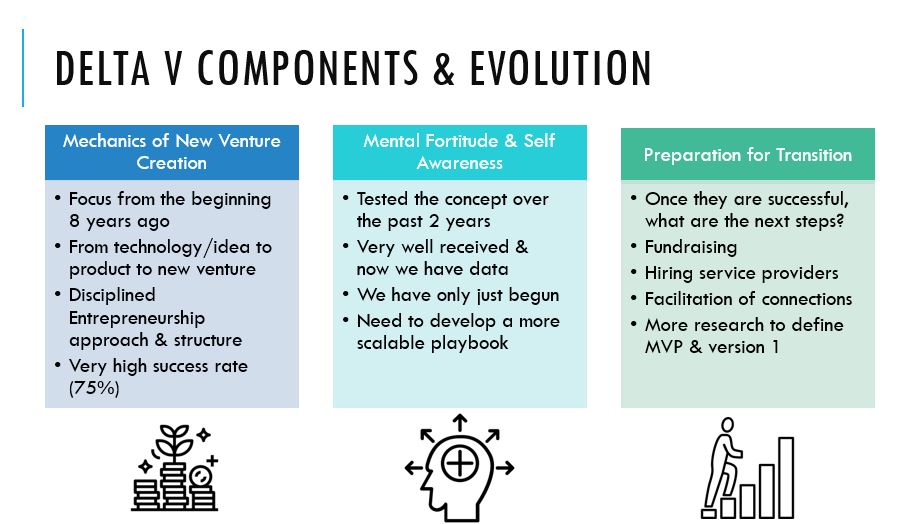
With the data we have gathered on the delta v teams over the past decade, one of our next steps is to develop a more scalable playbook so that we can extend our reach even further. At MIT, we rely on observations, research, and experimentation. Our motto, mens et manus (which translates from Latin to “mind and hand”), is present in everything we do. In entrepreneurship classes and programs, this approach is vital. Our students don’t automatically have a higher success rate; they learn the fundamentals of becoming an entrepreneur hands-on. At the Martin Trust Center, we have integrated the mechanics of new venture creation in curriculum, programming, community support, and we have validated them on a world stage.

As the collective knowledge of entrepreneurship improves, we continue to move forward to meet the needs of the entire entrepreneur. However, like any discovery, it takes several experiments and iterations to fully understand aspects of the problem you are trying to solve. We realize that mental fortitude and self-awareness are crucial to moving forward and are implementing some exciting new programming in this area.

As we prepare to lead entrepreneurs into the next decade, there are some “big rocks” to address. We need to prepare students for financial discussions and mental stamina for the funding process. We need to focus on establishing a culture and nurturing it, supported by our team. A business reflects the character of the founding and growing team, so the journey starts with an individual and builds to a long-term game.