A Customized Learning Opportunity: Coaching in Executive Education

Coaching, in general, is best for those who are truly invested in transformation. When coaching is integrated into executive education programs, it can provide a premium and personalized experience that bridges the gap between theoretical concepts and practical application. Over the last few weeks, I have been coaching in a few of MIT Sloan’s Executive Education Programs.  And although coaching is not built into every executive education program, when personalized coaching is offered, it can provide a customized learning opportunity that guides participants on how to apply what they are learning to their own unique situation. This process not only enhances retention but also empowers executives to implement changes in their organizations with confidence.

For instance, a participant in an executive education program might work with a coach to develop a plan for implementing a new organizational change model after an in-class presentation.  The coach helps them tailor the model to their specific context, considering factors like company culture and team dynamics. This personalized guidance ensures that when the executive returns to work, they have a concrete, actionable plan ready to execute. Coaching also plays a crucial role in addressing specific challenges executives face in their roles. Whether it’s navigating team conflicts, finding their leadership voice, or developing new strategies, individualized support from a coach can make a significant difference. It’s about acquiring skills for the future and moving on to the next challenge with confidence and clarity.

I have participated in executive education programs at MIT, Northeastern, Babson, Harvard Business School, and the University of Pennsylvania that have profoundly impacted my skills and knowledge. My experience with these programs has taught me the value of technology, culture, leadership skills, and team dynamics. Each course has provided new tools and perspectives that I have applied to my work, constantly striving for personal and professional growth. Throughout my career, I have seen firsthand the transformative power of executive education, and in my current role coaching senior executives and entrepreneurs at MIT, I’ve experienced how a coaching element in executive education strengthens the entire program.

The Executive Coaching Experience

At its core, executive education is designed to equip leaders with the skills, knowledge, and insights necessary to navigate complex business challenges. Individuals and companies alike seek out these programs for various reasons—whether it’s to stay ahead of industry trends, prepare for organizational changes, or simply to gain a competitive edge. But beyond the curriculum and the esteemed faculty, I believe the real transformative power of executive education often lies in the coaching component.

Here are some real-world reactions I’ve encountered when coaching executives, and how I’ve been able to work with participants to help them gain value from the coaching experience:

  •  “You have my DISC and 360 Assessment [self-awareness tools used in coaching]. Tell me where I need to improve.” 
    When a participant approaches coaching like this, my response is that coaching is all about showing up with a critical eye for yourself and improving your performance overall. No coach can tell you exactly what you need to do, but coaching can help you unlock areas where you can grow as a leader.
  • “What I am learning in the classroom is great, but what I really need is help figuring out what I do next because the current situation at work is not working.” 
    This is where coaching can shine. When an executive realizes they can reinforce their classroom experience with customized work that applies to their specific situation, they are two steps ahead and can more effectively integrate their learnings into their organization.
  • “I am taking the class, and I don’t see anyone of my level that I can connect with.”
    Hearing this type of comment makes me think that an executive was recommended to the program and may not have made the decision to attend themselves. They have some work to do on their leadership style, and I would encourage a participant like this to be more open to what they can learn from others, as well as offering their expertise for others to learn from them. 

Coaching has been proven as an effective support mechanism for learning. Research indicates that traditional training methods are often insufficient for long-term retention and application of new knowledge.  However, active learning approaches, which include coaching, can dramatically improve retention. A 2022 study revealed that active learners retained 93.5% of information after one month, compared to 79% for passive learners. This underscores the importance of incorporating active learning strategies, such as coaching, into executive education.

Conclusion

Within the MIT Sloan Executive Education programs and my own coaching practice, I see the impact of coaching every day. Participants emerge from programs and coaching not just with new knowledge, but with a renewed sense of purpose and the confidence to tackle their most pressing challenges. The one-on-one aspect of coaching, combined with the collaborative team projects, creates a rich, engaging learning environment that truly transforms these leaders.

As we continue to navigate an increasingly complex business landscape, the role of coaching, whether in executive education, in corporations, or through self-discovery becomes more impactful.  By providing personalized support and fostering an environment of active learning, coaching helps executives retain and apply new knowledge, and drives meaningful change within their organizations. It’s an investment in the future success of these leaders and the success of their companies.

In addition to coaching for MIT Sloan’s Executive Education programs, I also provide one-on-one leadership and entrepreneurship coaching for individuals. If you are interested in learning more, please contact me at Patricia Cotter patriciacotter76@gmail.com.

From Caps and Gowns to Startups: The Rising Trend of New Grads Choosing Entrepreneurship

We’re in the midst of graduation season—a time of excitement and anticipation as students leave behind the classroom and start to shape their futures. One trend I’m seeing is that new college graduates are investigating options for entrepreneurship directly out of college, before committing to full-time corporate roles.

A recent HBR article confirms what I’ve seen. It cites a Global University Entrepreneurial Spirit Students’ Survey (GUESSS) of 267,000 undergraduate and graduate students that revealed around 11% of students already own and run businesses. At least 18% of students wished to become entrepreneurs right after graduation and another 32% expressed interest in transitioning into entrepreneurship within five years of their graduation. The study also shows that investments in early-stage startups have increased from $72.8 billion in 2017 to $208 billion in 2021.

If you’ve ever had an idea to start your own business, it might be an ideal time to pursue that passion (especially, while you are still used to living on ramen as you work on getting funding!). Consider this period of your life as an opportunity to explore and to see if entrepreneurship is a viable option for you. At a time when there is so much chaos in the world, doing your own thing can give you back control.

This summer, I’ll be teaching at an entrepreneurship program designed by Dalhousie and the University of Calgary called Lab2Market Launch.  This 12-week summer accelerator brings together members of the entrepreneurial ecosystem from across Canada to turn ideas into viable businesses. In the past, I served as the Director of MIT’s delta v accelerator program, another summer program which is the capstone entrepreneurship experience for MIT students – both are excellent programs to help propel entrepreneurs. And along with these formal programs, there are a host of resources for people who want to explore entrepreneurship – check out this post about thriving as an entrepreneur, and see the links at the end.

As new graduates increasingly turn to entrepreneurship, the landscape of post-graduation career choices is rapidly evolving. This trend has been bolstered by a combination of technological advancements, changing economic conditions, and a growing desire for personal fulfillment and flexibility in career paths. Many prospective entrepreneurs are driven by the appeal of launching startups that align with their passions and the promise of greater autonomy compared to traditional corporate jobs.

Entrepreneurship Advice for New Graduates

For new graduates, exploring entrepreneurship offers several advantages. It provides a hands-on learning experience that can be more dynamic and varied than the structured environment of a corporate job. Starting a business can also foster critical skills such as resilience, problem-solving, and leadership.

However, it is crucial to recognize the challenges, particularly in securing funding. To gain an overview of the types of funding available, check out this article on 8 sources of start-up financing. Traditional funding avenues might be less accessible for entrepreneurs who are just starting out, prompting graduates to explore alternative sources like crowdfunding, government grants, incubator, and startup accelerator programs.

Members of Forbes’ Young Entrepreneur Council, also share their experiences and some solid advice in this Forbes article, including:

  • Create a business plan
  • Hustle and network in order to succeed
  • Picture your business like a workhorse
  • Listen to what your customers need
  • Focus on a niche market
  • Talk to those who have done it
  • Ask how you can help
  • Think long term
  • Ditch perfectionism
  • Invest in yourself

Not surprisingly, several of these pieces of advice align with the 24-steps to a successful startup that we teach at MIT with the Disciplined Entrepreneurship approach (you can read a short overview here), or check out the newly updated Disciplined Entrepreneurship book and the new Startup Tactics book by MIT’s Bill Aulet and Paul Cheek.

Impact of Mentors, Coaches, and Educators on Entrepreneurs

One thing I would stress is to make sure that you establish a strong connection with a mentor or coach – someone who can help keep you on track and provide support and guidance during your entrepreneurial journey. Established entrepreneurs can play a pivotal role by mentoring new graduates, offering insights and resources to navigate the complexities of starting a business. Coaches can help inspire you to achieve peak performance. As a certified Energy Leadership coach, I coach entrepreneurs on how they can harness their own unique energy and become a better leader. Having that mentor or coach who is separate from the day-to-day workings of your startup is a wonderful way to gain perspective as an entrepreneur.

In addition – for those who are still in school – educators are increasingly adapting their curricula to emphasize entrepreneurial skills, such as innovation, digital literacy, and strategic thinking. Incorporating real-world projects and case studies can bridge the gap between theoretical knowledge and practical application, better preparing students for entrepreneurial endeavors. Today, there are more than 5,000 entrepreneurship courses are offered in two-year and four-year institutions, according to the Kauffman Foundation, and more than 150 institutions in the U.S. allow students to major in entrepreneurship, according to Best Colleges. This is more than triple the number from two decades ago.

My Perspective

As someone deeply embedded in the entrepreneurial ecosystem, I see this shift towards entrepreneurship as an immediate path after graduation as both a challenge and an opportunity. The influx of young, innovative minds into entrepreneurship can drive significant advancements across various industries. However, it is vital to provide the right support systems to ensure their success. Mentorship programs, comprehensive entrepreneurship education, and access to diverse funding options are essential components of this support.

Moreover, fostering a mindset that embraces failure as a learning opportunity is crucial. New graduates should be encouraged to take calculated risks, understanding that setbacks are part of the entrepreneurial journey. This perspective not only builds resilience but also fosters a culture of continuous improvement and innovation.

Conclusion

The trend of new graduates exploring entrepreneurship before starting corporate jobs may signify a shift in career trajectories and workplace dynamics. By supporting these budding entrepreneurs through mentorship and coaching, education, and access to resources, we can harness their potential to drive innovation and economic growth. As educators, entrepreneurs, and thought leaders, it is our responsibility to guide and nurture this new generation, helping them navigate the challenges and seize the opportunities that lie ahead.

If you are interested in learning more about coaching sessions for entrepreneurs, please reach out at patriciacotter76@gmail.com.

How Are You Showing Up? A Primer on Energy Leadership

You bring your unique energy to how you show up each day – at home, at work, and generally in life.

This is especially important for leaders – both entrepreneurs running startups and managers leading teams in corporate enterprises. As a leader, you knowingly or unknowingly influence others, and this presents the opportunity to inspire and motivate your team.

This article will focus on Energy Leadership™, a concept I discussed in my presentation at the Association of Talent Development’s ATD ’23 conference on how to Think Like an Entrepreneur and Foster Creativity in Your Organization.

When you show up with your best energy, you can encourage your team to recognize and harness their own energy, feel a greater sense of purpose, and get more done with much less effort and stress. So, let’s delve into more detail on Energy Leadership.

Energy Leadership

“Energy is contagious; either you affect people or infect people,” says bestselling author and businessman, T. Harv Eker. When you realize how many people you interact with each day, you begin to realize how powerful your personal energy is.

The interesting thing about energy is that it can be both anabolic and catabolic. Both energy levels serve you daily, depending upon your lived experiences. Here is a brief overview of each:

  • Anabolic energy is associated with a constructive buildup force and less stress. With anabolic energy, it is easier to focus on solutions and tap creativity and experience for a complete and conscious view of situations. People have more access to this energy, with less judgment and less fear about themselves or situations – anabolic energy is essentially constructive, fueling, healing, and growth oriented. A leader with anabolic energy is collaborative, fuels creativity and productivity.
  • Catabolic energy, on the other hand, tends to distract you and pull your focus away from what you are doing. It is typically draining, resisting, and contracting energy. Yet, it serves the important purpose of self-protection, especially when experiencing uncomfortable situations. A leader with catabolic energy can use this energy in a time crunch or dangerous situations to address a particular situation. However, catabolic energy can be depleting and stress levels raised so the longer term effects are not positive. Think of it as being in continual fight or flight mode. 

In practice, a catabolic leader and anabolic leader may look like the following:

Neither type of energy is good nor bad, but an ambidextrous leader can adapt to the situation to create a better result.

The first step is to understand your personal Energy Leadership profile. This is done through an attitudinal assessment and can be used as a starting point to uncover how your energy can be harnessed to reach your goals and help you to lead more effectively.

So, how do you assess your current Energy Leadership?

The Energy Leadership Index (ELI) assessment tool, developed by the Institute for Professional Excellence in Coaching (iPEC) measures your unique energy profile. Through a series of 84 questions, the ELI reveals the percentage of each energy level you experience under normal circumstances and how your energy manifests under stress.

The 7 Levels of Energy

There are seven energy levels, each with a thought, emotion, and action attached.   Daily, you may operate on just a couple of levels or many, but this tool focuses on understanding where you are. 

Your individual results of the ELI assessment come in a sample like the chart below. This represents your average energy presentation under normal circumstances and under stress.

Everyone has a different ELI, which uniquely reflects their lived experiences. Through the debrief with an ELI Practitioner, you bring an awareness of how you show up. In the debrief, you go through your particular energy levels and find experiences that serve you well and others that do not. The tool’s power is recognizing your level and the ability to change the level and gain a better experience. The ELI tool, which can be used with individuals or teams, has a low entry bar, and it could pay significant dividends for leaders.

New Working Styles Benefit from Energy Leadership

The new normal of remote, hybrid, and in-person working styles has brought challenges for leaders. We are currently at a crossroads where workers value the flexibility of work from home options, but in many companies, management is dictating a return to the office, or hybrid approach. This puts a lot of pressure on team leaders. As mentioned in a previous blog post, speaker, author, and facilitator Priya Parker talks about gathering with intention for meetings (or classes), along with bringing an energy that meets the needs of the situation. If you are responsible for gathering and communicating with your team, consider your intention and your energy; the benefits could be significant.

How skillfully can you lead daily? An Energy Leadership approach will identify where you can adjust to having more experiences that better serve you and your clients, and it extends beyond the realm of work to your family and loved ones as well.

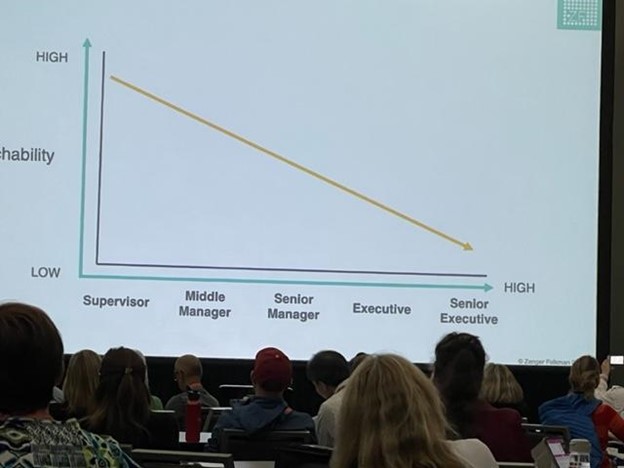
In one of the sessions at ATD ‘23 by Zenger Folkman, it was discussed that with more experienced leaders, coachability decreases. (Yes, that says “Coachability” on the left axis, my camera skills attest to capturing this during a live session!)  Senior leaders have been through a lot of training and I suggest the ELI assessment as a tool that could provide new insights into how they are leading today.  

In summary, embracing Energy Leadership can inspire peak performance from individual employees and transform the culture of organizations. A key element to Energy Leadership is that we are all leaders, every day, in every area of our lives. Energy Leadership can help individuals skillfully lead when interacting with others.

Further reading: Should I work with an Energy Leadership Coach?

Learn more at https://www.energyleadership.com/ or reach out to me at patriciacotter76@gmail.com or pcotter@mit.edu

In the face of Massive Layoffs, why should I work with an Energy Leadership Coach?

People in today’s workforce face stress – and lots of it. Layoffs, quiet quitting, a general sense of pandemic fatigue, and recessionary pressures are hitting all of us.

For corporate leaders, this stress is multiplied. Leaders are dealing with teams that are unmotivated and exhausted. In some organizations, leaders need to cut positions and continue to drive the business forward with fewer resources. Paradoxically, in other companies, there are open positions that are difficult to fill, and existing team members are stretched thin.

Burnout is real, and whether your company is primarily working from home, returning to the office, or trying a hybrid model these days – you are likely facing challenges and trying to figure out what works best. (Of course, some industries such as healthcare never had the option to work from home and the stress of these workplaces can be off the charts.)

What can we do about it? This article is about Energy Leadership™ and how you can use your energy to show up every day as your best self.

What is Energy Leadership?

Your life experiences significantly impact how you perceive things. This affects your energy in different situations. Although you may not be aware of it, you may be realizing less than your full potential at work, at home, or in social situations. 

Energy Leadership refers to both a particular and unique form of leadership, and to the process of leading energy so that it works for you, rather than against you. By learning and applying the principles and concepts of Energy Leadership, you can increase your ability to shift your own energy and the energy of those around you. When you do that, you will help inspire and motivate yourself and others, feel a greater sense of purpose, get more done with much less effort and stress, and constantly attract positive and powerful people and success to you.

If you manage people, an entire team, or a whole organization, your responsibility – and ability to influence the energy of that group – grows. Every interaction presents the opportunity to lead and have a positive impact on others. You not only need to show up with your best energy, but you need to motivate your team to recognize and harness their own energy.

That’s where Energy Leadership Coaching comes in.

How is Energy Leadership Coaching Different from Other Types of Coaching?

Many people are familiar with an executive coach, a career coach, or a life coach – Energy Leadership Coaching is different from all of these, yet it can help you with each of these aspects of your life.

Energy Leadership Coaching begins with an Energy Leadership Index (ELI) assessment, which applies a numerical value to the types of energy you experience in different situations.  It is not a personality test; it is an attitudinal assessment.  We use this assessment as a starting point, and coaching helps you identify where you believe you would like to spend more of your energy to gain the results you want.

You can work with a certified Energy Leadership coach, like me, with over 300 hours of coaching through iPEC, the Institute for Professional Excellence in Coaching. This will help uncover your unique energetic profile and your energetic stress reaction, and how they can be harnessed to reach your specific goals and potentially shift awareness and mindset.

What Types of Energy May be Affecting Me?

You lead with your energy. Everyone has a unique level of energy due to lived experiences. Whether you are a corporate leader or not, your energy is how you lead and influence your friends, family, and colleagues. Everyone has the potential to positively or negatively affect those around them.

As an overview, there are two main types of energy: anabolic and catabolic. Anabolic is typically thought of as constructive, fueling, healing, and growth-oriented energy. Catabolic is typically thought of as draining, resisting, and contracting energy, yet catabolic energy can be helpful for focusing and protecting us when experiencing uncomfortable situations.

Both types of energy serve a powerful purpose. And you determine how to use each type of energy appropriately, either with a thought or mindset, emotion, action, or inaction.

Who Benefits Most from Energy Leadership Coaching?

Anyone who wants insight into where they are spending their energy can benefit from Energy Leadership coaching. It can help you find areas where you can do more of what you want to do and develop strategies to improve energy-zapping situations. 

 Why is this Especially Well-Suited for Corporate Leaders and their Teams?

Executives have developed patterns over time and are often frustrated by certain situations without understanding why. Energy Leadership helps bring issues to the forefront to let you make changes if necessary. How you show up matters and all of the people you interact with – whether employees or family or friends – look at your actions more than your words.  With Energy Leadership coaching, you can identify patterns and learn to model your actions to best harness your energy.  

Can Energy Leadership Help to Build Better Relationships with Remote Teams?

Connections are so key, particularly in a remote situation. Leaders need to consider how they show up to their employees. Are your employees just listening to video calls on mute and not interacting? Are new employees feeling connected to the organization and their teams?  You can create an atmosphere of learning, risk-taking, and opportunities with a foundation of trust and creativity. However, you must understand what motivates you and your employees. 

Improving team dynamics so there is accountability and understanding can significantly improve performance – whether in a remote, in-person, or hybrid situation.  A manager or executive who feels there are barriers in the way of the organization’s creativity and communication can use Energy Leadership to improve interactions. Any time individuals or teams can better understand what is getting in the way of success – and fix the issue — results in a win for everyone involved.

What are the Takeaways?

Energy Leadership can profoundly change your leadership style. It helps you to become more self-aware and realize what messages you are sending, and how you can change this dynamic or shift your leadership style to bring out the best in your team.

Interested in learning more about Energy Leadership Coaching?

Send me an email and I’d be happy to share more information.

Regaining my Footing

We take a lot of things for granted in this life … like walking.

Last winter I had some pretty extensive foot surgery. Sure, I expected some recovery time, but it was longer and involved more rehabilitation than I had counted on – I essentially needed to learn to walk again after being in a cast, and then a boot for three months.

Although this isn’t the heroic story of someone who learns to walk again after losing a limb or being in a severe accident, it certainly was humbling for me. This setback made me reflect on how, in life, sometimes you need to stop, assess, and start again from the beginning. When you can’t walk, it is certainly a wake-up call – and you put yourself in the hands of experts.

 At some point in our lives, we all need to reach out for help and lean on other people (sometimes literally!). Taking those “baby steps” again as I re-learned the basics of balance, stability, and moving my body in the correct way made me think of the parallels to coaching. The physical shifts and the mental shifts involved mirror each other.

In my energy coaching practice, I am the one telling others to start at the beginning, work from the ground up, and lean on me for support. Just like my physical therapists, I am trying to help people get from one place to another. It’s not always easy, and often, it takes a lot of hard work over a period of time to get there.

I am now through the worst of it and walking several miles each day. I’ve realized the surgery and all the physical therapy were worth the end result. Here are the lessons I’ll try to hold on to and embed in my coaching practice:

  • Don’t take things for granted. Easy to say … hard to do. Be grateful for what you have and try not to be resentful when you no longer have those things.
  • It’s OK to start all over again. We are all starting from different places, and sometimes you need to regroup and go back to square one.
  • You will get discouraged. And angry. And furious. It’s natural to get discouraged but remember you are learning and perfecting the process.
  • Reach out for help. What resources do you have? Although it might not be in your nature, take stock of the people or organizations that are there to help and lean on them. When you lose hope, those folks can help lift you to the next milestone.
  • Take baby steps. It’s natural to want to hurry up and do all the things necessary to get better. But sometimes slow is good. If you can trust your guide (therapist/coach/mentor), learning each new step can end in a better result.
  • Be realistic. Be realistic with yourself that change is going to take time. Also be realistic about the milestones that will get you there.
  • Gain new perspectives. Sitting on the sidelines gives you a new appreciation, and also time to look at things with fresh eyes.  Shifting your perspective may help you understand situations better
  • Be aware of your blind spots. Sometimes you don’t see the bumps in the road that may trip you up. When reassessing your goals, try to be consciously aware of your blind spots. Believe me, I have a new appreciation of physical accessibility issues, something that I had not considered much in the past.
  • Keep your skills current. This is always a good practice, but my forced slow-down gave me a chance to do some research and work on some new skills as I was recuperating.
  • Just keep swimming. As Dory tells Nemo, in Finding Nemo, “just keep swimming” or walking! Try to make forward progress each day. . Keep moving and you will regain strength, whether it is physical or mental.

Life may throw us curveballs, but we need to gain wisdom and knowledge from those experiences in order to forge ahead.

Taking a Well-Deserved Break … and What I’ve Learned

Recently, I left my job at MIT, and I don’t have another job. As the Executive Director of the Martin Trust Center for MIT Entrepreneurship, my days (and many nights) were filled with activity – working with students, teaching, and shaping entrepreneurship education programs. All that has stopped, and I’ve taken time to be still, breathe, take stock, and think.

This time of reflection is providing me a much clearer view of what is possible—and realizing the big picture is even bigger than I thought. Quitting your job is not for everyone (and I am very fortunate that I’m in a position where I could do that), however, taking time to make room for other activities is something I highly recommend to everyone. Creating space to see that there are other opportunities, different ways to work, new skills to learn, and passions to embrace is enlightening. (My new passion is tennis! Who knew?)

I have had three acts thus far in my career. I held roles from engineer to executive in tech companies. Then, as an entrepreneur, I navigated two startups through to IPOs, and my third act was a career in academia teaching entrepreneurship in the classroom and through hands-on programs. Each transition had its moments where I said, “What did I get myself into?!” Yet, digging in and being open to learning proved to be rewarding in every case. I’ve had great rides with successful companies, enjoyed relationships with diverse and interesting colleagues, and embarked on learning experiences I could never have imagined. I have traveled the world, thrived in new environments, and have seen colleagues soar and cheered on their success. I’ve learned so much about people and how they think, work, celebrate, and come back from setbacks. It makes you realize that the people you work with truly can make or break any job experience.

As someone with many, varied job experiences, I’ve realized that experience is double-edged sword. On the one hand, you know how to do things, and perhaps you have even forgotten what others have not yet learned. However, experience also can leave you in a lane you know too well and prevent you from taking the risk of trying—and potentially failing—at new skills. When you are starting fresh, you know there will be new risks, new failures, and new experiences.

I am extremely fortunate to have enjoyed every job I’ve had, but I do realize my enjoyment of work is dependent on my own attitude and approach. Approaching each new role as a learning experience helps you get over the hurdles and enjoy the successes. I’ve worked with folks who had deep expertise but lacked some of the skills I have, and we ended up being a terrific team. I am fortunate to have friends from my very first job and from my most recent job, and I make a concerted effort to keep in touch with these people. My network—and talent tree—is something that was built organically with people I enjoy, and it makes a career so rewarding.

In my research findings for my doctorate, it wasn’t a real surprise that matching new graduates with seasoned employees in data analytics roles was a recipe for success. The veterans could contextualize situations for the students based on experience, and the recent graduates would apply that context to achieve a much more robust analysis. Later, my work at MIT included building mentorship programs and creating networking relationships between students, alumni, and startup founders. When I was no longer running these programs, I realized I needed to apply my networking and mentorship skills to myself as well.

Although I am a certified professional coach, it’s true that even coaches need a coach. If you want to do something different and are unsure about how to get there, working with a coach is a perfect way to figure out these decisions. I needed a coach to look at why I was working so hard; although I enjoyed the work and the people, it didn’t feel like it was enough for me at the time. My coach helped me realign my values and aspirations—something that had not been done for quite some time.

I have always been curious, optimistic, and a contributor, but I needed more balance, less commuting (yes, I still commuted through most of the pandemic!), and a good challenge to be passionate about. The first two were difficult to manage in my last job, but there was no lack of challenge, in fact, there were actually too many challenges! I spread myself so thin because I wanted to do everything and for everyone—and this led to an erosion in my passion for my job.

So, as I take time to reflect, I’m betting on myself and focusing on balance. Just creating the space to reflect has let me think about of all sorts of exciting things I can do next, both professionally and personally. I am enthusiastic about the future and approaching new challenges with the renewed energy that taking a break has given me. I hope my story inspires you to give yourself some space to think, reflect and renew!