Innovation in Real Estate: An Entrepreneurial Perspective

Presenting at MIT's Innovation in Real Estate Conference

Presenting at MIT’s Innovation in Real Estate Conference

I recently participated in the Innovation in Real Estate Conference at MIT, held at the MIT Media Lab. (If you don’t know the Media Lab at MIT, it is a magical place from the moment you step foot in the building. Art, Engineering Disciplines and Business are integrated into a place where creativity is encouraged and interdisciplinary work is the norm. I love it there!)

At the conference, a team from our summer GFSA Accelerator Program asked me to participate on a panel about the role real estate plays in innovation. Real Estate is essential in setting the right structure for an organization. For both businesses and institutions, space is often at a premium and you need ensure you use it wisely. This led me to think about the space we have at the Martin Trust Center for MIT Entrepreneurship that houses the Accelerator program, and also the role of real estate and the workplace of the future in three of the start-ups recently launched.

MIT’s Martin Trust Center Expands to accommodate more Accelerator Teams

At the Martin Trust Center, we have an open area that also has conference rooms, phone rooms to make calls all over the world, office supplies and equipment … and all the coffee, Ramen Noodles, and oatmeal that students can eat! We are expanding our space, and with that expansion we hope to take in 50% more teams into the Accelerator. This is terrific news to the applicants where turned many teams away.

The Trust Center at MIT is a work space that is supported by mentors and staff who help enhance learning and enthusiasm. Speakers who present at the center are MIT faculty, community leaders, and practitioners. Both the space and the people at the center make it a vibrant place to work.

Why is the space special? It is a place where like-minded people can meet and share ideas, coffee, and work in a collaborative work space. It is also where some of the new ideas about what a workplace will look like in the future.

Workplaces of the Future

Real estate innovation also encompasses how spaces will be transformed to fit future needs. Four of the start-ups who were part of the Accelerator program look at space in a new and innovative ways.

Spyce is a healthy automated restaurant that fits into a 20 square foot area, Tekuma curates art for Airbnb’s unique places to stay (and our space as well!), Morphlab is another real estate related venture that brings robotic furniture to small spaces to increase functionality. And, finally Smarking addresses the real estate of parking spaces with an application that optimizes parking. These are just a few of the new projects that are bringing innovation to real estate.

The message at the conference came through loud and clear that innovation in real estate is here. On a personal note, I can tell you as we reconfigure our space at the Trust Center, optimization and utilization are important, but maintaining the collaborative and entrepreneurial culture is first and foremost.

MIT Demo Days in Review: Whirlwind through Boston, NYC, and San Francisco!

MIT Demo Day 2015 - Boston

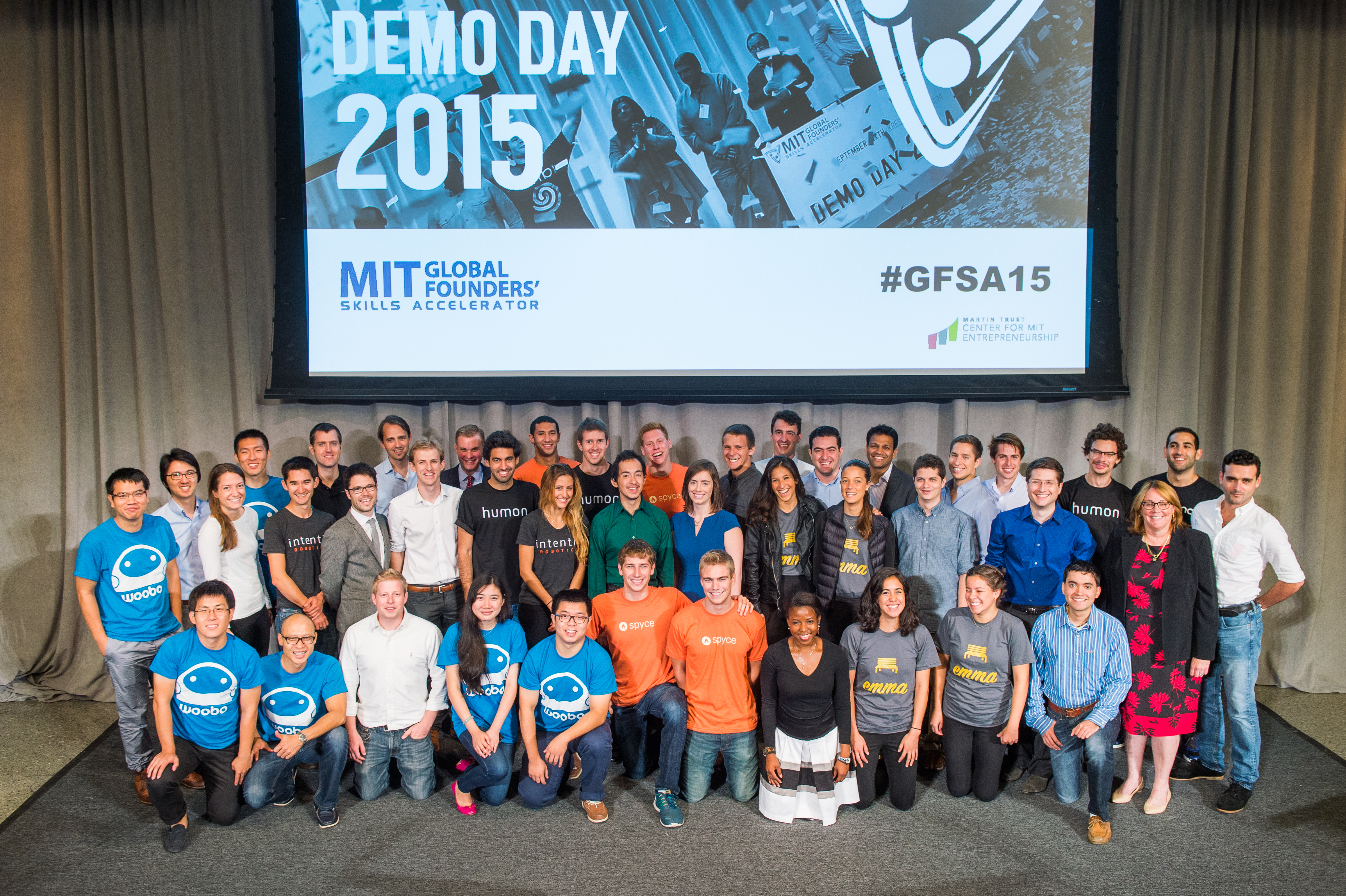
MIT Global Founders’ Skills Accelerator (GFSA) student entrepreneur teams
and their advisors at Demo Day 2015 in Boston

What an exciting few weeks it has been! Starting at the MIT campus on September 12, MIT’s Global Founders’ Skill Accelerator (GFSA) has recently completed outstanding presentations to over 1,200 attendees at Demo Days in Boston, New York City, and San Francisco.

Fourteen teams started with the accelerator at the beginning of summer – my first summer as GFSA program director and Entrepreneur in Residence. Twelve teams made it through the summer boot camp, yet the experiences of the two that didn’t make it to Demo Day are as important as the 12 that did. The lessons of leadership and commitment – along with knowing when to pull a plug on a business or pivot when the business doesn’t align with your goals – are key lessons for entrepreneurs.

The teams that came into the boot camp were students as undergraduates, Masters students, and Ph.D. students. Many graduated from MIT in June after the Accelerator program started, savoring their accomplishments for just a day or two before jumping back into the demands of an educational accelerator boot camp. Directing this program for the first time, I observed a very ambitious group that was also very aligned with the MIT community culture, which supports the teams through its educational process and ecosystem.

Life in Entrepreneur Boot Camp

The boot camp curriculum was mixed with faculty from MIT and community practitioners that offered the students the fundamentals and the application of concepts that are key to building a company, understanding your customer, creating a product customers will purchase, having a team that is committed and understands the vision, as well as understanding business and investment fundamentals. The boot camp puts a heavy emphasis on learning about the motivations and needs of every participant in the value chain you want to enter.

The focus on the customer and primary market research for many of the teams was a challenge. I came into the program with the belief that MIT students can solve any technical problem and that was validated. However, I did see many students challenged when it came to listening to customers, iterating on their product based upon that feedback, and communicating to investors, other students and the community about their company.

Can the MIT accelerator experience be replicated? I am sure it can, but MIT is helped immensely by its culture and its ecosystem. The MIT culture one of creativity, supported by an ecosystem that puts an instructional focus on user-focused business and product design. It is a culture that supports entrepreneurial activities at every stage of the journey.

2015 MIT Global Founders’ Skill Accelerator Companies

Here are the 12 outstanding startups that presented on Demo Day. If you are interested in learning more, their website or contact information is included. At this stage, many of the companies are actively looking for advisors, are hiring and several will be fundraising. You can also view the video of the entire Boston Demo Day event here.

Genesis DNA is developing a next-generation gene synthesis technology that can synthesize gene length DNA at a fraction of the price and turnaround time of existing services. (Genesisdna.com)

Humon is building a wearable which non-invasively measures the way athletes’ muscles use oxygen in real time, identifying their lactic acid threshold and unlocking their true potential. (Humon.io)

Intentiv Robotics is creating the first Aerial Control System for drone cinematography, giving videographers full manual control of their aerial camera and allowing them to execute complex aerial shots intuitively. (Intentiv.io)

Khethworks makes reliable, solar-powered irrigation systems designed for small-acreage farmers that enable their customers to cultivate year round and already has multiple pilot sites on the ground in east India. (Khethworks.com)

Lumio is building a digital health companion, powered by their revolutionary device that provides clinical-grade diagnostics in the home in hours instead of weeks. (Email info@lumiohealth.com)

Morphlab is a company that is focused on furniture with superpowers. The team is creating scalable technologies that enable reconfiguration of interior spaces that dramatically increase efficiency, affordability and functionality of urban micro-apartments. (Morphlab.com)

Sandymount has proprietary tools to ship natively brewed beers internationally while maintaining the flavor and experience they would have in their region of origin in a cost effective manner. (SandymountTechnologies.com)

Spyce is developing the world’s first completely automatic restaurant. A Spyce kitchen cooks and serves delicious meals from fresh ingredients with no human involvement. (spyce.io)

Tekuma connects artists with Airbnb hosts to create personalized galleries in shared living spaces. At the nexus of art, hospitality and real estate they can enhance exposure, environments and guest experience. (tekuma.io)

Woobo opens the world of imagination, fun and knowledge to children, bringing the magic of a robot companion to their lives. A plush doll with artificial intelligence capabilities, Woobo gives children infinite access to stories, music, and knowledge, which are developmentally appropriate and will help them grow. (woobo.io)

In addition to the MIT-led teams there were two international teams:

Emma from ITAM in Mexico City is a company that provides companionship and mobility assistance for the elderly generation. It connects decision makers, their son or daughter, with a companion that best fits their love one’s needs. (miemma.com)

VSParticle from TU Delft in the Netherlands is revolutionizing how electronics are manufactured. The company core technology enables them to fundamentally change the current production system, replacing the wasteful etching process by a simple printing process. (vsparticle.com)

Again, all the best to the spectacular start-ups that worked so hard this summer!

September 12 is Demo Day at MIT!

Demo Day 2015 It’s like the first day of school jitters magnified a thousand times … MIT’s Demo Day is coming September 12th!

What is Demo Day?

Demo Day is an event put on by the MIT Global Founders’ Skills Accelerator (MIT GFSA) and will showcase passionate and talented entrepreneurs at MIT and their innovative, potentially world-changing, companies.

On Demo Day, each of the groups that have been working in the accelerator will present their company to a live audience. As an Entrepreneur in Residence at MIT, this is my first time guiding students through the process, and we’ve certainly had an exciting summer. Some of the challenges the teams faced were moving from a concept to a real plan for a product or service, defining their beachhead market, determining costs and pricing, and figuring out how to clearly and succinctly present their ideas to the board.

Who will be presenting?

We can’t reveal the companies or their concepts until September 12th, but innovative ideas will be presented by 14 fantastic teams – with inspirations that cover everything from fitness to farming to fertilization. To whet your appetite, here’s a recap of inspiring startups from last year’s Demo Day.

As the premier university student accelerator in the world, the MIT GFSA provides a capstone educational opportunity for MIT student entrepreneurs and prepares them to hit “escape velocity” and launch their companies into the real world. We hope you can join us for this amazing event.

Yes, you can attend!

This event is open to the public! Last year, over a thousand people gathered to see the latest innovative companies presented.

Join us in the heart of MIT under the dome in 10-250. (Overflow space will be available where the presentations will be live streamed.) Demo Day is free; but, you do need to register in advance. Come and encourage our next generation of entrepreneurs in Boston! You can also watch the live stream from your computers. And, after the Boston event, we’re on to New York and San Francisco … I’ll keep you posted!

MIT Global Founders

Are you a Disciplined Entrepreneur?

Picture1_croppedAs some of my loyal blog readers know, I’ve recently started a new position as Entrepreneur-in-Residence at the Martin Trust Center for MIT Entrepreneurship.

I’m thrilled to have joined this incredible program at MIT, and have met some wonderful people, including the Center’s Managing Director Bill Aulet. Bill is also the author of a book called “Disciplined Entrepreneurship: 24 Steps to a Successful Startup.” I’ve enjoyed reading it and thought I would share some of the highlights.

In my mind, “disciplined” and “entrepreneur” – are two words that are seemingly in juxtaposition. Most of us think of entrepreneurs as brilliant people with lots of ideas flying around in their heads and innate entrepreneurial talent. We think that they get lucky – or, are at the right place at the right time – when they actually launch a business based on one of these ideas.

In his book, Bill asserts that entrepreneurship can be taught, and that intelligent, hardworking people can become successful entrepreneurs by following a systematic, disciplined approach to starting a new company.

The book is structured around six themes, and the 24 steps mentioned in the title each fall into one of these themes:

  • Who is your customer?
  • What can you do for your customer?
  • How does your customer acquire your product?
  • How do you make money off your product?
  • How do you design and build your product?
  • How do you scale your business?

Bill points out that while following the sequential steps, entrepreneurs will undoubtedly learn new information that will take you back to revise what you’ve done in previous steps. The graphic showing the steps is a wonderful curvy path with “go back” arrows reminiscent of the game Candy Land. This shows me that that wacky, yet brilliant entrepreneur is in there somewhere! Yet, I love that the steps give structure to the process of launching your own business.

I also really embrace the idea Bill sets forth in his book that “ideas mean nothing without execution.” If there was one nugget of advice that I would share with entrepreneurs, this would be it.

As an entrepreneur myself, I value the examples in every chapter, drawn from projects that Bill has worked on with MIT students. Bill uses these real-life examples to guides those with ideas, new technologies, or passion into channeling that energy into a viable business.

At MIT, I am currently taking 14 student-founder teams through the disciplined entrepreneur process in a program called Global Founders Skills Accelerator (GFSA) … I will let you know how it goes!

The Top 5 Characteristics of Winning Startups

startup-signI was recently invited to speak to students involved in a local university’s entrepreneurship program. In preparing my presentation, I reflected on my startup experiences – the good, the bad and the ugly.

Truthfully, my experiences with startups were mostly very good. I was extremely fortunate to be part of the leadership team for two successful technology companies. I helped to steer them from the start-up stage through the entrepreneurial process and into rapid growth, and each was a great ride. Both companies had public offerings and were ultimately acquired by leading companies in their industry, which is especially remarkable given that 75 percent of all startups and 90 percent of all products fail, according to Harvard Business School statistics.

Why did these two companies prosper when so many others fail? Here are the top five characteristics of winning startups, based on what I’ve learned and witnessed over my career:

Solve a Customer Pain Point with your Product – Build a product that customers can use. Sure, it sounds simple, but you need to balance listening to your customers with keeping an eye on new technology. There’s an old adage that if Henry Ford listened to his customers they would have ended up with faster horses. This does have some truth to it – sometimes customers don’t know how new technologies could solve their current problems – but they do know the result they want. So, listen to their pains, and see if you can think of new ways to solve them.

Companies also need to balance adding technological features with usability. Most customers won’t use every bell and whistle that is included in the product, but they do want the product to be easy-to-use and intuitive. The bottom line is that you need to deliver a positive customer experience. An advantage I had with both startups was that as we were developing the right product at the right time, we had the ability to change course as needed – or to “pivot” in today’s terminology. The ability to be flexible and strike at the right point to continue market share and revenue growth was essential.

Tight Team Environment – It is vital to build a good core group of people early. The leadership team is important, of course, but every employee also needs to be part of an innovative and collaborative culture to help the company thrive. In the early phases of building a company, I found that the first 50 employees were a very tightly knit core group. But then we needed to scale and replicate that success, so that when we doubled our staff that same culture survived. Nurturing, training and retaining employees were fundamental elements to our success, as was confidence in the company’s leadership.

Leadership, trust and strong opinions are key elements that create a positive energy and personal commitment to the company and to each other. Sure, a strong opinion can sometimes cause conflict, but it exemplifies the passion of the company’s employees. As long as there is a forum for communication, this can be a constructive force for growth.

Relentless Customer Focus – In addition to ensuring that your product solves a customer pain point, you need to focus on your customers as your number one priority. One of the ways we listened to our customers was to bring them into our company-wide meetings to share their experiences. In our weekly “Pizza Meetings,” we discussed Product, People, Prospects and Profits to give the entire team the big picture, and customers would often join us. It was important to hear the good and bad about the product and what our customers hoped to do with our solution in the longer term. This had profound effects on the developers to develop more modules and tight code, because it let them see how their work directly affected the people who used our products.

Operations as a Company Backbone – Although it’s not always seen as the most glamorous function, Operations is the workhorse of any startup. From the beginning, we linked Operations into tech support, manufacturing, logistics, and tied it closely to new product introductions. That way, if a customer had a problem with a product, we not only fixed that problem, we tried to figure out why this issue happened and make an operational fix within the company so that the larger problem would be solved long-term. When small companies are growing rapidly, a learning cycle needs be put into place to feed “lessons learned” back into the organization. This prevents repeated errors and was a major factor for our success.

Start Selling Early –
I can’t overemphasize the importance of establishing an excellent sales force, and the need to start selling as early as possible. At one company, we needed to get customers on board before we could get funding. It was really a leap of faith, but our early sales team delivered. We couldn’t get Series A funding until investors saw that we had customers. There was little angel investing at that time and early stage investors were very conservative. Therefore, our early focus on sales was critical to our future funding – as well as our revenue.

Although I started this post by talking about the successful exits of these two companies, it is important to build your business as a strong company that can stand on its own, rather than planning a specific exit strategy. The right product, a tight team and a focus on customers, tied together with strong operations and sales will be a solid foundation for success.