
You bring your unique energy to how you show up each day – at home, at work, and generally in life.
This is especially important for leaders – both entrepreneurs running startups and managers leading teams in corporate enterprises. As a leader, you knowingly or unknowingly influence others, and this presents the opportunity to inspire and motivate your team.
This article will focus on Energy Leadership™, a concept I discussed in my presentation at the Association of Talent Development’s ATD ’23 conference on how to Think Like an Entrepreneur and Foster Creativity in Your Organization.
When you show up with your best energy, you can encourage your team to recognize and harness their own energy, feel a greater sense of purpose, and get more done with much less effort and stress. So, let’s delve into more detail on Energy Leadership.
Energy Leadership
“Energy is contagious; either you affect people or infect people,” says bestselling author and businessman, T. Harv Eker. When you realize how many people you interact with each day, you begin to realize how powerful your personal energy is.
The interesting thing about energy is that it can be both anabolic and catabolic. Both energy levels serve you daily, depending upon your lived experiences. Here is a brief overview of each:
- Anabolic energy is associated with a constructive buildup force and less stress. With anabolic energy, it is easier to focus on solutions and tap creativity and experience for a complete and conscious view of situations. People have more access to this energy, with less judgment and less fear about themselves or situations – anabolic energy is essentially constructive, fueling, healing, and growth oriented. A leader with anabolic energy is collaborative, fuels creativity and productivity.
- Catabolic energy, on the other hand, tends to distract you and pull your focus away from what you are doing. It is typically draining, resisting, and contracting energy. Yet, it serves the important purpose of self-protection, especially when experiencing uncomfortable situations. A leader with catabolic energy can use this energy in a time crunch or dangerous situations to address a particular situation. However, catabolic energy can be depleting and stress levels raised so the longer term effects are not positive. Think of it as being in continual fight or flight mode.
In practice, a catabolic leader and anabolic leader may look like the following:

Neither type of energy is good nor bad, but an ambidextrous leader can adapt to the situation to create a better result.
The first step is to understand your personal Energy Leadership profile. This is done through an attitudinal assessment and can be used as a starting point to uncover how your energy can be harnessed to reach your goals and help you to lead more effectively.
So, how do you assess your current Energy Leadership?
The Energy Leadership Index (ELI) assessment tool, developed by the Institute for Professional Excellence in Coaching (iPEC) measures your unique energy profile. Through a series of 84 questions, the ELI reveals the percentage of each energy level you experience under normal circumstances and how your energy manifests under stress.
The 7 Levels of Energy
There are seven energy levels, each with a thought, emotion, and action attached. Daily, you may operate on just a couple of levels or many, but this tool focuses on understanding where you are.

Your individual results of the ELI assessment come in a sample like the chart below. This represents your average energy presentation under normal circumstances and under stress.

Everyone has a different ELI, which uniquely reflects their lived experiences. Through the debrief with an ELI Practitioner, you bring an awareness of how you show up. In the debrief, you go through your particular energy levels and find experiences that serve you well and others that do not. The tool’s power is recognizing your level and the ability to change the level and gain a better experience. The ELI tool, which can be used with individuals or teams, has a low entry bar, and it could pay significant dividends for leaders.
New Working Styles Benefit from Energy Leadership
The new normal of remote, hybrid, and in-person working styles has brought challenges for leaders. We are currently at a crossroads where workers value the flexibility of work from home options, but in many companies, management is dictating a return to the office, or hybrid approach. This puts a lot of pressure on team leaders. As mentioned in a previous blog post, speaker, author, and facilitator Priya Parker talks about gathering with intention for meetings (or classes), along with bringing an energy that meets the needs of the situation. If you are responsible for gathering and communicating with your team, consider your intention and your energy; the benefits could be significant.
How skillfully can you lead daily? An Energy Leadership approach will identify where you can adjust to having more experiences that better serve you and your clients, and it extends beyond the realm of work to your family and loved ones as well.
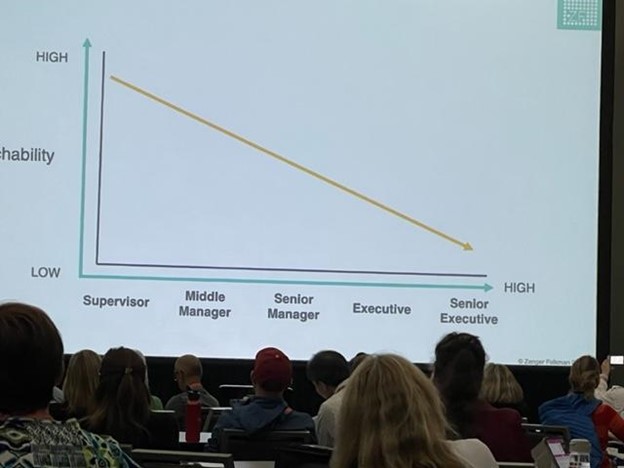
In one of the sessions at ATD ‘23 by Zenger Folkman, it was discussed that with more experienced leaders, coachability decreases. (Yes, that says “Coachability” on the left axis, my camera skills attest to capturing this during a live session!) Senior leaders have been through a lot of training and I suggest the ELI assessment as a tool that could provide new insights into how they are leading today.
In summary, embracing Energy Leadership can inspire peak performance from individual employees and transform the culture of organizations. A key element to Energy Leadership is that we are all leaders, every day, in every area of our lives. Energy Leadership can help individuals skillfully lead when interacting with others.
Further reading: Should I work with an Energy Leadership Coach?
Learn more at https://www.energyleadership.com/ or reach out to me at patriciacotter76@gmail.com or pcotter@mit.edu

 Trish Cotter