
Building a Fulfilling Career: Steps for Networking, Learning, and Personal Branding

Many of today’s early-career professionals are struggling. They’ve worked through a pandemic; they’ve embraced work from home (WFH) and may now be facing a return to the office (RTO) or hybrid model. Although working from home has many benefits, employees who are just starting their careers miss out on the support, training, informal mentorship, and camaraderie that were once a normal part of corporate life.

In my last blog post on preparing our next generation of corporate leaders, I explored the shifts in traditional employment and how many companies no longer provide scaffolding for their employees to learn and grow. I offered 11 strategies for employers to improve employee satisfaction, engagement, and development to foster a more engaged and loyal workforce.

Yet, this responsibility doesn’t solely rest on the shoulders of employers. Ultimately, employees are responsible for managing their own careers, particularly if their current company doesn’t provide a lot of support.

The following strategies can be used by all early-career professionals to take ownership of their careers and successfully navigate advancement and job satisfaction:

1. Enhance Your Networking Skills

  • Leverage Existing Contacts: Contact college friends, family, and colleagues to rekindle connections and explore opportunities.
  • Expand Your Network: Attend industry events, join professional associations, and engage in online forums related to your field.
  • Informational Interviews: Schedule meetings with people in roles you aspire to. Ask about their career paths, challenges, and advice for joining similar positions.

2. Develop and Utilize a Personal Brand

  • Build an Online Presence: Update your LinkedIn profile with your accomplishments and skills. Ask for LinkedIn recommendations to share on your profile. Share relevant content and engage with posts to increase your visibility.
  • Showcase Your Skills: Create a personal website or portfolio if applicable. Highlight projects, achievements, and skills that make you stand out.

3. Stay Informed About Industry Trends

  • Set Up Alerts: Use tools like Google Alerts to keep track of developments in your field or industry.
  • Follow Industry Leaders: Keep up with thought leaders and organizations in your sector through social media and industry publications.

4. Document Your Achievements

  • Maintain a Log: Regularly update a document with your accomplishments, skills developed, and project contributions. This can help you during performance reviews or job interviews. Create a folder and save those “kudos” emails.
  • Create Impact Statements: Quantify your achievements with specific metrics (e.g., increased sales by X%, reduced costs by Y%).

5. Seek Continuous Learning and Development

  • Enroll in Courses: Take advantage of online courses, certifications, or workshops to enhance your skills and make yourself more marketable. Ask your manager what professional development courses they would recommend that the company will fund.
  • Stay Updated: Learn new tools, technologies, and methodologies relevant to your industry.

6. Evaluate and Explore New Opportunities

  • Set Career Goals: Define what you want in your next role, whether it’s higher pay, more responsibility, or better work-life balance.
  • Apply Strategically: When exploring new job opportunities, target roles that align with your career goals and offer growth potential.

7. Communicate Effectively with Your Current Employer

  • Request Feedback: Regularly seek feedback from supervisors to understand areas for improvement and express your interest in taking on more responsibilities.
  • Discuss Career Development: Talk with your manager about your career aspirations and seek guidance on achieving them within the company.

8. Consider Freelancing or Consulting

  • Explore Side Projects: If feasible, undertake freelance work or consulting projects to build experience, expand your network, and discover new career paths.
  • Diversify Income Streams: Freelancing can offer financial flexibility and open new professional opportunities.

9. Maintain Work-Life Balance

  • Set Boundaries: Ensure a healthy balance between work and personal life to avoid burnout and maintain job satisfaction.
  • Engage in Hobbies: Pursue interests outside of work to stay motivated and keep a positive outlook on your career.

By combining these strategies, employees can effectively navigate their career paths, find new opportunities, and achieve greater job satisfaction.

Other suggestions or strategies that have worked for you? Please add them to the comments!

As 9-to-5 Office Jobs Become Extinct, How Are We Preparing Our Next Generation of Corporate Leaders?

Recently, I’ve been coaching young professionals seeking the second or third jobs of their careers. Many started their careers with jobs they couldn’t refuse—positions that allowed them to live in their preferred city, pay back student loans, or get off the family payroll. After a few years, however, they’ve realized that the dream job they once sought isn’t aligning with their current reality, and they feel the need for a change.

In this post, I’ll explore what this means for both these employees and the employers who need to recruit, train, and retain top talent to build the next generation of leaders.

A Shift in Traditional Employment

Reid Hoffman, co-founder of LinkedIn, predicted that 9-to-5 jobs are dying and will be extinct by 2034, as shared in this post on LinkedIn and an  X thread by entrepreneur and investor Neal Taparia. Hoffman also predicts that within a decade, 50% of the US population will be freelancers—and they’ll earn more than traditional employees. As AI enters the picture, personal branding and standing out among your peers will become more important than ever.

Where does this leave those employees just starting in their careers? They are facing a new workplace reality due to the ripple effect of the COVID-19 pandemic which enabled a remote work environment for many professions disrupting the traditional requirements to be in the office to get your work done. As the nature of work shifts, we are all grappling with what works best for each company’s environment, and I’m finding that the supports that were once built into corporate onboarding and training have slipped tremendously. Unfortunately, this does a disservice both to employees and the companies they work for.

One key factor contributing to their sense of disconnection is companies’ failure to integrate new hires effectively, particularly in hybrid or fully remote work setups. This lack of inclusion breeds isolation and significantly hampers productivity and job satisfaction.

Working in the office can present a Catch-22. Interpersonal relationships with co-workers and learning by osmosis are real benefits of in-person workplaces that can get lost when working remotely. However, forced office time often backfires and causes resentment when employees find themselves in impersonal environments with few familiar faces when they arrive. Many times, in-the-office time is not coordinated by teams to gain the benefit of in-person meetings and mentor sessions. The lack of integration and the prevalence of closed office doors contribute to a disengaging experience that can be emotionally draining. As a result, early-career employees— who often have long commutes due to the high cost of city living—feel that they have wasted time commuting just to “show up.”  

So, while companies invest heavily in recruiters and AI-driven tools to screen resumes, there seems to be a lack of emphasis on employee development once employees are onboarded. This glaring oversight results in fewer growth opportunities leading to an absence of employee loyalty. A downward spiral ensues, as employees feel like they have to leave the company to seek new ways to advance their careers. It is a frustrating situation for HR managers, company managers, and employees.

Where Talented Young People Are Struggling

Here are some real-life examples of how companies have neglected to train and prepare new employees, leading to discouragement and ultimately turnover in some cases.

  • One company placed an employee in a sales role without providing any sales training, only to criticize them for not meeting quotas. Without mentorship, coaching, or guidance, the promising employee eventually became disheartened and risked being fired.
  • Another case involved a new hire asked to represent their company at a tradeshow. They were assigned to work the tradeshow booth without adequate training in how to speak about the company’s products and services. The lack of customer and marketing training paired with insufficient product knowledge meant that the new hire could not generate leads or effectively engage with potential clients. A brief, targeted training session could have significantly improved their performance and outreach.
  • In an educational setting, a recently hired teacher was isolated when assigned to a floor with veteran educators who were resistant to learning about new teaching methods. Despite the new teacher’s eagerness to implement innovative concepts, the resistance from experienced colleagues stifled their efforts and limited their impact, as well as prevented the teacher from bonding with new colleagues.

What has Changed

In contrast, when I was starting my career, companies like Honeywell and IBM offered rotation programs to expose new engineers to various areas, along with classroom training, guest speakers, and supportive mentors. This scaffolding for learning fostered both loyalty and job satisfaction. Unfortunately, many modern companies lack the resources or commitment to provide similar support, leading to diminished employee engagement and enthusiasm.

So, how did we get here? The gap between initial enthusiasm and long-term satisfaction is widening due to inadequate support systems, poor integration, and a lack of meaningful growth opportunities. Addressing these issues is crucial for fostering a more engaged and loyal workforce.

Strategies for Employers

Here are 11 strategies companies can implement to improve employee satisfaction, engagement, and development for long-term employees with a multifaceted approach:

1. Create Clear Career Pathways – Develop personalized career development plans that outline potential career paths for growth opportunities and clearly define promotion requirements.

2. Enhance Learning and Development Opportunities – Offer continuous learning opportunities through workshops, seminars, online courses, and certifications. Implement mentorship or coaching programs where experienced employees guide and support newer or less experienced staff. Provide leadership training and succession planning to prepare employees for future roles.

3. Foster a Supportive Work Environment – Cultivate an inclusive and supportive culture where all employees feel valued and respected. Promote work-life balance through flexible work arrangements, remote work options, and adequate vacation time.

4. Recognize and Reward Contributions – Implement regular recognition programs to celebrate achievements and milestones and ensure competitive compensation packages are regularly reviewed to reflect performance and market conditions.

5. Provide Meaningful Work and Autonomy – To keep employees engaged, assign meaningful projects that align with their skills and interests. Allow employees to take ownership of their work and make decisions that impact their roles.

6. Improve Communication and Feedback – Conduct one-on-one meetings to discuss career goals, feedback, and concerns.Maintain open communication channels for employees to voice their ideas, feedback, and concerns.

7. Support Personal Well-being – Offer programs that support mental, emotional, and physical well-being, such as counseling services, fitness memberships, and wellness initiatives. Provide resources and training for stress management and coping strategies.

8. Encourage Innovation and Creativity – Create platforms for employees to share innovative ideas, participate in brainstorming sessions, and allow employees to work on creative projects or initiatives outside their regular responsibilities.

9. Promote Team Collaboration – Invest in team-building activities that foster collaboration and strengthen relationships among team members. Encourage employees to work on cross-functional projects to broaden their experience and network within the company.

10. Provide Robust Onboarding and Integration – Ensure new employees receive comprehensive onboarding so they can integrate smoothly into the company culture and understand their role. Facilitate opportunities for new hires to build relationships and connect with their colleagues through social events and team activities.

11. Adapt to Changing Needs – Be adaptable and responsive to employees’ evolving needs and preferences, including changes in work patterns or personal circumstances. Continuously gather and act on employee feedback to improve policies and practices.

By implementing these strategies, companies can enhance employee satisfaction, engagement, and development, leading to a more motivated and loyal workforce. Leaders must champion these initiatives and ensure they are integrated into the company’s culture and operations, which can be especially difficult with a remote or hybrid working environment—but it is essential to put in the extra effort to make it work.

Of course, new employees need to do their part as well—simply changing jobs when you are dissatisfied with your current situation is not a solution. I’ll address how employees can proactively manage their careers in my next post.

[Image source: AI generated]

A Customized Learning Opportunity: Coaching in Executive Education

Coaching, in general, is best for those who are truly invested in transformation. When coaching is integrated into executive education programs, it can provide a premium and personalized experience that bridges the gap between theoretical concepts and practical application. Over the last few weeks, I have been coaching in a few of MIT Sloan’s Executive Education Programs.  And although coaching is not built into every executive education program, when personalized coaching is offered, it can provide a customized learning opportunity that guides participants on how to apply what they are learning to their own unique situation. This process not only enhances retention but also empowers executives to implement changes in their organizations with confidence.

For instance, a participant in an executive education program might work with a coach to develop a plan for implementing a new organizational change model after an in-class presentation.  The coach helps them tailor the model to their specific context, considering factors like company culture and team dynamics. This personalized guidance ensures that when the executive returns to work, they have a concrete, actionable plan ready to execute. Coaching also plays a crucial role in addressing specific challenges executives face in their roles. Whether it’s navigating team conflicts, finding their leadership voice, or developing new strategies, individualized support from a coach can make a significant difference. It’s about acquiring skills for the future and moving on to the next challenge with confidence and clarity.

I have participated in executive education programs at MIT, Northeastern, Babson, Harvard Business School, and the University of Pennsylvania that have profoundly impacted my skills and knowledge. My experience with these programs has taught me the value of technology, culture, leadership skills, and team dynamics. Each course has provided new tools and perspectives that I have applied to my work, constantly striving for personal and professional growth. Throughout my career, I have seen firsthand the transformative power of executive education, and in my current role coaching senior executives and entrepreneurs at MIT, I’ve experienced how a coaching element in executive education strengthens the entire program.

The Executive Coaching Experience

At its core, executive education is designed to equip leaders with the skills, knowledge, and insights necessary to navigate complex business challenges. Individuals and companies alike seek out these programs for various reasons—whether it’s to stay ahead of industry trends, prepare for organizational changes, or simply to gain a competitive edge. But beyond the curriculum and the esteemed faculty, I believe the real transformative power of executive education often lies in the coaching component.

Here are some real-world reactions I’ve encountered when coaching executives, and how I’ve been able to work with participants to help them gain value from the coaching experience:

  •  “You have my DISC and 360 Assessment [self-awareness tools used in coaching]. Tell me where I need to improve.” 
    When a participant approaches coaching like this, my response is that coaching is all about showing up with a critical eye for yourself and improving your performance overall. No coach can tell you exactly what you need to do, but coaching can help you unlock areas where you can grow as a leader.
  • “What I am learning in the classroom is great, but what I really need is help figuring out what I do next because the current situation at work is not working.” 
    This is where coaching can shine. When an executive realizes they can reinforce their classroom experience with customized work that applies to their specific situation, they are two steps ahead and can more effectively integrate their learnings into their organization.
  • “I am taking the class, and I don’t see anyone of my level that I can connect with.”
    Hearing this type of comment makes me think that an executive was recommended to the program and may not have made the decision to attend themselves. They have some work to do on their leadership style, and I would encourage a participant like this to be more open to what they can learn from others, as well as offering their expertise for others to learn from them. 

Coaching has been proven as an effective support mechanism for learning. Research indicates that traditional training methods are often insufficient for long-term retention and application of new knowledge.  However, active learning approaches, which include coaching, can dramatically improve retention. A 2022 study revealed that active learners retained 93.5% of information after one month, compared to 79% for passive learners. This underscores the importance of incorporating active learning strategies, such as coaching, into executive education.

Conclusion

Within the MIT Sloan Executive Education programs and my own coaching practice, I see the impact of coaching every day. Participants emerge from programs and coaching not just with new knowledge, but with a renewed sense of purpose and the confidence to tackle their most pressing challenges. The one-on-one aspect of coaching, combined with the collaborative team projects, creates a rich, engaging learning environment that truly transforms these leaders.

As we continue to navigate an increasingly complex business landscape, the role of coaching, whether in executive education, in corporations, or through self-discovery becomes more impactful.  By providing personalized support and fostering an environment of active learning, coaching helps executives retain and apply new knowledge, and drives meaningful change within their organizations. It’s an investment in the future success of these leaders and the success of their companies.

In addition to coaching for MIT Sloan’s Executive Education programs, I also provide one-on-one leadership and entrepreneurship coaching for individuals. If you are interested in learning more, please contact me at Patricia Cotter patriciacotter76@gmail.com.

A Bold Journey

Living life boldly means exposing yourself to all sorts of risk – risk of loss, risk of criticism and judgement, risk of mental, emotional, or physical distress. It’s no wonder, so many of us are raised to not live boldly, to not take risks, to not push ourselves to reach our highest potential.  

Bold Journey, an online magazine, asks people to share the story of their lives and how they got to where they are today. Their mission is to create a space for all of us to learn from each other. They recently reached out to profile my bold journey – the interview is shared below.

Trish, thank you so much for joining us today. Let’s jump right into something we’re really interested in hearing about from you – being the only one in the room. So many of us find ourselves as the only woman in the room, the only immigrant or the only artist in the room, etc. Can you talk to us about how you have learned to be effective and successful in situations where you are the only one in the room like you?

I began my career in the chemical industry, initially working in the lab and later as an engineer running a plating line. I was often the only woman in meetings, in the manufacturing area, and at lunch. My upbringing with six brothers (and two sisters) and playing team sports prepared me for that experience. As the only female, I was frequently offered training programs aimed at increasing diversity. Early in my career, my boss would joke that I went to another facility for lunch because there were more women, and he was right. I did feel lonely and excluded at times, but being the only female also brought unique opportunities. The support, mentorship, and sponsorship I received from men far outweighed the challenges I faced.

Thanks, so before we move on maybe you can share a bit more about yourself?

I am currently in the fourth stage of my career. I started as an engineer making circuit boards and gradually expanded to building various computer components and ultimately overseeing comprehensive product testing. Moving laterally within the company proved to be a transformative experience, allowing me to work with new people in a management role and learn skills and techniques I would call upon for years – this was the second stage of my career.

In my third stage, I ventured into academia, teaching entrepreneurship at MIT and spearheading its capstone accelerator, delta v. This experience was exceptional, immersing me in cutting-edge technology daily and mentoring students eager to make a positive impact on the world. It also provided opportunities to research entrepreneurial ventures globally (check out my free ebook on Start-up Accelerator Programs Around the World).

I continue to collaborate with MIT in the fourth stage of my career, contributing to partner programs in entrepreneurship education. Additionally, I focus on entrepreneurship and energy coaching through my own business. This work has been particularly inspiring, enabling me to help clients maximize their positive impact through enhanced focus and joy in their lives.

There is so much advice out there about all the different skills and qualities folks need to develop in order to succeed in today’s highly competitive environment and often it can feel overwhelming. So, if we had to break it down to just the three that matter most, which three skills or qualities would you focus on?

My career success is significantly attributed to the invaluable mentorship and sponsorship I received, which provided me with a solid foundation of technical, leadership, and personal skills. Several mentors offered training opportunities, and sponsors recommended I transition into the executive ranks. Without their support, I don’t believe my career would have been as successful.

A mentor encouraged me to explore opportunities in the startup realm, a decision that proved to be highly rewarding. I played a pivotal role in the remarkable growth of two startups, helping the first grow to over $100M, and the second to over $225M before it was acquired by IBM.

At MIT, I dedicated my tenure to sharing my entrepreneurship experience and preparing students to excel in business. Over six years, I worked with a fantastic team to teach and develop the skills of student entrepreneurs. Our energy coaching program empowered them to understand their professional presence better and take control of their business and career. We also introduced a mental health aspect into the entrepreneurial journey, a focus that was previously absent. I co-authored an article for HBR about this program titled, “Passion for Your Startup Doesn’t Have to Mean Constant Stress.” This investment in the mental health of entrepreneurs has created a more resilient generation of business leaders ready to face the challenges of the outside world.

We’ve all got limited resources, time, energy, focus, etc. – so if you had to choose between going all in on your strengths or working on areas where you aren’t as strong, what would you choose?

A well-rounded approach will serve you well. Some skills that I’ve developed include the ability to take risks, a strong work ethic, and being a good listener.

I never considered myself a risk taker until my dad, who had been with an employer forever, asked why I was changing jobs. My reason was that there was so much more in the world to learn. I moved from making computers to testing them, using them, monitoring them, and analyzing data. This wasn’t a wild risk, but the shift from large companies to startups was viewed as one. However, as the companies got smaller, I had more control and impact.

I knew that no one would outwork me, and I surrounded myself with a great group of people in a culture I crafted. In this environment, work was recognized, teams were rewarded, and customers received value from our products. I also knew I needed to get comfortable with being uncomfortable, learning from intelligent people who had clever ways to solve problems, regardless of their position.

A learning mindset serves you well. Good listening skills help you zero in on the root cause of issues rather than revisiting them repeatedly. As an entrepreneur, you’re not just taking risks; you’re mitigating them every day. The key is to surround yourself with intelligent and creative people who can build a team where – even if we miss – we win by learning together.

The original article was published in Bold Journey here: “Meet Dr. Trish Cotter.”
Thank you for the opportunity!

From Caps and Gowns to Startups: The Rising Trend of New Grads Choosing Entrepreneurship

We’re in the midst of graduation season—a time of excitement and anticipation as students leave behind the classroom and start to shape their futures. One trend I’m seeing is that new college graduates are investigating options for entrepreneurship directly out of college, before committing to full-time corporate roles.

A recent HBR article confirms what I’ve seen. It cites a Global University Entrepreneurial Spirit Students’ Survey (GUESSS) of 267,000 undergraduate and graduate students that revealed around 11% of students already own and run businesses. At least 18% of students wished to become entrepreneurs right after graduation and another 32% expressed interest in transitioning into entrepreneurship within five years of their graduation. The study also shows that investments in early-stage startups have increased from $72.8 billion in 2017 to $208 billion in 2021.

If you’ve ever had an idea to start your own business, it might be an ideal time to pursue that passion (especially, while you are still used to living on ramen as you work on getting funding!). Consider this period of your life as an opportunity to explore and to see if entrepreneurship is a viable option for you. At a time when there is so much chaos in the world, doing your own thing can give you back control.

This summer, I’ll be teaching at an entrepreneurship program designed by Dalhousie and the University of Calgary called Lab2Market Launch.  This 12-week summer accelerator brings together members of the entrepreneurial ecosystem from across Canada to turn ideas into viable businesses. In the past, I served as the Director of MIT’s delta v accelerator program, another summer program which is the capstone entrepreneurship experience for MIT students – both are excellent programs to help propel entrepreneurs. And along with these formal programs, there are a host of resources for people who want to explore entrepreneurship – check out this post about thriving as an entrepreneur, and see the links at the end.

As new graduates increasingly turn to entrepreneurship, the landscape of post-graduation career choices is rapidly evolving. This trend has been bolstered by a combination of technological advancements, changing economic conditions, and a growing desire for personal fulfillment and flexibility in career paths. Many prospective entrepreneurs are driven by the appeal of launching startups that align with their passions and the promise of greater autonomy compared to traditional corporate jobs.

Entrepreneurship Advice for New Graduates

For new graduates, exploring entrepreneurship offers several advantages. It provides a hands-on learning experience that can be more dynamic and varied than the structured environment of a corporate job. Starting a business can also foster critical skills such as resilience, problem-solving, and leadership.

However, it is crucial to recognize the challenges, particularly in securing funding. To gain an overview of the types of funding available, check out this article on 8 sources of start-up financing. Traditional funding avenues might be less accessible for entrepreneurs who are just starting out, prompting graduates to explore alternative sources like crowdfunding, government grants, incubator, and startup accelerator programs.

Members of Forbes’ Young Entrepreneur Council, also share their experiences and some solid advice in this Forbes article, including:

  • Create a business plan
  • Hustle and network in order to succeed
  • Picture your business like a workhorse
  • Listen to what your customers need
  • Focus on a niche market
  • Talk to those who have done it
  • Ask how you can help
  • Think long term
  • Ditch perfectionism
  • Invest in yourself

Not surprisingly, several of these pieces of advice align with the 24-steps to a successful startup that we teach at MIT with the Disciplined Entrepreneurship approach (you can read a short overview here), or check out the newly updated Disciplined Entrepreneurship book and the new Startup Tactics book by MIT’s Bill Aulet and Paul Cheek.

Impact of Mentors, Coaches, and Educators on Entrepreneurs

One thing I would stress is to make sure that you establish a strong connection with a mentor or coach – someone who can help keep you on track and provide support and guidance during your entrepreneurial journey. Established entrepreneurs can play a pivotal role by mentoring new graduates, offering insights and resources to navigate the complexities of starting a business. Coaches can help inspire you to achieve peak performance. As a certified Energy Leadership coach, I coach entrepreneurs on how they can harness their own unique energy and become a better leader. Having that mentor or coach who is separate from the day-to-day workings of your startup is a wonderful way to gain perspective as an entrepreneur.

In addition – for those who are still in school – educators are increasingly adapting their curricula to emphasize entrepreneurial skills, such as innovation, digital literacy, and strategic thinking. Incorporating real-world projects and case studies can bridge the gap between theoretical knowledge and practical application, better preparing students for entrepreneurial endeavors. Today, there are more than 5,000 entrepreneurship courses are offered in two-year and four-year institutions, according to the Kauffman Foundation, and more than 150 institutions in the U.S. allow students to major in entrepreneurship, according to Best Colleges. This is more than triple the number from two decades ago.

My Perspective

As someone deeply embedded in the entrepreneurial ecosystem, I see this shift towards entrepreneurship as an immediate path after graduation as both a challenge and an opportunity. The influx of young, innovative minds into entrepreneurship can drive significant advancements across various industries. However, it is vital to provide the right support systems to ensure their success. Mentorship programs, comprehensive entrepreneurship education, and access to diverse funding options are essential components of this support.

Moreover, fostering a mindset that embraces failure as a learning opportunity is crucial. New graduates should be encouraged to take calculated risks, understanding that setbacks are part of the entrepreneurial journey. This perspective not only builds resilience but also fosters a culture of continuous improvement and innovation.

Conclusion

The trend of new graduates exploring entrepreneurship before starting corporate jobs may signify a shift in career trajectories and workplace dynamics. By supporting these budding entrepreneurs through mentorship and coaching, education, and access to resources, we can harness their potential to drive innovation and economic growth. As educators, entrepreneurs, and thought leaders, it is our responsibility to guide and nurture this new generation, helping them navigate the challenges and seize the opportunities that lie ahead.

If you are interested in learning more about coaching sessions for entrepreneurs, please reach out at patriciacotter76@gmail.com.

How Are You Showing Up? A Primer on Energy Leadership

You bring your unique energy to how you show up each day – at home, at work, and generally in life.

This is especially important for leaders – both entrepreneurs running startups and managers leading teams in corporate enterprises. As a leader, you knowingly or unknowingly influence others, and this presents the opportunity to inspire and motivate your team.

This article will focus on Energy Leadership™, a concept I discussed in my presentation at the Association of Talent Development’s ATD ’23 conference on how to Think Like an Entrepreneur and Foster Creativity in Your Organization.

When you show up with your best energy, you can encourage your team to recognize and harness their own energy, feel a greater sense of purpose, and get more done with much less effort and stress. So, let’s delve into more detail on Energy Leadership.

Energy Leadership

“Energy is contagious; either you affect people or infect people,” says bestselling author and businessman, T. Harv Eker. When you realize how many people you interact with each day, you begin to realize how powerful your personal energy is.

The interesting thing about energy is that it can be both anabolic and catabolic. Both energy levels serve you daily, depending upon your lived experiences. Here is a brief overview of each:

  • Anabolic energy is associated with a constructive buildup force and less stress. With anabolic energy, it is easier to focus on solutions and tap creativity and experience for a complete and conscious view of situations. People have more access to this energy, with less judgment and less fear about themselves or situations – anabolic energy is essentially constructive, fueling, healing, and growth oriented. A leader with anabolic energy is collaborative, fuels creativity and productivity.
  • Catabolic energy, on the other hand, tends to distract you and pull your focus away from what you are doing. It is typically draining, resisting, and contracting energy. Yet, it serves the important purpose of self-protection, especially when experiencing uncomfortable situations. A leader with catabolic energy can use this energy in a time crunch or dangerous situations to address a particular situation. However, catabolic energy can be depleting and stress levels raised so the longer term effects are not positive. Think of it as being in continual fight or flight mode. 

In practice, a catabolic leader and anabolic leader may look like the following:

Neither type of energy is good nor bad, but an ambidextrous leader can adapt to the situation to create a better result.

The first step is to understand your personal Energy Leadership profile. This is done through an attitudinal assessment and can be used as a starting point to uncover how your energy can be harnessed to reach your goals and help you to lead more effectively.

So, how do you assess your current Energy Leadership?

The Energy Leadership Index (ELI) assessment tool, developed by the Institute for Professional Excellence in Coaching (iPEC) measures your unique energy profile. Through a series of 84 questions, the ELI reveals the percentage of each energy level you experience under normal circumstances and how your energy manifests under stress.

The 7 Levels of Energy

There are seven energy levels, each with a thought, emotion, and action attached.   Daily, you may operate on just a couple of levels or many, but this tool focuses on understanding where you are. 

Your individual results of the ELI assessment come in a sample like the chart below. This represents your average energy presentation under normal circumstances and under stress.

Everyone has a different ELI, which uniquely reflects their lived experiences. Through the debrief with an ELI Practitioner, you bring an awareness of how you show up. In the debrief, you go through your particular energy levels and find experiences that serve you well and others that do not. The tool’s power is recognizing your level and the ability to change the level and gain a better experience. The ELI tool, which can be used with individuals or teams, has a low entry bar, and it could pay significant dividends for leaders.

New Working Styles Benefit from Energy Leadership

The new normal of remote, hybrid, and in-person working styles has brought challenges for leaders. We are currently at a crossroads where workers value the flexibility of work from home options, but in many companies, management is dictating a return to the office, or hybrid approach. This puts a lot of pressure on team leaders. As mentioned in a previous blog post, speaker, author, and facilitator Priya Parker talks about gathering with intention for meetings (or classes), along with bringing an energy that meets the needs of the situation. If you are responsible for gathering and communicating with your team, consider your intention and your energy; the benefits could be significant.

How skillfully can you lead daily? An Energy Leadership approach will identify where you can adjust to having more experiences that better serve you and your clients, and it extends beyond the realm of work to your family and loved ones as well.

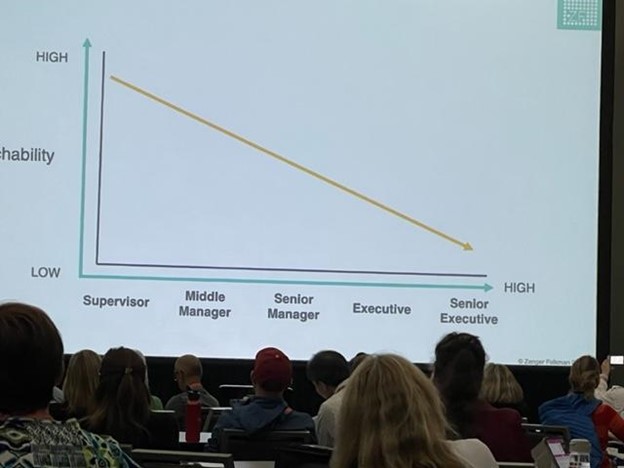
In one of the sessions at ATD ‘23 by Zenger Folkman, it was discussed that with more experienced leaders, coachability decreases. (Yes, that says “Coachability” on the left axis, my camera skills attest to capturing this during a live session!)  Senior leaders have been through a lot of training and I suggest the ELI assessment as a tool that could provide new insights into how they are leading today.  

In summary, embracing Energy Leadership can inspire peak performance from individual employees and transform the culture of organizations. A key element to Energy Leadership is that we are all leaders, every day, in every area of our lives. Energy Leadership can help individuals skillfully lead when interacting with others.

Further reading: Should I work with an Energy Leadership Coach?

Learn more at https://www.energyleadership.com/ or reach out to me at patriciacotter76@gmail.com or pcotter@mit.edu

Four Highlights of the ATD’23 Conference

In May, I traveled to San Diego to present at the Association of Talent Development’s ATD ’23 conference which featured over 250 sessions to educate and inspire professionals in the talent development field.

This is a terrific conference for Learning and Development (L&D) leaders to share insights, research, and best practices, and when my colleague Rita B. Allen, and I learned our presentation was accepted for the conference, we were thrilled. (Rita, author of Personal Branding and founder of Rita B. Allen Associates, has presented at the conference before and says only a small percentage of submitted presentations are accepted, so this was music to our ears.)

Our session, titled Think Like an Entrepreneur: Foster Creativity in Your Organization, aimed to help L&D professionals take lessons from entrepreneurship and apply them to their organizations. This is different from the audiences of entrepreneurs I usually present to. With this audience, there is an opportunity to bring some frameworks that might help foster the entrepreneurial mindset in their organizations or unleash their inner entrepreneur. For that, I am grateful for the opportunity.

Since this message is something that we’d like to share more widely, I’ll be writing blog posts on the elements of our presentation, including disciplined entrepreneurship, an antifragile and entrepreneurial mindset, and energy leadership. Before I dive into those topics, however, I’d like to share four highlights of the conference – and positive messages that I walked away with. These are not in any particular order, other than they build on each other. 

Adam Grant

If you’re not already a fan of Adam Grant, he is an organizational psychologist at Wharton, a best-selling author, and the host of the TED podcast WorkLife. If you don’t follow Adam on social media, I suggest you start – his practical advice on work/life balance is a breath of fresh air. Adam hosted the opening general session, titled Think Again: The Power of Knowing What You Don’t Know. He covered a lot of ground, but three things stood out from his keynote:  

  • Invitations into your network should be given to “disagreeable givers” — blunt people who aren’t afraid to tell you hard truths, but who also have your best interests at heart. An example for those familiar with the Ted Lasso TV series is Roy Kent.  
  • “Unlearning” often focuses on making room for new learning. This lets you address things you are doing that are not servicing you or others. Adam explains it takes courage to unlearn. Unlearning requires the integrity to admit that you were wrong yesterday. Learning is how you evolve. Unlearning is how you keep up as the world evolves.
  • As an entrepreneur, Adam also discussed scientific thinking and its impact on startups. Thinking more like a scientist, having the ability to pivot, individuals with the humility and curiosity to search for information all support entrepreneurship success.
Session capture by Lisa Rothstein

Priya Parker 

Facilitator, strategic advisor, and author Priya Parker presented on The Art of Gathering. Priya presented a new – at least new to me – way of thinking about how you hold meetings and gatherings. She spoke about how these gatherings should be intentional and benefit from setting expectations around the goals of the meeting, party, or gathering. The intent in the design is critical to ensure that both the host’s and guests’ experience is as intended. 

This made me think about how I am designing my summer entrepreneurship classes with MIT/Dalhousie with specific learning content. I do focus on the experience for the students, but the classes are much more focused on the content. This talk offered me a fresh look at hosting and attending events from now on, putting some boundaries around what is acceptable. It works best if you are super-specific about the intention of a meeting (or another event) and specify what you intend to accomplish. Priya recommends starting with a strong opening and closing as opposed to covering logistics. 

Session capture by Lisa Rothstein

Katrina Kennedy

Known to the training community as “the trainer’s trainer,” Katrina Kennedy’s session was titled It’s All About Retrieval and discussed the retrieval of information. She explained that retrieval is more than just recall; retrieval is accomplished in a way that you have context for the information. Learning needs to be varied, spaced, and interleaved. The retrieval practice needs to focus on learning. How many times have you re-read material several times and still not been able to recall the information when it is required?

Rita B. Allen, Katrina Kennedy, and Trish Cotter

Retrieval in practice is what we refer to as “use it or lose it.” If you want to play a piece of music and it is difficult to start, the struggle to learn to play it is actually a “desirable difficult” process that helps you solidify the learning. This isn’t about repetition. It is about spacing and breaking up the learning. In the classes I teach, I use breakouts to discuss further and debrief concepts as well as games to reinforce learning. Still, this retrieval discussion brought both the unlearning and learning of new ways of teaching and the intention to gather for a class together. The most memorable experiences will be those in which you have “desirable difficulty.”

University of Pennsylvania Chief Learning Officer Ed.D. Program

One personal highlight at the conference was the scholarly presentations of University of Pennsylvania Chief Learning Officer (CLO) doctorate graduates. I graduated from this program with an M.Ed. ’13 and Ed.D. ’14 and couldn’t be prouder! I wanted to give a shout out to these amazing presentations by my fellow Penn CLO grads:

  • Dr. Carol Henry (Implications for Practice: Behaviors and Competencies for Future Leadership Development Programs)
  • Dr. Jennifer Neumaier presented her dissertation: A Perspective Study on Cultural Conditions That Enable Social Learning.
  • Dr. Kandi Wiens, is a Senior Fellow and runs the master’s portion of the program at Penn, also presented the Ed.D. program and her research which will be out in her book due out next year, Burnout Immunity: How Emotional Intelligence Can Help You Build Resilience and Heal Your Relationship with Work. (Read her recent HBR article on Has Cynicism Infected Your Organization?)

If there was any concern that COVID slowed down the Penn CLO program, it was clear that this was not the case! Applications are up, the strength of diverse cohorts was showcased, and the quality of the research adding to the field of Learning and Development and other areas was on display at ATD ‘23.

In closing, post-COVID travel to a conference can often feel tougher than before, yet the amazing and energized professionals I met, and the concepts discussed at gatherings like this were worth the effort and can unexpectedly warm your heart.

In the face of Massive Layoffs, why should I work with an Energy Leadership Coach?

People in today’s workforce face stress – and lots of it. Layoffs, quiet quitting, a general sense of pandemic fatigue, and recessionary pressures are hitting all of us.

For corporate leaders, this stress is multiplied. Leaders are dealing with teams that are unmotivated and exhausted. In some organizations, leaders need to cut positions and continue to drive the business forward with fewer resources. Paradoxically, in other companies, there are open positions that are difficult to fill, and existing team members are stretched thin.

Burnout is real, and whether your company is primarily working from home, returning to the office, or trying a hybrid model these days – you are likely facing challenges and trying to figure out what works best. (Of course, some industries such as healthcare never had the option to work from home and the stress of these workplaces can be off the charts.)

What can we do about it? This article is about Energy Leadership™ and how you can use your energy to show up every day as your best self.

What is Energy Leadership?

Your life experiences significantly impact how you perceive things. This affects your energy in different situations. Although you may not be aware of it, you may be realizing less than your full potential at work, at home, or in social situations. 

Energy Leadership refers to both a particular and unique form of leadership, and to the process of leading energy so that it works for you, rather than against you. By learning and applying the principles and concepts of Energy Leadership, you can increase your ability to shift your own energy and the energy of those around you. When you do that, you will help inspire and motivate yourself and others, feel a greater sense of purpose, get more done with much less effort and stress, and constantly attract positive and powerful people and success to you.

If you manage people, an entire team, or a whole organization, your responsibility – and ability to influence the energy of that group – grows. Every interaction presents the opportunity to lead and have a positive impact on others. You not only need to show up with your best energy, but you need to motivate your team to recognize and harness their own energy.

That’s where Energy Leadership Coaching comes in.

How is Energy Leadership Coaching Different from Other Types of Coaching?

Many people are familiar with an executive coach, a career coach, or a life coach – Energy Leadership Coaching is different from all of these, yet it can help you with each of these aspects of your life.

Energy Leadership Coaching begins with an Energy Leadership Index (ELI) assessment, which applies a numerical value to the types of energy you experience in different situations.  It is not a personality test; it is an attitudinal assessment.  We use this assessment as a starting point, and coaching helps you identify where you believe you would like to spend more of your energy to gain the results you want.

You can work with a certified Energy Leadership coach, like me, with over 300 hours of coaching through iPEC, the Institute for Professional Excellence in Coaching. This will help uncover your unique energetic profile and your energetic stress reaction, and how they can be harnessed to reach your specific goals and potentially shift awareness and mindset.

What Types of Energy May be Affecting Me?

You lead with your energy. Everyone has a unique level of energy due to lived experiences. Whether you are a corporate leader or not, your energy is how you lead and influence your friends, family, and colleagues. Everyone has the potential to positively or negatively affect those around them.

As an overview, there are two main types of energy: anabolic and catabolic. Anabolic is typically thought of as constructive, fueling, healing, and growth-oriented energy. Catabolic is typically thought of as draining, resisting, and contracting energy, yet catabolic energy can be helpful for focusing and protecting us when experiencing uncomfortable situations.

Both types of energy serve a powerful purpose. And you determine how to use each type of energy appropriately, either with a thought or mindset, emotion, action, or inaction.

Who Benefits Most from Energy Leadership Coaching?

Anyone who wants insight into where they are spending their energy can benefit from Energy Leadership coaching. It can help you find areas where you can do more of what you want to do and develop strategies to improve energy-zapping situations. 

 Why is this Especially Well-Suited for Corporate Leaders and their Teams?

Executives have developed patterns over time and are often frustrated by certain situations without understanding why. Energy Leadership helps bring issues to the forefront to let you make changes if necessary. How you show up matters and all of the people you interact with – whether employees or family or friends – look at your actions more than your words.  With Energy Leadership coaching, you can identify patterns and learn to model your actions to best harness your energy.  

Can Energy Leadership Help to Build Better Relationships with Remote Teams?

Connections are so key, particularly in a remote situation. Leaders need to consider how they show up to their employees. Are your employees just listening to video calls on mute and not interacting? Are new employees feeling connected to the organization and their teams?  You can create an atmosphere of learning, risk-taking, and opportunities with a foundation of trust and creativity. However, you must understand what motivates you and your employees. 

Improving team dynamics so there is accountability and understanding can significantly improve performance – whether in a remote, in-person, or hybrid situation.  A manager or executive who feels there are barriers in the way of the organization’s creativity and communication can use Energy Leadership to improve interactions. Any time individuals or teams can better understand what is getting in the way of success – and fix the issue — results in a win for everyone involved.

What are the Takeaways?

Energy Leadership can profoundly change your leadership style. It helps you to become more self-aware and realize what messages you are sending, and how you can change this dynamic or shift your leadership style to bring out the best in your team.

Interested in learning more about Energy Leadership Coaching?

Send me an email and I’d be happy to share more information.

Regaining my Footing

We take a lot of things for granted in this life … like walking.

Last winter I had some pretty extensive foot surgery. Sure, I expected some recovery time, but it was longer and involved more rehabilitation than I had counted on – I essentially needed to learn to walk again after being in a cast, and then a boot for three months.

Although this isn’t the heroic story of someone who learns to walk again after losing a limb or being in a severe accident, it certainly was humbling for me. This setback made me reflect on how, in life, sometimes you need to stop, assess, and start again from the beginning. When you can’t walk, it is certainly a wake-up call – and you put yourself in the hands of experts.

 At some point in our lives, we all need to reach out for help and lean on other people (sometimes literally!). Taking those “baby steps” again as I re-learned the basics of balance, stability, and moving my body in the correct way made me think of the parallels to coaching. The physical shifts and the mental shifts involved mirror each other.

In my energy coaching practice, I am the one telling others to start at the beginning, work from the ground up, and lean on me for support. Just like my physical therapists, I am trying to help people get from one place to another. It’s not always easy, and often, it takes a lot of hard work over a period of time to get there.

I am now through the worst of it and walking several miles each day. I’ve realized the surgery and all the physical therapy were worth the end result. Here are the lessons I’ll try to hold on to and embed in my coaching practice:

  • Don’t take things for granted. Easy to say … hard to do. Be grateful for what you have and try not to be resentful when you no longer have those things.
  • It’s OK to start all over again. We are all starting from different places, and sometimes you need to regroup and go back to square one.
  • You will get discouraged. And angry. And furious. It’s natural to get discouraged but remember you are learning and perfecting the process.
  • Reach out for help. What resources do you have? Although it might not be in your nature, take stock of the people or organizations that are there to help and lean on them. When you lose hope, those folks can help lift you to the next milestone.
  • Take baby steps. It’s natural to want to hurry up and do all the things necessary to get better. But sometimes slow is good. If you can trust your guide (therapist/coach/mentor), learning each new step can end in a better result.
  • Be realistic. Be realistic with yourself that change is going to take time. Also be realistic about the milestones that will get you there.
  • Gain new perspectives. Sitting on the sidelines gives you a new appreciation, and also time to look at things with fresh eyes.  Shifting your perspective may help you understand situations better
  • Be aware of your blind spots. Sometimes you don’t see the bumps in the road that may trip you up. When reassessing your goals, try to be consciously aware of your blind spots. Believe me, I have a new appreciation of physical accessibility issues, something that I had not considered much in the past.
  • Keep your skills current. This is always a good practice, but my forced slow-down gave me a chance to do some research and work on some new skills as I was recuperating.
  • Just keep swimming. As Dory tells Nemo, in Finding Nemo, “just keep swimming” or walking! Try to make forward progress each day. . Keep moving and you will regain strength, whether it is physical or mental.

Life may throw us curveballs, but we need to gain wisdom and knowledge from those experiences in order to forge ahead.