Accelerator Programs in the U.S.

In my role as Entrepreneur in Residence at MIT and Program Director for MIT’s Global Founders’ Skill Accelerator (GFSA), I’ve been researching accelerator programs worldwide, and I thought I’d share some of that research in a series of blog post. This is the second post in the series; read the first post here.

startup picIn recent years, many global accelerator programs have launched in the US, and Silicon Valley certainly takes the lead in this effort. The original accelerators such as Y Combinator or Techstars are still regarded as leaders, followed by many other programs as role models.

However, the sterling lineup of mentors in Techstars or YC makes these two programs highly desirable to both entrepreneurs and the venture capitalists. As literally hundreds of startups from all over the globe appear everyday looking for ideal accelerators, it is prudent to know that joining an accelerator program in itself does not guarantee success.

Incubators versus Accelerators

When Paul Graham created the Y Combinator program in 2005, the program was thought of as an incubator, which largely promises office space in exchange for equity. However, later this program developed into a strong accelerator displaying marked differences from the incubator model. While both the incubator and the accelerator share a common mission of guiding a startup, the main differences between the two are the applicable time periods which are short and defined in case of accelerators; time-bound funding in exchange of equity for accelerators; and the rare incentive of A-list mentors offered by most accelerators.

The 500 Startups accelerator network has connected the Silicon Valley with the rest of the world in an excellent manner. Catering mostly to international startups, this program is doing a commendable job of supporting startup founders from abroad to get their feet wet.

Accelerators Who Take Equity versus Who Don’t

It is widely known that YC takes 7% equity, 500 Startups takes 5%, but there are some accelerator programs who take as much as 50%. This practice may make it difficult to raise another funding round later with less equity to offer VCs.

On the other hand, the programs offered by top university campuses like MIT, Stanford or Harvard do not take any equity from student companies. Non-academic accelerator programs like Mass Challenge also do not take any equity. The programs who do not take any equity usually demonstrate strong networks with the VC community and other corporate sponsors for fund raising issues.

Academic vs. Independent Accelerator Programs

The accelerator community in the U.S. can be broadly divided into two segments: The accelerators owned by university campuses and the independent accelerator programs. For additional information, budding entrepreneurs with startup ambition should refer to this Mashable article: The Pros and Cons of Startup Accelerators.

The accelerators who take equity believe they are the ones who will finally survive; they say accelerators who have no financial stake in a startup are simply there for public relations and no real financial growth for the company. Yet, educational accelerators are driven by universities, with unique capabilities and access to talent. My next post will delve into some of the best academic accelerators in the U.S.

If you want to read my next post in this series check back here on my blog or follow me on LinkedIn or Twitter, as I will post about new updates there as well.


Accelerator Programs: How they stack up


Accelerator_1Inc. magazine
reports that accelerator programs in the U.S. have doubled every two years between 2008 and 2014 with roughly 172 accelerators in America today. With entrepreneurship rapidly growing and reshaping economies on a worldwide basis, accelerator programs can enable entrepreneurs to jump start their businesses and help attract venture funding.

The primary role of an accelerator program is to facilitate rapid growth of a startup company through planned funding, mentorship, resources, guidance, and community support in exchange for equity or pure satisfaction.

Many people are familiar with programs like AngelPad, MuckerLab, Techstars, and Y Combinator (which now actually classifies itself as a seed fund), but many universities have their own very successful accelerator programs as well.

In my role as Entrepreneur in Residence at MIT and Program Director for MIT’s Global Founders’ Skill Accelerator (GFSA), I’ve been researching accelerator programs in the U.S. and how they compare with programs in India, China, and Europe – and I thought I’d share the highlights of some of that research in a series of blog posts.

How Does an Accelerator Program Work?

In a typical accelerator program, the program offers seed funding, office space, access to technology, expert mentorship, and an inspiring community environment—all packed into a limited time frame, usually three to six months. In most accelerator programs, the final benefit to the startup is a repeatable model, which may be used many times to churn out successful companies in an assembly-line fashion.

So what will the accelerator programs gain in return? Well, the gain may be company stocks, equity, or just plain satisfaction of being able to mentor startups to the level of fully operational businesses.

However, as literally hundreds of startups from all over the globe appear every day looking for ideal accelerators, it is prudent to know that joining an accelerator program in itself does not guarantee success. Here is an interesting tutorial on how to join an accelerator program from Business News Daily: Accelerator Programs 101: How to Apply and What to Expect.

The article points out that the typical applicant is in the early stages of business development and has either just launched or is getting ready to do so. Many companies that join an accelerator have a finished product or concept, and may have even raised capital, but others may only have an idea and no funding whatsoever. Startups that may be looking to join an accelerator must have certain prerequisites and the right mindset.

Prerequisites for Joining an Accelerator

Wherever in the world you are looking to join an accelerator, there are some common prerequisites. In order to locate a good match between a startup and an accelerator, startups ought to consider these prerequisites:

  • You must have a product—not just an idea!
  • You must be willing to take financial risks.
  • You must be willing to wait and watch, while you are learning about the startup process.

Without the right mindset, a startup, no matter how enthusiastic, will not be successful.

Entrepreneurial Growth on the Rise

In a recent CNBC report, the Kauffman Foundation’s Startup Activity Index shows that in 2015 U.S. entrepreneurship levels had the greatest year-over-year increase in the past two decades. The group estimates that every month, some 530,000 Americans become new business owners. Yet, statistics show that as many as 90% of startups fail, so seeking out an accelerator program can help startup ventures beat the odds with resources, networking, and experienced mentors.

I’ll be sharing a series of blog posts on accelerators around the globe – and the approaches taken by different regions. For my next post check back here on my blog or follow me on LinkedIn or Twitter, as I will post about new updates there as well.

Can you guess which country has the world’s 10th largest economy?

Illustration: Christine Daniloff / MIT

Illustration: Christine Daniloff / MIT

Did you guess Russia, with a Gross Domestic Product of $1.86 trillion? You’re right!  – sort of.  It’s a trick question, because really, I want to talk to you about entrepreneurship.

With nearly $2 trillion in annual revenues, the impact of companies founded by living MIT alumni is roughly equivalent to the GDP of the world’s 10th largest economy. Wow! Even working day-to-day in the Martin Trust Center for MIT Entrepreneurship, I still find these numbers staggering.

In a recent report, MIT unveiled that the university’s alums have founded 30,200 active companies that generate annual revenues of $1.9 trillion and employ approximately 4.6 million people. This is quite impressive, especially given the fact that the researchers excluded companies that are no longer active, as well as many large companies whose co-founders are deceased, such as Hewlett-Packard, Intel, Raytheon, and Texas Instruments.

In a first-of-its-kind initiative in 2003, Professor Edward Roberts along with then PhD student Charles Eesley developed a survey to explore the entrepreneurial activities of MIT alumni. In 2014, Professor Roberts and Associate Dean Fiona Murray updated the data, assisted by PhD candidate J. Daniel Kim.

The report shows a shift in entrepreneurial activity over the past decade. On one hand, fund raising and capital access became more challenging as the US economy entered a recession in 2007, resulting in declining venture capital assets and investments. On the other hand, entrepreneurship may be seen as a more appealing career choice than working for a large corporation. The proportion of MIT undergrads selecting employment in venture capital–backed start-ups upon graduation increased from less than 2% in 2006 to 15% in 2014.

The average age of MIT entrepreneurs has also decreased. The age dropped from 39 for alumni who graduated in the 1940s, to 30 years old for those graduating in the 2000s, to today’s median age of 27. The factors contributing to this are not entirely known, but it could be tied to the rise in service-based businesses which are less capital intensive, today’s tools such as cloud computing and application program interface (API) tools that can reduce IT costs, and enhanced access to alternative forms of capital, such as crowdfunding campaigns.

Here are a few more stats about MIT entrepreneurs and their businesses:

  • 25% of MIT alumni have founded companies, with 40% of those considered serial entrepreneurs, founding two or more companies.
  • While roughly only 8% of MIT undergraduates were admitted from Massachusetts, 31% of alumni-founded companies in the US are based here, followed by 21% in California and 7% in New York.
  • The rate of startup foundation by gender is 12% for women versus 29% for men—a more than two-fold difference. This finding is consistent with the fact that roughly only 30% of U.S. businesses are women-owned.
  • MIT alumni-founded companies have a better track record than startups as a whole. 80% of MIT startups survived five or more years and 70% have survived 10 years. Compare this to the U.S. average of roughly 50% of startups last five years and only 35% last 10 years.
  • Overall, 2% of MIT alumni companies in the survey experienced an IPO while 8% were bought out through acquisition as an exit strategy. The majority remain privately held.

Why so many successful MIT entrepreneurs? MIT’s ambitious entrepreneurship educational program rests upon three principles: 1) “Mens et Manus” (Mind and Hand), 2) teams, not individuals, and 3) cross-disciplinary collaboration. These principles are reinforced by the support offered by the Martin Trust Center and by other centers and programs committed to the innovation inherent at MIT. Together we work across campus to go beyond the classroom and engage all MIT students in co-curricular activities that strengthen the entrepreneurial practice and skills.

You can check out more fascinating statistics in this MIT News article or download the full report.


Innovation in Real Estate: An Entrepreneurial Perspective

Presenting at MIT's Innovation in Real Estate Conference

Presenting at MIT’s Innovation in Real Estate Conference

I recently participated in the Innovation in Real Estate Conference at MIT, held at the MIT Media Lab. (If you don’t know the Media Lab at MIT, it is a magical place from the moment you step foot in the building. Art, Engineering Disciplines and Business are integrated into a place where creativity is encouraged and interdisciplinary work is the norm. I love it there!)

At the conference, a team from our summer GFSA Accelerator Program asked me to participate on a panel about the role real estate plays in innovation. Real Estate is essential in setting the right structure for an organization. For both businesses and institutions, space is often at a premium and you need ensure you use it wisely. This led me to think about the space we have at the Martin Trust Center for MIT Entrepreneurship that houses the Accelerator program, and also the role of real estate and the workplace of the future in three of the start-ups recently launched.

MIT’s Martin Trust Center Expands to accommodate more Accelerator Teams

At the Martin Trust Center, we have an open area that also has conference rooms, phone rooms to make calls all over the world, office supplies and equipment … and all the coffee, Ramen Noodles, and oatmeal that students can eat! We are expanding our space, and with that expansion we hope to take in 50% more teams into the Accelerator. This is terrific news to the applicants where turned many teams away.

The Trust Center at MIT is a work space that is supported by mentors and staff who help enhance learning and enthusiasm. Speakers who present at the center are MIT faculty, community leaders, and practitioners. Both the space and the people at the center make it a vibrant place to work.

Why is the space special? It is a place where like-minded people can meet and share ideas, coffee, and work in a collaborative work space. It is also where some of the new ideas about what a workplace will look like in the future.

Workplaces of the Future

Real estate innovation also encompasses how spaces will be transformed to fit future needs. Four of the start-ups who were part of the Accelerator program look at space in a new and innovative ways.

Spyce is a healthy automated restaurant that fits into a 20 square foot area, Tekuma curates art for Airbnb’s unique places to stay (and our space as well!), Morphlab is another real estate related venture that brings robotic furniture to small spaces to increase functionality. And, finally Smarking addresses the real estate of parking spaces with an application that optimizes parking. These are just a few of the new projects that are bringing innovation to real estate.

The message at the conference came through loud and clear that innovation in real estate is here. On a personal note, I can tell you as we reconfigure our space at the Trust Center, optimization and utilization are important, but maintaining the collaborative and entrepreneurial culture is first and foremost.

MIT Demo Days in Review: Whirlwind through Boston, NYC, and San Francisco!

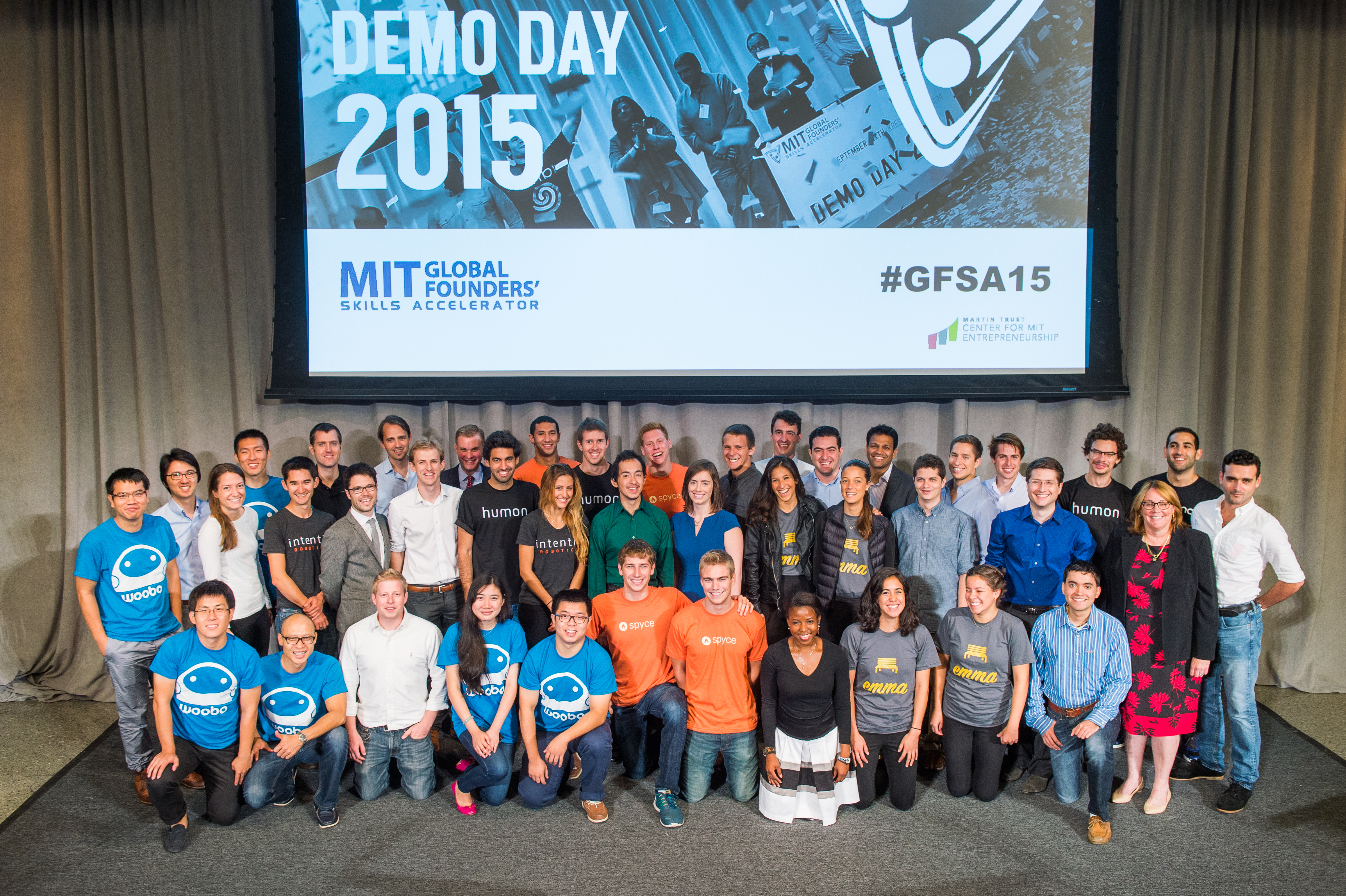
MIT Demo Day 2015 - Boston

MIT Global Founders’ Skills Accelerator (GFSA) student entrepreneur teams
and their advisors at Demo Day 2015 in Boston

What an exciting few weeks it has been! Starting at the MIT campus on September 12, MIT’s Global Founders’ Skill Accelerator (GFSA) has recently completed outstanding presentations to over 1,200 attendees at Demo Days in Boston, New York City, and San Francisco.

Fourteen teams started with the accelerator at the beginning of summer – my first summer as GFSA program director and Entrepreneur in Residence. Twelve teams made it through the summer boot camp, yet the experiences of the two that didn’t make it to Demo Day are as important as the 12 that did. The lessons of leadership and commitment – along with knowing when to pull a plug on a business or pivot when the business doesn’t align with your goals – are key lessons for entrepreneurs.

The teams that came into the boot camp were students as undergraduates, Masters students, and Ph.D. students. Many graduated from MIT in June after the Accelerator program started, savoring their accomplishments for just a day or two before jumping back into the demands of an educational accelerator boot camp. Directing this program for the first time, I observed a very ambitious group that was also very aligned with the MIT community culture, which supports the teams through its educational process and ecosystem.

Life in Entrepreneur Boot Camp

The boot camp curriculum was mixed with faculty from MIT and community practitioners that offered the students the fundamentals and the application of concepts that are key to building a company, understanding your customer, creating a product customers will purchase, having a team that is committed and understands the vision, as well as understanding business and investment fundamentals. The boot camp puts a heavy emphasis on learning about the motivations and needs of every participant in the value chain you want to enter.

The focus on the customer and primary market research for many of the teams was a challenge. I came into the program with the belief that MIT students can solve any technical problem and that was validated. However, I did see many students challenged when it came to listening to customers, iterating on their product based upon that feedback, and communicating to investors, other students and the community about their company.

Can the MIT accelerator experience be replicated? I am sure it can, but MIT is helped immensely by its culture and its ecosystem. The MIT culture one of creativity, supported by an ecosystem that puts an instructional focus on user-focused business and product design. It is a culture that supports entrepreneurial activities at every stage of the journey.

2015 MIT Global Founders’ Skill Accelerator Companies

Here are the 12 outstanding startups that presented on Demo Day. If you are interested in learning more, their website or contact information is included. At this stage, many of the companies are actively looking for advisors, are hiring and several will be fundraising. You can also view the video of the entire Boston Demo Day event here.

Genesis DNA is developing a next-generation gene synthesis technology that can synthesize gene length DNA at a fraction of the price and turnaround time of existing services. (Genesisdna.com)

Humon is building a wearable which non-invasively measures the way athletes’ muscles use oxygen in real time, identifying their lactic acid threshold and unlocking their true potential. (Humon.io)

Intentiv Robotics is creating the first Aerial Control System for drone cinematography, giving videographers full manual control of their aerial camera and allowing them to execute complex aerial shots intuitively. (Intentiv.io)

Khethworks makes reliable, solar-powered irrigation systems designed for small-acreage farmers that enable their customers to cultivate year round and already has multiple pilot sites on the ground in east India. (Khethworks.com)

Lumio is building a digital health companion, powered by their revolutionary device that provides clinical-grade diagnostics in the home in hours instead of weeks. (Email info@lumiohealth.com)

Morphlab is a company that is focused on furniture with superpowers. The team is creating scalable technologies that enable reconfiguration of interior spaces that dramatically increase efficiency, affordability and functionality of urban micro-apartments. (Morphlab.com)

Sandymount has proprietary tools to ship natively brewed beers internationally while maintaining the flavor and experience they would have in their region of origin in a cost effective manner. (SandymountTechnologies.com)

Spyce is developing the world’s first completely automatic restaurant. A Spyce kitchen cooks and serves delicious meals from fresh ingredients with no human involvement. (spyce.io)

Tekuma connects artists with Airbnb hosts to create personalized galleries in shared living spaces. At the nexus of art, hospitality and real estate they can enhance exposure, environments and guest experience. (tekuma.io)

Woobo opens the world of imagination, fun and knowledge to children, bringing the magic of a robot companion to their lives. A plush doll with artificial intelligence capabilities, Woobo gives children infinite access to stories, music, and knowledge, which are developmentally appropriate and will help them grow. (woobo.io)

In addition to the MIT-led teams there were two international teams:

Emma from ITAM in Mexico City is a company that provides companionship and mobility assistance for the elderly generation. It connects decision makers, their son or daughter, with a companion that best fits their love one’s needs. (miemma.com)

VSParticle from TU Delft in the Netherlands is revolutionizing how electronics are manufactured. The company core technology enables them to fundamentally change the current production system, replacing the wasteful etching process by a simple printing process. (vsparticle.com)

Again, all the best to the spectacular start-ups that worked so hard this summer!

September 12 is Demo Day at MIT!

Demo Day 2015 It’s like the first day of school jitters magnified a thousand times … MIT’s Demo Day is coming September 12th!

What is Demo Day?

Demo Day is an event put on by the MIT Global Founders’ Skills Accelerator (MIT GFSA) and will showcase passionate and talented entrepreneurs at MIT and their innovative, potentially world-changing, companies.

On Demo Day, each of the groups that have been working in the accelerator will present their company to a live audience. As an Entrepreneur in Residence at MIT, this is my first time guiding students through the process, and we’ve certainly had an exciting summer. Some of the challenges the teams faced were moving from a concept to a real plan for a product or service, defining their beachhead market, determining costs and pricing, and figuring out how to clearly and succinctly present their ideas to the board.

Who will be presenting?

We can’t reveal the companies or their concepts until September 12th, but innovative ideas will be presented by 14 fantastic teams – with inspirations that cover everything from fitness to farming to fertilization. To whet your appetite, here’s a recap of inspiring startups from last year’s Demo Day.

As the premier university student accelerator in the world, the MIT GFSA provides a capstone educational opportunity for MIT student entrepreneurs and prepares them to hit “escape velocity” and launch their companies into the real world. We hope you can join us for this amazing event.

Yes, you can attend!

This event is open to the public! Last year, over a thousand people gathered to see the latest innovative companies presented.

Join us in the heart of MIT under the dome in 10-250. (Overflow space will be available where the presentations will be live streamed.) Demo Day is free; but, you do need to register in advance. Come and encourage our next generation of entrepreneurs in Boston! You can also watch the live stream from your computers. And, after the Boston event, we’re on to New York and San Francisco … I’ll keep you posted!

MIT Global Founders

Closing the Opportunity Divide … one person at a time

Francilia Jones, my Year Up mentee

Francilia Jones, my Year Up mentee

Watching your child succeed at something important in life tends brings that choked up feeling – pride swells your chest and you blink away a tear or two. Well, Francilia Jones is not my child, but I’ve mentored Francilia over the past year, and I felt all those same emotions as I watched her give her graduation speech at this year’s Year Up graduation ceremony.

Year Up is an organization that empowers urban, low-income young adults to go from poverty to professional careers in a single year. As a mentor at Year Up in Boston, every year I’m amazed at the transformation of these young adults. They come to the program with talent and motivation – but, unfortunately, lack skills, experience, and opportunities. However, with the help of Year Up, these young people can gain six months of professional training in IT, Finance, or Customer Service, a six month corporate internship with a respected company, and up to 24 college credits – all in the course of one year.

The program’s success rate is impressive; 85% of Year Up graduates are employed or attending college full-time within four months of completing the program. Those employed earn an average starting salary of $16 per hour – $32,000 per year for salaried employees.

In Francilia’s case, her family was supportive and she was accepted into her dream school, the University of North Carolina at Chapel Hill. However, a family illness and other misfortune meant that she could not afford to attend the school. She tried working to save money to do it on her own – and one day, Year Up’s Director of Student Services for Boston, Rob Fladger, entered the branch of the bank where she was working and told her she looked miserable. He told her about Year Up and she even attended an information session.

However, Francilia still wanted to do this on her own and tried attending college for one semester while working 70 hours per week. Needless to say, that didn’t work out. She still had Rob’s card and gave him a call. By joining the Year Up program, Francilia completed an internship at Harvard University and gained a passion for technology. She now hopes to attend community college and then gain her bachelor’s degree in computer science. She is also looking to work part-time to fulfill her goals. In the entrepreneurship program I help to lead at MIT we call it “escape velocity” and Francilia is on her way, but finding a job still is not easy.

In her graduation speech Francilia states, “I always knew that I could be more than by current situation. I always knew I could be better than my struggles.”  I couldn’t agree more.

I believe this really summarizes the Year Up program, and how it helps bright, motivated young people overcome their current situations. Year Up calls this the “Opportunity Divide” – millions of young adults in the U.S. have talent and motivation, but lack opportunity. They estimate that 6 million bright young people are without access to opportunities to connect to the economic mainstream. Meanwhile, over the next decade, American companies will face a shortage of over 14 million qualified workers. Year Up’s mission is to close the Opportunity Divide.

I wanted to share this experience because being a mentor is one of the most fulfilling things that I’ve done. It puts your personal issues into check, and you just feel good helping to guide someone who is so motivated to succeed. Year Up is always looking for more mentors, so I encourage others to share their time and talents and learn what it takes to become a mentor for Year Up – they have locations in many cities throughout the U.S.

Plus, I’d also like to put a shout out to my network – Francilia is looking for her next job opportunity, preferably in the technology space. Any interest in hiring a hard-working “go-getter”? Please let me know and I will make the connection.

Year up logo

Are you a Disciplined Entrepreneur?

Picture1_croppedAs some of my loyal blog readers know, I’ve recently started a new position as Entrepreneur-in-Residence at the Martin Trust Center for MIT Entrepreneurship.

I’m thrilled to have joined this incredible program at MIT, and have met some wonderful people, including the Center’s Managing Director Bill Aulet. Bill is also the author of a book called “Disciplined Entrepreneurship: 24 Steps to a Successful Startup.” I’ve enjoyed reading it and thought I would share some of the highlights.

In my mind, “disciplined” and “entrepreneur” – are two words that are seemingly in juxtaposition. Most of us think of entrepreneurs as brilliant people with lots of ideas flying around in their heads and innate entrepreneurial talent. We think that they get lucky – or, are at the right place at the right time – when they actually launch a business based on one of these ideas.

In his book, Bill asserts that entrepreneurship can be taught, and that intelligent, hardworking people can become successful entrepreneurs by following a systematic, disciplined approach to starting a new company.

The book is structured around six themes, and the 24 steps mentioned in the title each fall into one of these themes:

  • Who is your customer?
  • What can you do for your customer?
  • How does your customer acquire your product?
  • How do you make money off your product?
  • How do you design and build your product?
  • How do you scale your business?

Bill points out that while following the sequential steps, entrepreneurs will undoubtedly learn new information that will take you back to revise what you’ve done in previous steps. The graphic showing the steps is a wonderful curvy path with “go back” arrows reminiscent of the game Candy Land. This shows me that that wacky, yet brilliant entrepreneur is in there somewhere! Yet, I love that the steps give structure to the process of launching your own business.

I also really embrace the idea Bill sets forth in his book that “ideas mean nothing without execution.” If there was one nugget of advice that I would share with entrepreneurs, this would be it.

As an entrepreneur myself, I value the examples in every chapter, drawn from projects that Bill has worked on with MIT students. Bill uses these real-life examples to guides those with ideas, new technologies, or passion into channeling that energy into a viable business.

At MIT, I am currently taking 14 student-founder teams through the disciplined entrepreneur process in a program called Global Founders Skills Accelerator (GFSA) … I will let you know how it goes!

Does our Education System Benefit from Data-driven Decision Making?

THE Journal cover story on

THE Journal cover story on “The Power of Small Data”

Big data is everywhere. You may not expect it to impact how decisions are made in a kindergarten classroom, but big data and analytics are becoming more deeply engrained in the education system – even at the youngest grade levels

A recent article in THE Journal on “The Power of Small Data” asserts that in order to deliver personalized education, districts have to gather and share students’ statistics. The article goes on to explain how the strategic use of data can boost teaching and learning.

The author was kind enough to reach out to me to provide some context for this article. My dissertation for my doctorate in work-based learning at the University of Pennsylvania focused on “Analytics by Degree: The Dilemmas of Big Data Analytics in Lasting University/Corporate Partnerships.” I was able to share my insights in higher education, and also discuss how big data has a major impact on school systems at every level.

Here are some excerpts from the article, along with some of my additional thoughts and research on the topic:

I am seeing a renaissance in data collection in the education field, supported by new tools and technologies. “Recent technologies like big data, the Internet of Things, mobile apps and improved storage have made it possible to acquire, combine, store, analyze, interpret and report findings during any phase of data management.”

“The data repositories residing in disconnected, fragmented departments with little sharing have now been transformed into centralized, interrelated data systems to enable fast and efficient retrieval of interrelated data for quick and informed decision-making.”

However, leadership, based solely on data, will not be successful. Educational systems need to involve key players in the community, particularly the educators themselves, to listen and ascertain what is needed most.

As the article points out, analytics can have many positive uses in the school system, including:

  • Instant Feedback for Students and Parents
  • Formative Assessments that Help Students Grow
  • Using Data to Connect people

However, sadly sometimes educators are spending so much time gathering data (and posting it) that there is little time for instruction. We need to think of how technology, data collection and the onus on high test scores impacts our next generation.

“Data is not the problem. The problem is getting the data to the right people so it can be used…. Data only tells part of the story, and a lot of it is basic so it doesn’t provide the insights that teachers and schools need to pinpoint teaching and learning problems and identify the best ways to solve them.”

We need to ensure that the educators are involved in determining what is needed in terms of useful data, and that a balance is achieved between gathering and analyzing data and effectively teaching our students.

I encourage you to read the full article to learn more.

Preparing Today’s Students: Notes from the 2015 T-Summit

what-is-tHow can industry, universities and students work together to address the business analytics skills gap?

I was fortunate to speak on this topic at the 2015 T-Summit at Michigan State University in March.

Demand for business analytics skills has increased sharply in just the past few years, with the rise of powerful analytics tools and Big Data. Companies today need business analytics skill sets at every level and in every department. Organizational demand for people with business analytics skills is increasing, while at the same time, more people are leaving jobs than coming in – and that’s a problem.

While companies look to universities to increase their pools of analytical staff, business leaders consistently report that there is a yawning gap between the skills that are required and the training that most academic institutions provide.

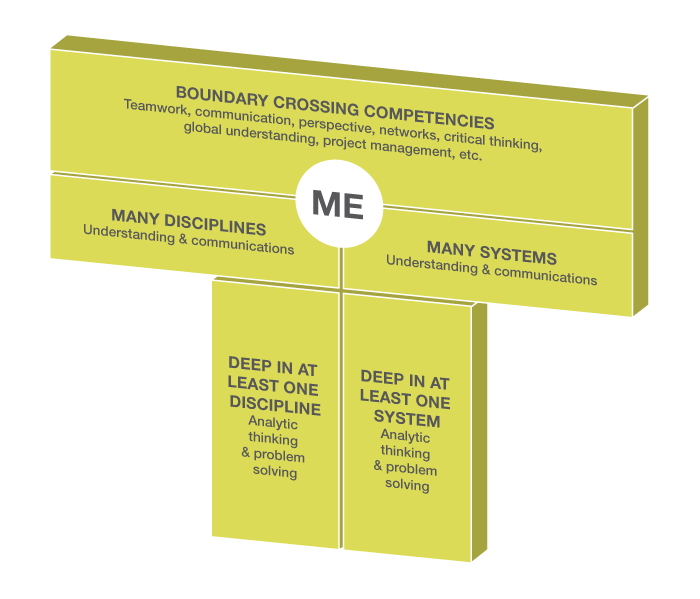
Currently, higher education is producing I-shaped graduates, or students with deep disciplinary knowledge. As I’ve noted before, T-shaped professionals are characterized by their deep disciplinary knowledge in at least one area, an understanding of systems, and their ability to function as “adaptive innovators” and cross the boundaries between disciplines.

The defining characteristic of the “T-shaped professional” is the horizontal stroke, which represents their ability to collaborate across a variety of different disciplines. To contribute to a creative and innovative process, one has to fully engage in a wide range of activities within a community that acknowledges their expertise in a particular craft or discipline and share information competently with those who are not experts.

Responsibility for training graduates is often mistakenly seen as belonging to universities. But businesses are in an essential training role through internships, mentoring, and on-the-job training. Likewise, businesses need candidates with more than just a degree, but who are actually qualified for the positions they are seeking to fill.

Research I’ve done through interviews with corporate executives suggests several key ways to improve:

– Encourage strong and collaborative partnerships between universities, placement offices and businesses. Course offerings should foster the T-shaped skills that hiring organizations demand.

– Create, support and manage robust internship and mentoring programs that include students in curriculum planning and emphasize the enhancement of T-shaped thinking.

These suggested improvements can help corporations and universities to become better partners in providing students with most effective training for tomorrow’s workplace.

At this year’s T-Summit, Jeff Selingo, author of “College Unbound,” shared his findings about some of the innovative approaches underway right now to close the skills gap. I highly recommend watching his presentation, which is included below.