How Are You Showing Up? A Primer on Energy Leadership

You bring your unique energy to how you show up each day – at home, at work, and generally in life.

This is especially important for leaders – both entrepreneurs running startups and managers leading teams in corporate enterprises. As a leader, you knowingly or unknowingly influence others, and this presents the opportunity to inspire and motivate your team.

This article will focus on Energy Leadership™, a concept I discussed in my presentation at the Association of Talent Development’s ATD ’23 conference on how to Think Like an Entrepreneur and Foster Creativity in Your Organization.

When you show up with your best energy, you can encourage your team to recognize and harness their own energy, feel a greater sense of purpose, and get more done with much less effort and stress. So, let’s delve into more detail on Energy Leadership.

Energy Leadership

“Energy is contagious; either you affect people or infect people,” says bestselling author and businessman, T. Harv Eker. When you realize how many people you interact with each day, you begin to realize how powerful your personal energy is.

The interesting thing about energy is that it can be both anabolic and catabolic. Both energy levels serve you daily, depending upon your lived experiences. Here is a brief overview of each:

  • Anabolic energy is associated with a constructive buildup force and less stress. With anabolic energy, it is easier to focus on solutions and tap creativity and experience for a complete and conscious view of situations. People have more access to this energy, with less judgment and less fear about themselves or situations – anabolic energy is essentially constructive, fueling, healing, and growth oriented. A leader with anabolic energy is collaborative, fuels creativity and productivity.
  • Catabolic energy, on the other hand, tends to distract you and pull your focus away from what you are doing. It is typically draining, resisting, and contracting energy. Yet, it serves the important purpose of self-protection, especially when experiencing uncomfortable situations. A leader with catabolic energy can use this energy in a time crunch or dangerous situations to address a particular situation. However, catabolic energy can be depleting and stress levels raised so the longer term effects are not positive. Think of it as being in continual fight or flight mode. 

In practice, a catabolic leader and anabolic leader may look like the following:

Neither type of energy is good nor bad, but an ambidextrous leader can adapt to the situation to create a better result.

The first step is to understand your personal Energy Leadership profile. This is done through an attitudinal assessment and can be used as a starting point to uncover how your energy can be harnessed to reach your goals and help you to lead more effectively.

So, how do you assess your current Energy Leadership?

The Energy Leadership Index (ELI) assessment tool, developed by the Institute for Professional Excellence in Coaching (iPEC) measures your unique energy profile. Through a series of 84 questions, the ELI reveals the percentage of each energy level you experience under normal circumstances and how your energy manifests under stress.

The 7 Levels of Energy

There are seven energy levels, each with a thought, emotion, and action attached.   Daily, you may operate on just a couple of levels or many, but this tool focuses on understanding where you are. 

Your individual results of the ELI assessment come in a sample like the chart below. This represents your average energy presentation under normal circumstances and under stress.

Everyone has a different ELI, which uniquely reflects their lived experiences. Through the debrief with an ELI Practitioner, you bring an awareness of how you show up. In the debrief, you go through your particular energy levels and find experiences that serve you well and others that do not. The tool’s power is recognizing your level and the ability to change the level and gain a better experience. The ELI tool, which can be used with individuals or teams, has a low entry bar, and it could pay significant dividends for leaders.

New Working Styles Benefit from Energy Leadership

The new normal of remote, hybrid, and in-person working styles has brought challenges for leaders. We are currently at a crossroads where workers value the flexibility of work from home options, but in many companies, management is dictating a return to the office, or hybrid approach. This puts a lot of pressure on team leaders. As mentioned in a previous blog post, speaker, author, and facilitator Priya Parker talks about gathering with intention for meetings (or classes), along with bringing an energy that meets the needs of the situation. If you are responsible for gathering and communicating with your team, consider your intention and your energy; the benefits could be significant.

How skillfully can you lead daily? An Energy Leadership approach will identify where you can adjust to having more experiences that better serve you and your clients, and it extends beyond the realm of work to your family and loved ones as well.

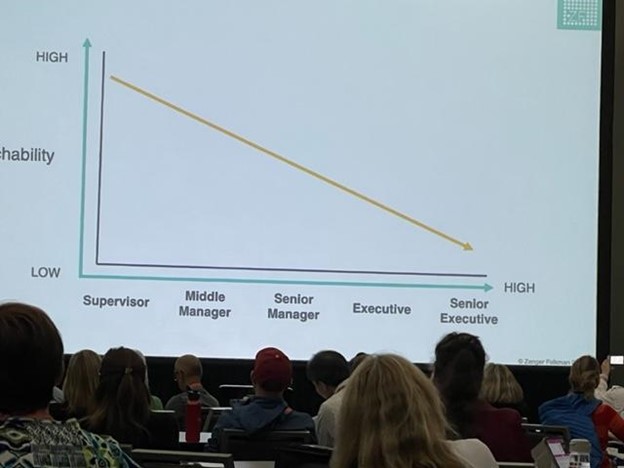
In one of the sessions at ATD ‘23 by Zenger Folkman, it was discussed that with more experienced leaders, coachability decreases. (Yes, that says “Coachability” on the left axis, my camera skills attest to capturing this during a live session!)  Senior leaders have been through a lot of training and I suggest the ELI assessment as a tool that could provide new insights into how they are leading today.  
In summary, embracing Energy Leadership can inspire peak performance from individual employees and transform the culture of organizations. A key element to Energy Leadership is that we are all leaders, every day, in every area of our lives. Energy Leadership can help individuals skillfully lead when interacting with others.

Further reading: Should I work with an Energy Leadership Coach?

Learn more at https://www.energyleadership.com/ or reach out to me at patriciacotter76@gmail.com or pcotter@mit.edu

When Entrepreneurship and Antifragility Collide

Think like an entrepreneur to cultivate creativity and innovation in your role.

As a learning and development (L&D) professional, you may not think of yourself as an entrepreneur, but embracing an entrepreneurial mindset can help you foster creativity and innovation in your organization. Understanding how you can encourage an antifragile approach to deal with internal forces as challenges arise within your company is essential. Connect that to how you show up in your job and how it affects both your own effectiveness as well as co-workers’ effectiveness.

What it is

The pursuit of entrepreneurship in the context of an existing organization is often called corporate entrepreneurship or intrapreneurship – whether it is a for-profit corporation, a not-for-profit organization, a government agency, or any other type of company.

Corporate entrepreneurship is a method used to develop new businesses, products, services, or processes inside of an existing organization to create value and generate new revenue growth through entrepreneurial thought and action. People who see themselves as corporate entrepreneurs are the engines of growth within a company; they are often corporate leaders or develop into leadership roles.

L&D professionals are well positioned to harness their intrinsic entrepreneurial skills to create value in their organizations given their roles entail working with both internal customers and a variety of other stakeholders. Further, the skills, knowledge, and ability L&D practitioners possess can help them solve corporate problems by thinking like an entrepreneur.

How it works

Here’s an example: The operations team at a small technology company in the data analytics space had a major problem – the startup competed against industry giants such as IBM. As the old saying goes, “Nobody ever got fired for buying IBM.” The team leader needed to figure out how the company could compete and get the attention of prospects to have them take the leap of faith to buy from a smaller, unproven vendor.

Operations team members assessed the skills, knowledge, and abilities in terms of how they could take an entrepreneurial approach to solve that problem. The team identified the company’s customers and their compelling needs. Because people were tired of waiting on hold and dealing with multiple customer service representatives who couldn’t solve their problems, the startup began taking a customer-centric approach. The team figured out that one way it could differentiate was by gearing all its operational decisions toward how to best serve the customer and provide an excellent customer experience.

The operations team simplified the process for the customer – from being able to always talk to a knowledgeable person to easy, one-page contracts – which helped the business succeed. As the company grew from a startup to a more established business, customers still valued and encouraged the founders’ entrepreneurial spirit and mindset. The happy ending to this story is that IBM acquired the company after seeing the value it provided to customers.

Guidelines

As corporate entrepreneurs start activating their ideas, they should aim small so that if they succeed, they can build on that success; if they miss, they may learn even more from that experience, which will help in the future.

Corporate entrepreneurs should also look to cultivate an antifragile mindset, a concept taken from Nassim Nicholas Taleb’s book Antifragile. His premise is that many things in life benefit from stress, disorder, volatility, and turmoil — they not only gain from chaos but need it to survive and flourish. To be antifragile, individuals must bend but be strong enough not to break.

In a talk by GE Ventures CEO Sue Siegel to entrepreneurs at the Massachusetts Institute of Technology, she said, “The pace of change today is the slowest it will ever be.” People with an entrepreneurial and antifragile mindset can prepare themselves and their organizations for rapid change and disruption. They get stronger in the face of adversity.

Results

The outcomes of corporate entrepreneurship will be evident once individuals start thinking like an entrepreneur and moving forward with this mindset, which opens up a world of possibilities – such as IBM acquiring your startup business. Set a vision and create a team of people with credibility and a good understanding of the problem you are trying to solve.

One of the biggest obstacles is overcoming initial inertia. The do-nothing strategy tends to be easier for corporate employees than embracing change. To combat this, align yourself with employees who have a compelling reason to change, and educate them on how the new product or service or way of doing things will address their problem.

As Netflix co-founder Marc Randolph, states, “If you are unwilling to disrupt your business, there will always be someone willing to do it for you.” Demonstrate that you are able to stand in the storm and provide leadership as a change agent for your organization.

Checklist

  • What is the problem you are trying to solve? What benefits will it deliver to your customers?
  • Define the problem, quantify it. Can you do primary market research with open-ended questions to validate your hypothesis?
  • Come up with solutions. Does your solution solve a compelling need? Does it make monetary sense?
  • De-risk your solutions. How can these solutions be adopted by your prospects with a low risk to them?
  • Identify a team to help. Success is more likely when you are backed by a team. Entrepreneurship is not a solo sport!

Resources

Disciplined Entrepreneurship,Bill Aulet

Antifragile, Nassim Nicholas Taleb

An Introduction to Start-up Accelerators Around the World, Trish Cotter

Personal Branding and Marketing Yourself, Rita Balian Allen

About the authors

Patricia “Trish” Cotter is an entrepreneurship consultant and coach as well as a past director of MIT’s delta v student venture accelerator program;  patriciacotter76@gmail.com.

Rita Balian Allen is an executive coach focused on leadership development, management training and career development; rita@ritaballenassociates.com.

Note: This article is the property of ATD. It was published August 1, 2023 in TD Magazine:
https://www.td.org/magazines/td-magazine/when-entrepreneurship-and-antifragility-collide

What is Disciplined Entrepreneurship? A Short Overview for the Uninitiated.

When I recently presented at the Association of Talent Development’s ATD ’23 conference, our session was focused on how to Think Like an Entrepreneur and Foster Creativity in Your Organization. This was geared to help learning & development (L&D) professionals take lessons from entrepreneurship and apply them to their organizations.

One of the topics that we touched upon was Disciplined Entrepreneurship. The Disciplined Entrepreneurship approach was such an important and ingrained part of the entrepreneurship program at MIT, that I had to step back and realize that this was new information to most of the ATD ’23 attendees. (In fact, I’m currently preparing materials to teach Disciplined Entrepreneurship content via a partnership between MIT and Dalhousie University in Nova Scotia.) 

Since I had a lot of follow up questions on Disciplined Entrepreneurship, I thought I’d give a little more background on the approach and how it works in this blog post. Disciplined Entrepreneurship – or DE as we like to call it – is an approach to help you think about how you start to get your product or service to move forward.

This methodology assists the start of an entrepreneurship journey, and Bill Aulet, Managing Director of The Martin Trust Center for MIT Entrepreneurship, has documented this in his Disciplined Entrepreneurship book.  This is a great place to start if you are looking for an accessible and methodical approach to entrepreneurship. (Plus, the illustrations are fantastic!)

Source: Disciplined Entrepreneurship

The focus is that entrepreneurship can be broken down into 24 steps based on six themes. The discipline comes in by following these steps.

Six Major Themes of Entrepreneurship

As you’ll see in the DE map, the themes are color-coded. The six themes are:

  1. Who is your customer?
  2. What can you do for your customer?
  3. How does your customer acquire your product?
  4. How do you make money off your product?
  5. How do you design and test (prototype) your product? and
  6. How do you scale your business?

(This process does not include sales, sales tactics, marketing, raising capital, team building, etc. but if you are thinking about a venture this is a good place to start.)

De-Risking Your Venture

A disciplined approach focuses on de-risking the venture by understanding your customer’s needs and providing value, so they become paying customers. It will help you establish your business and understand how customers are going to find you (along with where you will find your customers). You also need to thoroughly understand how you will make money (renewals, add-ons, etc.).

The book takes you takes you through important steps that are often overlooked – like hypothesis testing and concept validation. It also talks about how you need to focus on designing a prototype or minimum viable product (MVP), as well as how you are going to scale.

People think it is risky to be an entrepreneur. Yet, as discussed in the ATD23 session, an entrepreneur is adaptable and willing to focus on a core group of customers to build the business rather than trying to be everything to everyone.

How do you start?

Start with the first theme—what problem are you solving and for whom? You need to move from concept through qualitative interviews (talk to humans), then quantitative research if required. Find a core group with a message that resonates and a problem you can solve; this is problem research.  

If you start with an open-ended question about what you do on a typical day? Ask open-ended questions (Tell me more? What about that product or service that is going well? What is not? etc.). There is a free e-book online called Talking to Humans by Giff Constable that can help with this. This is a process that continually refines and tests your hypotheses. Your primary market research (PMR) will help you understand your potential customers’ pain points.

Giff also has a book (another short read) called Testing with Humans.  At the end of the problem research, if customers didn’t mention the problem that you are building or providing a solution to, then move on to others, and if you can’t find your core, you may want to revisit your core assumptions.

Once you have a core that has the compelling problem then work with that set to review potential solutions. You then will move to what value they will achieve from your solution so you can gauge purchase intent.  

As you explore entrepreneurship further, make sure you are thinking from a global perspective. My ebook on Startup Accelerator Programs Around the World can help entrepreneurs find accelerator resources, with a focus outside the US.

This blog post presents a quick overview of Disciplined Entrepreneurship that gives a little more information that was possible in my session, but there are many resources for you to delve into further.  For those looking for ideas and ways to potentially introduce entrepreneurship ideas into their corporation, there is a short blog explaining the four models of corporate entrepreneurship and a more in-depth article from MIT on the four models.

More Entrepreneurship Resources

For further reading, viewing, or participation, here are some additional resources on entrepreneurship:

Four Highlights of the ATD’23 Conference

In May, I traveled to San Diego to present at the Association of Talent Development’s ATD ’23 conference which featured over 250 sessions to educate and inspire professionals in the talent development field.

This is a terrific conference for Learning and Development (L&D) leaders to share insights, research, and best practices, and when my colleague Rita B. Allen, and I learned our presentation was accepted for the conference, we were thrilled. (Rita, author of Personal Branding and founder of Rita B. Allen Associates, has presented at the conference before and says only a small percentage of submitted presentations are accepted, so this was music to our ears.)

Our session, titled Think Like an Entrepreneur: Foster Creativity in Your Organization, aimed to help L&D professionals take lessons from entrepreneurship and apply them to their organizations. This is different from the audiences of entrepreneurs I usually present to. With this audience, there is an opportunity to bring some frameworks that might help foster the entrepreneurial mindset in their organizations or unleash their inner entrepreneur. For that, I am grateful for the opportunity.

Since this message is something that we’d like to share more widely, I’ll be writing blog posts on the elements of our presentation, including disciplined entrepreneurship, an antifragile and entrepreneurial mindset, and energy leadership. Before I dive into those topics, however, I’d like to share four highlights of the conference – and positive messages that I walked away with. These are not in any particular order, other than they build on each other. 

Adam Grant

If you’re not already a fan of Adam Grant, he is an organizational psychologist at Wharton, a best-selling author, and the host of the TED podcast WorkLife. If you don’t follow Adam on social media, I suggest you start – his practical advice on work/life balance is a breath of fresh air. Adam hosted the opening general session, titled Think Again: The Power of Knowing What You Don’t Know. He covered a lot of ground, but three things stood out from his keynote:  

  • Invitations into your network should be given to “disagreeable givers” — blunt people who aren’t afraid to tell you hard truths, but who also have your best interests at heart. An example for those familiar with the Ted Lasso TV series is Roy Kent.  
  • “Unlearning” often focuses on making room for new learning. This lets you address things you are doing that are not servicing you or others. Adam explains it takes courage to unlearn. Unlearning requires the integrity to admit that you were wrong yesterday. Learning is how you evolve. Unlearning is how you keep up as the world evolves.
  • As an entrepreneur, Adam also discussed scientific thinking and its impact on startups. Thinking more like a scientist, having the ability to pivot, individuals with the humility and curiosity to search for information all support entrepreneurship success.
Session capture by Lisa Rothstein

Priya Parker 

Facilitator, strategic advisor, and author Priya Parker presented on The Art of Gathering. Priya presented a new – at least new to me – way of thinking about how you hold meetings and gatherings. She spoke about how these gatherings should be intentional and benefit from setting expectations around the goals of the meeting, party, or gathering. The intent in the design is critical to ensure that both the host’s and guests’ experience is as intended. 

This made me think about how I am designing my summer entrepreneurship classes with MIT/Dalhousie with specific learning content. I do focus on the experience for the students, but the classes are much more focused on the content. This talk offered me a fresh look at hosting and attending events from now on, putting some boundaries around what is acceptable. It works best if you are super-specific about the intention of a meeting (or another event) and specify what you intend to accomplish. Priya recommends starting with a strong opening and closing as opposed to covering logistics. 

Session capture by Lisa Rothstein

Katrina Kennedy

Known to the training community as “the trainer’s trainer,” Katrina Kennedy’s session was titled It’s All About Retrieval and discussed the retrieval of information. She explained that retrieval is more than just recall; retrieval is accomplished in a way that you have context for the information. Learning needs to be varied, spaced, and interleaved. The retrieval practice needs to focus on learning. How many times have you re-read material several times and still not been able to recall the information when it is required?

Rita B. Allen, Katrina Kennedy, and Trish Cotter

Retrieval in practice is what we refer to as “use it or lose it.” If you want to play a piece of music and it is difficult to start, the struggle to learn to play it is actually a “desirable difficult” process that helps you solidify the learning. This isn’t about repetition. It is about spacing and breaking up the learning. In the classes I teach, I use breakouts to discuss further and debrief concepts as well as games to reinforce learning. Still, this retrieval discussion brought both the unlearning and learning of new ways of teaching and the intention to gather for a class together. The most memorable experiences will be those in which you have “desirable difficulty.”

University of Pennsylvania Chief Learning Officer Ed.D. Program

One personal highlight at the conference was the scholarly presentations of University of Pennsylvania Chief Learning Officer (CLO) doctorate graduates. I graduated from this program with an M.Ed. ’13 and Ed.D. ’14 and couldn’t be prouder! I wanted to give a shout out to these amazing presentations by my fellow Penn CLO grads:

  • Dr. Carol Henry (Implications for Practice: Behaviors and Competencies for Future Leadership Development Programs)
  • Dr. Jennifer Neumaier presented her dissertation: A Perspective Study on Cultural Conditions That Enable Social Learning.
  • Dr. Kandi Wiens, is a Senior Fellow and runs the master’s portion of the program at Penn, also presented the Ed.D. program and her research which will be out in her book due out next year, Burnout Immunity: How Emotional Intelligence Can Help You Build Resilience and Heal Your Relationship with Work. (Read her recent HBR article on Has Cynicism Infected Your Organization?)

If there was any concern that COVID slowed down the Penn CLO program, it was clear that this was not the case! Applications are up, the strength of diverse cohorts was showcased, and the quality of the research adding to the field of Learning and Development and other areas was on display at ATD ‘23.

In closing, post-COVID travel to a conference can often feel tougher than before, yet the amazing and energized professionals I met, and the concepts discussed at gatherings like this were worth the effort and can unexpectedly warm your heart.

A New Resource for Global Entrepreneurs

In my mind, entrepreneurs are the “grittiest” types of people around – I’ve been one and I’ve taught entrepreneurship to hundreds of students through the entrepreneurship programs at MIT, including my five years as the director of MIT’s delta v student venture accelerator program, which launches student start-ups into the real world.

“The harder the challenge, the more it builds you up,” explains Leslie Feinzaig, founder and managing director of the Graham & Walker Venture Fund, when discussing the recent Silicon Valley Bank collapse. “The best entrepreneurs I know will face a hundred insurmountable obstacles – and come back for the 101st because they actively believe that with enough time and opportunity, they will come out victorious.”

If this is your mindset, my new ebook was written for you. It is a resource for entrepreneurs as they face challenges unique to start-up founders.

As more people become entrepreneurs, they claim ownership of their future and help to drive the economy of their own country – and potentially global economies as well. Start-up companies fuel world economies and have created a $6.4 trillion start-up economy.

Exploring Start-Up Accelerator Programs Worldwide

During the time I spent at the Martin Trust Center for MIT Entrepreneurship, I was fully immersed in a wide variety of innovative technologies and start-ups – including working with students who had come to MIT from all over the world. I also traveled to various countries to present and share our insights on entrepreneurship and to gain knowledge from programs abroad. And while there are many programs to support entrepreneurs in the United States, I realized that start-up founders from other countries have fewer resources available to guide them.

That planted a seed in my mind to create a guide for entrepreneurs who may be exploring ways to start their own businesses, especially in countries outside the U.S. In my current role as an entrepreneurship consultant and coach, I’ve taken on a project to develop this resource. I also hope this ebook serves as a resource for global accelerators, governments, and other stakeholders as well.

Global Venture Funding Activity

According to data compiled by Crunchbase, global venture funding in 2022 totaled $445 billion — 35% lower as compared to 2021, but $100 billion more than invested in 2020. Regionally, the U.S. secures most of this investment at nearly 50%, followed by China (10%), the U.K. (6%), and India (5%) based on Dealroom data.

Some entrepreneurs may think that they need to be in the United States because of the amount of investment money here, but we’re seeing more money flow to other regions as well. Today, there are lots of options for entrepreneurs globally. Often, students I worked with at MIT realized they needed more time to get the required product fit and build the company with customer feedback. The growth of accelerators worldwide provides options if they decide to leave the U.S. and grow their companies in another part of the world – whether it is their home country or a region that is a good launching pad for their product or service. This growth of accelerators, government support, and growing entrepreneurial communities worldwide can provide entrepreneurs with this needed support.

Diversity, thought leadership, and collaboration all work together to make the global ecosystem of entrepreneurs a much richer place. I hope that the information I’ve collected about entrepreneurship around the world and how different countries support their entrepreneurs is helpful in your pursuits.

As a note, this ebook is NOT meant to be comprehensive – it is more of a directional guide. It does not cover all regions or all countries in any region. I also realize that entrepreneurial ecosystems are continuously evolving, so new information will always be coming to light. To that end, I’ve published this ebook under a Creative Commons license – I am open to other contributors who want to add to this resource from here – please feel free to reach out.

Take the Next Step to Entrepreneurship

If you are a student, an entrepreneur, an entrepreneur-to-be, or you work in an accelerator or government that is working to encourage entrepreneurship, I hope this ebook provides you with insight and resources to explore entrepreneurship further in a global sense!

Download the PDF ebook:

 An Introduction to Start-Up Accelerator Programs around the World

This free ebook was designed to be shared – you don’t even need to fill out any forms to gain access.

In the face of Massive Layoffs, why should I work with an Energy Leadership Coach?

People in today’s workforce face stress – and lots of it. Layoffs, quiet quitting, a general sense of pandemic fatigue, and recessionary pressures are hitting all of us.

For corporate leaders, this stress is multiplied. Leaders are dealing with teams that are unmotivated and exhausted. In some organizations, leaders need to cut positions and continue to drive the business forward with fewer resources. Paradoxically, in other companies, there are open positions that are difficult to fill, and existing team members are stretched thin.

Burnout is real, and whether your company is primarily working from home, returning to the office, or trying a hybrid model these days – you are likely facing challenges and trying to figure out what works best. (Of course, some industries such as healthcare never had the option to work from home and the stress of these workplaces can be off the charts.)

What can we do about it? This article is about Energy Leadership™ and how you can use your energy to show up every day as your best self.

What is Energy Leadership?

Your life experiences significantly impact how you perceive things. This affects your energy in different situations. Although you may not be aware of it, you may be realizing less than your full potential at work, at home, or in social situations. 

Energy Leadership refers to both a particular and unique form of leadership, and to the process of leading energy so that it works for you, rather than against you. By learning and applying the principles and concepts of Energy Leadership, you can increase your ability to shift your own energy and the energy of those around you. When you do that, you will help inspire and motivate yourself and others, feel a greater sense of purpose, get more done with much less effort and stress, and constantly attract positive and powerful people and success to you.

If you manage people, an entire team, or a whole organization, your responsibility – and ability to influence the energy of that group – grows. Every interaction presents the opportunity to lead and have a positive impact on others. You not only need to show up with your best energy, but you need to motivate your team to recognize and harness their own energy.

That’s where Energy Leadership Coaching comes in.

How is Energy Leadership Coaching Different from Other Types of Coaching?

Many people are familiar with an executive coach, a career coach, or a life coach – Energy Leadership Coaching is different from all of these, yet it can help you with each of these aspects of your life.

Energy Leadership Coaching begins with an Energy Leadership Index (ELI) assessment, which applies a numerical value to the types of energy you experience in different situations.  It is not a personality test; it is an attitudinal assessment.  We use this assessment as a starting point, and coaching helps you identify where you believe you would like to spend more of your energy to gain the results you want.

You can work with a certified Energy Leadership coach, like me, with over 300 hours of coaching through iPEC, the Institute for Professional Excellence in Coaching. This will help uncover your unique energetic profile and your energetic stress reaction, and how they can be harnessed to reach your specific goals and potentially shift awareness and mindset.

What Types of Energy May be Affecting Me?

You lead with your energy. Everyone has a unique level of energy due to lived experiences. Whether you are a corporate leader or not, your energy is how you lead and influence your friends, family, and colleagues. Everyone has the potential to positively or negatively affect those around them.

As an overview, there are two main types of energy: anabolic and catabolic. Anabolic is typically thought of as constructive, fueling, healing, and growth-oriented energy. Catabolic is typically thought of as draining, resisting, and contracting energy, yet catabolic energy can be helpful for focusing and protecting us when experiencing uncomfortable situations.

Both types of energy serve a powerful purpose. And you determine how to use each type of energy appropriately, either with a thought or mindset, emotion, action, or inaction.

Who Benefits Most from Energy Leadership Coaching?

Anyone who wants insight into where they are spending their energy can benefit from Energy Leadership coaching. It can help you find areas where you can do more of what you want to do and develop strategies to improve energy-zapping situations. 

 Why is this Especially Well-Suited for Corporate Leaders and their Teams?

Executives have developed patterns over time and are often frustrated by certain situations without understanding why. Energy Leadership helps bring issues to the forefront to let you make changes if necessary. How you show up matters and all of the people you interact with – whether employees or family or friends – look at your actions more than your words.  With Energy Leadership coaching, you can identify patterns and learn to model your actions to best harness your energy.  

Can Energy Leadership Help to Build Better Relationships with Remote Teams?

Connections are so key, particularly in a remote situation. Leaders need to consider how they show up to their employees. Are your employees just listening to video calls on mute and not interacting? Are new employees feeling connected to the organization and their teams?  You can create an atmosphere of learning, risk-taking, and opportunities with a foundation of trust and creativity. However, you must understand what motivates you and your employees. 

Improving team dynamics so there is accountability and understanding can significantly improve performance – whether in a remote, in-person, or hybrid situation.  A manager or executive who feels there are barriers in the way of the organization’s creativity and communication can use Energy Leadership to improve interactions. Any time individuals or teams can better understand what is getting in the way of success – and fix the issue — results in a win for everyone involved.

What are the Takeaways?

Energy Leadership can profoundly change your leadership style. It helps you to become more self-aware and realize what messages you are sending, and how you can change this dynamic or shift your leadership style to bring out the best in your team.

Interested in learning more about Energy Leadership Coaching?

Send me an email and I’d be happy to share more information.

Celebrating Our Entrepreneurs


Photo credit: MIT

It is with fond memories that I watched this year’s MIT delta v Demo Day presentations. Even though I was traveling out of the country, Demo Day generates the kind of enthusiasm and excitement that had me tuning in and watching the passion of these student entrepreneurs. (You can catch the replay of the Cambridge presentation here. The group also presented in San Francisco and New York City.)

MIT delta v Demo Day

Demo Day is an annual event that showcases the culmination of three months of work with the intensive delta v capstone educational accelerator program. Why am I so passionate about delta v? For five years I served as the director of this MIT program – a full immersion into a wide variety of innovative technologies and startups.

This year, watching from abroad, I saw a new cohort of entrepreneurs pitch their innovative and potentially world-changing companies to an audience of MIT students, mentors, friends, investors, and perhaps even customers. Kudos to Executive Director Paul Cheek, Jenny Larios Berlin, and Ben Soltoff, along with the entire Martin Trust Center staff for a successful Demo Day! Like any successful performance, there is an immense amount of hard work and preparation that goes into the final production. Like a proud parent, it was gratifying to pass the torch and see the program grow and move forward.

delta v 10-year Impact Study

In addition to celebrating this year’s delta v entrepreneurs, MIT just released an in-depth longitudinal study of the impact of delta v. I’d like to highlight some of the findings here to show how much this program has meant to the students and their startup companies, the MIT community, and to demonstrate the overall economic impact of the program.

The study was based on 10 cohorts of delta v students who comprised 181 teams. There were 692 participants during that time (67% were MIT students), and 322 of them (47%) responded to the survey. Some of the highlights include:

  • Survival Rate: Since its inception, 61% of delta v projects have become real companies that either continue to exist to this day or have been acquired. (For companies from the past five years of delta v, that number increases to 69%.)
  • Attractiveness to Investors: 63% of all the projects have resulted in companies that raised money.
  • Funding Attracted: The companies that have raised funding to date have totaled over $1 billion, and that continues to grow.
  • Founding Other Companies: Over 130 new additional companies have been created and raised an additional $2 billion beyond the companies started from the projects worked on in delta v.
  • Broader Entrepreneurship Communities: 68 (37.5%) of delta v startups were accepted into external, private/for-profit accelerators, including Y Combinator, TechStars, and Mass Challenge.
  • Connected Community: 83% of survey respondents say they are still in touch with their delta v cohort.

What’s Next for Me?

So, how can we help the next generation of entrepreneurs around the world be successful in their endeavors? Now that I’m working on the “fourth act” of my career, I’m working one-on-one with entrepreneurs and their startups in a consulting and coaching role.

These days I’m also traveling more for both pleasure and business. And, I’m working on an e-book resource on Global Entrepreneurship and Accelerator Programs around the World.

Interested in the e-book? Sign up here and I’ll send you a copy once it’s completed.

Regaining my Footing

We take a lot of things for granted in this life … like walking.

Last winter I had some pretty extensive foot surgery. Sure, I expected some recovery time, but it was longer and involved more rehabilitation than I had counted on – I essentially needed to learn to walk again after being in a cast, and then a boot for three months.

Although this isn’t the heroic story of someone who learns to walk again after losing a limb or being in a severe accident, it certainly was humbling for me. This setback made me reflect on how, in life, sometimes you need to stop, assess, and start again from the beginning. When you can’t walk, it is certainly a wake-up call – and you put yourself in the hands of experts.

 At some point in our lives, we all need to reach out for help and lean on other people (sometimes literally!). Taking those “baby steps” again as I re-learned the basics of balance, stability, and moving my body in the correct way made me think of the parallels to coaching. The physical shifts and the mental shifts involved mirror each other.

In my energy coaching practice, I am the one telling others to start at the beginning, work from the ground up, and lean on me for support. Just like my physical therapists, I am trying to help people get from one place to another. It’s not always easy, and often, it takes a lot of hard work over a period of time to get there.

I am now through the worst of it and walking several miles each day. I’ve realized the surgery and all the physical therapy were worth the end result. Here are the lessons I’ll try to hold on to and embed in my coaching practice:

  • Don’t take things for granted. Easy to say … hard to do. Be grateful for what you have and try not to be resentful when you no longer have those things.
  • It’s OK to start all over again. We are all starting from different places, and sometimes you need to regroup and go back to square one.
  • You will get discouraged. And angry. And furious. It’s natural to get discouraged but remember you are learning and perfecting the process.
  • Reach out for help. What resources do you have? Although it might not be in your nature, take stock of the people or organizations that are there to help and lean on them. When you lose hope, those folks can help lift you to the next milestone.
  • Take baby steps. It’s natural to want to hurry up and do all the things necessary to get better. But sometimes slow is good. If you can trust your guide (therapist/coach/mentor), learning each new step can end in a better result.
  • Be realistic. Be realistic with yourself that change is going to take time. Also be realistic about the milestones that will get you there.
  • Gain new perspectives. Sitting on the sidelines gives you a new appreciation, and also time to look at things with fresh eyes.  Shifting your perspective may help you understand situations better
  • Be aware of your blind spots. Sometimes you don’t see the bumps in the road that may trip you up. When reassessing your goals, try to be consciously aware of your blind spots. Believe me, I have a new appreciation of physical accessibility issues, something that I had not considered much in the past.
  • Keep your skills current. This is always a good practice, but my forced slow-down gave me a chance to do some research and work on some new skills as I was recuperating.
  • Just keep swimming. As Dory tells Nemo, in Finding Nemo, “just keep swimming” or walking! Try to make forward progress each day. . Keep moving and you will regain strength, whether it is physical or mental.

Life may throw us curveballs, but we need to gain wisdom and knowledge from those experiences in order to forge ahead.

How to Hire for Diversity and Reap the Benefits

Hiring struggles endure as companies try to employ and retain the talent needed to grow their businesses. The Great Resignation (or Great Reshuffle) continues in many industries as people consider new post-pandemic options. While nearly 4.3 million people in the U.S. quit their jobs in January (2022), there were also 11.3 million job openings, according to the latest report from the U.S. Department of Labor. What does this mean for hiring?

In my last blog post, I wrote about how to lead with empathy in hiring and recruitment practices. Part of leading with empathy is to make sure our workplaces are representative of the society we live in by implementing effective diversity, equity, and inclusion (DEI) hiring practices. This post will explore how companies and hiring managers can help make an impact, even when talent may be scarce.

There is much lip service given to diversity, equity, and inclusion, and some companies are making strides, but many companies are not. This quote resonated with me as a goal for DEI initiatives:

“As a society, if we begin to shape our practices around how we treat people, how our work environments are structured, the Great Reshuffle will end,” states Gina Ganesh, VP of People and Culture at Florence Healthcare. Treating all people well is the right thing to do. And hiring diverse candidates drives real progress, including bottom-line business results.

Diversity Drives Business Results

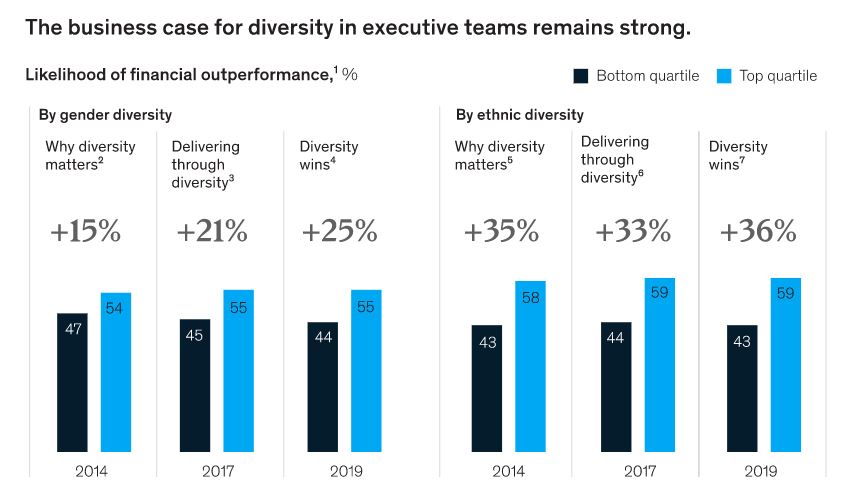
It has been proven that ethnically diverse companies perform 36% better than companies that are not. We’ll dive into that stat in a minute, but first, some important definitions and distinctions when thinking about a DEI recruiting strategy.

  • Diversity is the range of differences that make people unique, both seen and unseen. (Be mindful that diversity includes not only race and gender, but age, ethnicity, sexual orientation, physical disabilities, and neurodiversity).
  • Inclusion is an environment that engages multiple perspectives, different ideas, and individuals to define organizational policy and culture.

Remember, when you hire for diversity, you get the benefits of inclusion.

An important point according to Janet Stovall, Executive Communications Manager at UPS, in her TED talk. “Let’s be clear: diversity and inclusion are not the same things. Diversity is a numbers game. Inclusion is about impact. Companies can mandate diversity, but they have to cultivate inclusion.”  Stovall is also clear that businesses can be a key force to dismantle racism.

McKinsey has done a series of studies on the topic of DEI and the latest study encompasses 15 countries and more than 1,000 large companies. This latest report, titled Diversity Wins shows that the relationship between diversity on executive teams and the likelihood of financial outperformance has strengthened over time.

See original source for all chart footnotes.

McKinsey explored how different approaches to inclusion and diversity could have shaped the trajectories of the companies in their data set and found two critical factors: a systematic business-led approach to inclusion and diversity, and bold action on inclusion.

One Leader’s Story on Building a Diverse Organization

The business case for DEI is there, but it’s not always easy. I’d like to (anonymously) share the story of a friend of mine who was trying to increase diverse hiring his organization.

He was the head of AI software for products at a Fortune 500 company and specifically set out to hire more female engineers. He met with his managers and discussed ideas. He challenged his staff to look through LinkedIn for candidates. He spent one morning combing through LinkedIn and personally wrote 100 cold/semi-cold emails to prospects.

I think it’s important to note that he didn’t delegate it out. From this initial outreach, he received 35 responses, and he reached out personally to all.  Then he interviewed and hired several of these women.  After a period of one year, 20% of his team were women – from less than 5% – and the percentages were still climbing.  

A couple of things had to happen to make this work. He told his staff that they needed to get involved and invest in their networks – both college alumni networks and other networks of friends and past colleagues.  He made it clear that hiring for diversity is key in jobs at every level. He also made sure that candidates met a diverse group of people within the company during interviews.  His staff was taught to follow up with every candidate personally.  These may seem like small things, but they were game changers for both the new employees and the organization’s depth.

Unfortunately, there is bad news here. Two years after this initiative, there was a full reorganization and my friend parted ways with this company. The commitment to hiring for diversity was not sustained, the DEI focus faded within the organization, and progress was lost. I believe that the moral of this story is that enabling real change takes both time and commitment, and awareness is only the first step.

Beyond the Rooney Rule

The “Rooney Rule” – a diversity initiative started by the National Football League that calls for interviewing minority candidates for top jobs – has been adopted by corporate America, but experts believe it hasn’t made much of an impact.

As companies release detailed information about the diversity of their workforces, the data shows that women and people of color are well-represented in the lowest rungs of many company workforces, but there’s often little representation in leadership roles and board positions. When companies adopt a Rooney Rule, they’re pledging to add at least one candidate to their interview pool to increase gender and racial diversity, but that’s usually not enough to foster real change.

To make a meaningful impact, hiring managers should aim to interview a slate of candidates that’s 30% diverse, according to Alina Polonskaia, global leader of the D&I practice at executive recruiter Korn Ferry. Companies could also set a standard of having their executive ranks mirror the gender and race breakdown of the usually much-more-diverse entry-level workforce. In addition, employers should also use the same diversity standards they are applying for new hires to people being considered for promotions.

How Diversity can be Your Superpower

Let’s take a look at a study focused on hiring for B2B sales roles. This study by Forrester, commissioned by Outreach, confirms it is time for us all to commit to diversity, equity, and inclusion. Since sellers are the first point of contact for a company, sales reps must represent the world around them, and organizations must commit to DEI or risk losing revenue and talent.

Sales leaders understand the need for diverse teams; 67% of respondents say it’s important for their team to represent the world around them. However, although sales respondents in North America say DEI is important, they are not ranking DEI efforts over other priorities. Respondents ranked almost every other sales leadership skill before DEI. Yet, customers are demanding diversity now.

A separate Forrester Study on Diversity Drives Sales Success, reports the following metrics:

  • 60% of respondents stated that diversity within their sales team has contributed to their teams’ success.
  • 82% predict that the racial or ethnic diversity of their sales team will be equally or more important in the next two years.
  • 72% believe that DEI will play an equally important or more important role in business decisions in the next two years.

They conclude that companies with strong DEI practices have better-performing sales teams, including higher forecasts, higher conversion rates, and higher sales attainment.

How to Walk the Walk

The Inclusion Solution blog points out, “it’s not just about introducing shiny new initiatives and hiring the first head of DEIBJ (diversity, equity, inclusion, belonging, and justice) — it’s about displaying a real, sustainable commitment to these efforts through financial and human resources deployed over time… not just when the cameras are rolling and the topic is trending.” 

To that end, here are some strategies and ideas on how to walk the walk and incorporated diversity in your hiring to reap the benefits of inclusivity. Some are tactical tips, others are broader, more strategic initiatives gathered from the reports, experts, and sources mentioned in this blog.

  • Focus on developing an equitable talent process, purposely create diverse and inclusive teams, and create development programs for under-represented groups. (Korn Ferry)
  • When conducting campus recruiting, think beyond Ivy League schools and schools you may be personally connected to, and consider Minority-Serving Institutions (MSIs) (Excelencia in Education)
  • A “work from anywhere” environment can foster diversity hires. In an all-virtual environment, there are very few limitations in terms of where to find talent. (Bloomberg)
  • Challenge your definitions of “professionalism” and “leadership” within your organization – and then hire and promote diverse leaders. (Mac’s List)
  • Broaden your lens on DE&I, including embracing neurodiversity. One big benefit of an inclusive work culture is that it fosters diversity of thought, different approaches to work, innovation, and creativity. (Deloitte)
  • Provide education around and try to use inclusive language. (Mac’s List)
  • Training is a good start, but mature organizations do more. Leaders need to model inclusive behavior, and the organization as a whole needs to value and measure progress toward DEI goals. (Forrester)
  • Strengthen leadership accountability and capabilities for inclusion and diversity (I&D). Companies should place their core-business leaders and managers at the heart of the I&D effort—beyond the HR function or employee resource-group leaders. (McKinsey)
  • Enable equality of opportunity through fairness and transparency. Deploy analytics tools to show that promotions, pay processes, and the criteria behind them, are transparent and fair. (McKinsey)
  • If companies want to do a better job of retaining diverse talent, they can’t go back to “business as usual.” It’s time to make work more equitable, and while flexibility is not the panacea, it is a step in the right direction. (Harvard Business Review)
  • Workers overall want to feel like their boss cares about them. Gen Z wants a culture built on mental health and wellness. (LinkedIn)
  • Flexibility is increasingly prized, particularly by underrepresented groups. Leaders who hope to retain top talent and maintain diversity must act swiftly and deliberately to counter the forces of proximity bias. (i.e., if managers spend most of their time working in the office, that is likely to lead to a double standard of valuing employees who also come into the office). (Future Forum)
  • Continue pushing the conversation forward, even if you don’t have all the answers. DEI strategy is an essential element of building a strong business that is able to attract and retain great talent and connect with a diverse customer base. (Forrester)

As you search out new talent, there are a lot of nuances that you need to consider. Your HR team may have guidelines, and you may want to “go with your gut” in terms of what is right, but there are many factors and issues involved. Educate yourself and become an agent for change, dedicating the time and commitment necessary to foster inclusivity for all.

Leading with Empathy – A New Outlook on Hiring and Retention

As we enter the new year, HR managers and CEOs face a wake-up call. Employee recruitment and retention are major priorities for so many businesses this year, with companies unable to fill positions as we face continued uncertainty with COVID and the Great Resignation – now also being termed the Great Reshuffle.

The most recent statistics from the U.S. labor department said there were 10.6 million job openings at the end of November 2021 and 6.9 million unemployed people – 1.5 jobs per unemployed person. The number of “quits” hit a new high of 4.5 million in November. An article in The Guardian explains, “Quitting, most economists will tell you, is usually an expression of optimism. And yet, 2021’s quits happened against a larger economic picture that remains difficult to interpret with confidence.”

Some of the reasons people are quitting their jobs, according to USA Today and The Guardian, include:

  • Retirement – Most of the 5 million people who have left the labor force since the start of the pandemic are over 55 and have retired – early or naturally.
  • Career or industry switching – Others are switching careers or industries, for example, from restaurants and hotels to technology and warehousing, leaving some sectors with lots of openings and fewer candidates to fill them. Not surprisingly, given the stress on educators over the past two years, teachers are most likely to leave the labor force as compared to their counterparts in other industries.
  • Work-life balance – Thirteen percent of workers said they quit because their jobs didn’t provide work-life balance.
  • Care insecurity – Related to work-life balance, mothers with college degrees and telework-compatible jobs were more likely to exit the labor force and more likely to be on leave than women without children. One of the underlying reasons is an unequal distribution of labor at home and a critical degree of burnout contributing to “care insecurity.” Care insecurity is defined as uncertainty about daycare and school schedules that are unpredictably interrupted by periods of quarantine prompted by exposure to COVID.
  • Entrepreneurship – One-third of workers quit jobs to launch businesses. This may be either necessity- or innovation-based entrepreneurs.

The short-term outlook for the labor market suggests workers are likely to continue to have considerable bargaining power in 2022, says Indeed in its 2022 Labor Market Outlook report. But interestingly, job seekers remain hesitant. Active job search – that is, people taking specific steps to land work, like responding to job ads – hasn’t budged since the summer.

Where does all of this leave employers as they seek to recruit solid candidates to fill open positions?

Recruiting During a Time of Resentment

From the conversations I’ve had with friends, family, and colleagues recently, businesses that are hiring aren’t doing themselves any favors. Too many companies are approaching recruiting without empathy making it difficult to recruit good people. At the same time, prospective employees are hesitant and may have negative experiences with previous employers. Maybe it’s time for HR Managers to take a step back and look at their hiring processes.

You’re essentially recruiting during a time of resentment. People are disheartened, they’re tired, they’re sick of COVID, and at times sick from COVID. They may be working in an industry, such as healthcare, teaching, hospitality, or retail, where they are on the front lines every day and are looking for something different and less stressful. On the other hand, many office workers have the advantage of being able to work remotely, but that has its challenges as well. Are they being supported and mentored? Are they learning and growing? If this is going to be the new normal – rather than just a phase to get through – are you fully invested in making it successful?

New recruits will be precious resources in your company. Do you understand how to communicate effectively and listen to their thoughts and ideas?

5 Tips for Hiring and Retaining Employees with Empathy

Here’s a collection of tips for hiring with empathy. I believe that companies who approach their hiring process this way demonstrate to recruits that they support their employees and provide a positive work environment. Empathy then needs to be reflected in the workplace to retain your talent.

  1. Stop Ghosting Prospects

Maybe this should be common sense, but it’s not. If a candidate has taken the time to interview with you, they at least deserve a response – positive or negative. And a candidate who may not be right for a specific position today may be worth connecting with in the future, so keep that door open. Although many companies are using recruiting technology to automate the hiring process, we need to remember that there are real people behind each resume.

Fifty-two percent of job hunters say a lack of response from employers is their biggest frustration, according to Websolutions. In the current hiring environment, candidates have higher expectations for proactive, transparent, and frequent communications from employers. This needs to be communicated from the heads of HR to all the hiring managers involved in the process. If your current screening process is handled by a bot, you could be losing out to great people including referrals from current employees.

2. Prioritize Soft Skills

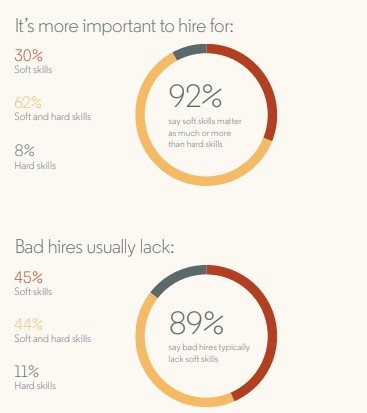
LinkedIn’s Global Talent Trends survey shows that bad hires are almost never a matter of hard skills alone. Prioritize soft skills – such as creativity, persuasion, collaboration, adaptability, and time management – in your hiring process. Although hard skills certainly matter, most hiring and firing decisions come down to soft skills.

 Part of the issue is that soft skills are more difficult to evaluate than hard skills. You can reasonably determine if a programmer has the right coding skills, or a translator has the right language skills, to perform adequately in their jobs. However, identifying poor soft skills is much harder, which is why this is often discovered too late, after a hire has been made.


Source: LinkedIn

3. Fully support Flexibility and Remote Work

Pre-pandemic, businesses expected that in five years 38% of their remote workforce would be fully remote, while today they expect 58% to be fully remote in five years, says Upwork in its Future Workforce report.

Career Builder adds that 35% of job seekers say they will turn down an offer if the employer does not offer a remote work option. The pandemic has forced the issue of remote work and flexible work schedules, making it a priority for employees. As companies consider return-to-the-office policies, they must realize there has been a mindset shift for many employees, and flexibility is now valued more than ever. It may be better for business too.

An Airtasker survey shows on average, remote employees work 1.4 more days every month, or 16.8 more days every year, than those who work in an office – and on workdays, they spend more time getting things done. Many workers are more productive and less stressed in a work-from-home environment since there is no commute, less water cooler talk, and more opportunity to fit exercise into their daily routine.


Source: Airtasker

4. Hire People You want to Coach

As a certified, professional coach, I spend time coaching people on energy leadership, and how you “show up” truly matters. Are you hiring people who will show up with an positive attitude and a mindset to think out of the box, bring all their creative skills, and work as a team?

Companies need to look at their interviewing process in a couple of ways. Are they looking to find the perfect candidate, or can they hire for aptitude and attitude? If they can identify the right aptitude and attitude, will the company culture embrace that and provide the training to help them grow? You may want to map out your hiring process from the humanistic viewpoint.

5. Listen to People to Retain Them

Once you’ve hired good people, you need to work hard to keep them. According to a recent Fast Company article, 2022 will be a key year for companies to live up to their promises to employees, or risk losing them. The best way to retain workers includes listening to their needs, accommodating their different work styles, and addressing inequities.

One member of the Fast Company Impact Council, Angie Klein, CEO of Visible, predicts, “We’re going to see a pretty big shift from talking about The Great Resignation to ‘The Great Retention,’ with [companies] focused on doing what it takes to keep talent. Employees aren’t really leaving because they’re unsatisfied—some are—but because they want to see what’s out there at a time when it seems far less risky to do so. Putting in proactive-retention measures while ensuring that we manage to drive meaning and purpose—there will be a heavy focus in retention like we have never seen before in corporate America.”

One employee retention tool that is gaining popularity is the “Stay Interview,” where a manager sits down with an employee to explore what it takes them to stay at the company. Ideally, these are regularly occurring conversations, built on a foundation of trust, where the employer doesn’t only focus on the job, but the individual’s professional and life goals.

Conclusion

Recruiting and retention are always challenging, but our current environment makes it even more so. However, I don’t believe the number of jobs out there is the reason you can’t find good people. I believe the primary issue is that companies are not putting the proper emphasis on recruiting and retaining talent, including a humanistic approach.

To find the right people, you may want to look at your processes and see if you can create a more empathetic way to attract and keep the best people.