Finding Glimmers: How Entrepreneurs can Reframe and Reset with Small Moments of Joy

Think about the last time you saw the sky turn brilliant orange as you caught an unexpected glimpse of the sunset. Or maybe you smelled fresh brewed coffee when you came in from a brisk walk. Or patted a furry friend contentedly. These are all examples of “glimmers” – tiny, positive moments that have the potential to bring joy or happiness and promote mental well-being.

This use of the term was coined by Deb Dana, a licensed clinical social worker who specializes in complex trauma, in her 2018 book “The Polyvagal Theory in Therapy.” According to the Polyvagal Theory, glimmers activate the parasympathetic nervous system, promoting a state of calm and relaxation. Glimmers are often described as the opposite of triggers – they are personal to each individual and can be experienced with any of the senses. They spark ease, relaxation, safety, and connection.

In the high-stakes world of entrepreneurship, where stress and anxiety are constant companions, these moments of calm can be a game-changer.

The Power of Glimmers

Entrepreneurs often face immense challenges, from financial pressures to the uncertainty of the market. As an entrepreneur, the demands and pressures of launching and running a business can become all-consuming and can take a toll on your mental health. Plus, the culture of entrepreneurship celebrates working round the clock and always putting your startup first. A founder’s self-identity is often tied to the success of their startup, and as a result, entrepreneurs often experience loneliness, depression, and anxiety as they experience the ups and downs of startup life.

As entrepreneurs strive for success, it’s helpful to recognize and embrace this concept of glimmers — and how those small, uplifting moments may be able to positively impact the well-being and mental health of entrepreneurs.

Glimmers and Entrepreneurship

Incorporating the concept of glimmers into the entrepreneurial journey can positively affect mental health, and even perhaps, business success. Yes, it’s true that a glimmer is just a small moment, but it can let you reframe and reset a situation you are going through, and that self-awareness is a critical skill for entrepreneurs to learn.

When I held the role of executive director of MIT’s Martin Trust Center for Entrepreneurship, I worked with MIT Sloan MBA alumna Kathleen Stetson to debut the Entrepreneurial Confidence and Communication (E.C.C.) program at M.I.T.’s delta v accelerator.

This was the first comprehensive program to address mental health challenges in the start-up community and is outlined in this article in HBR. Our goal was to teach student founders and their team members tools to build greater self-awareness. Stress is inevitable in start-ups, but by learning how to manage that stress, the entrepreneurs could make better choices for themselves and their start-ups.

We taught MIT student entrepreneurs the tools and benefits of self-awareness, and the results were impressive. After taking part in the program, 93% of participants felt that a self-awareness practice could help entrepreneurs create more successful businesses. By the end of the summer-long program, 88% of student entrepreneurs had independently established their own regular, weekly meditation or mindfulness practice (vs. 21% before the program), despite heavy workloads and continual critical deadlines. The data affirms that self-awareness tools are useful in managing stress — and they can be taught.

Building upon that foundation, I believe that finding glimmers and using those moments as a pause for reflection and self-awareness can create a positive mental health break for entrepreneurs that can be easily incorporated into their daily routine.

Recognizing and Cultivating Glimmers

To harness the benefits of glimmers, entrepreneurs must first recognize and appreciate these small moments of positivity. It could be a compliment from a colleague, hearing a favorite song, or enjoying a piece of chocolate. The key is to be mindful and intentional about acknowledging and savoring these positive experiences.

Create a routine that allows for the acknowledgment of glimmers – you may even want to jot it down or take a picture. Plus, the more you look for glimmers, the more you’ll find them due to frequency bias. Whether it’s starting the day with a gratitude journal or taking short breaks to appreciate achievements, these intentional practices can contribute to a more positive and resilient entrepreneurial mindset.

In an article in USA Today, Amy Morin, a licensed clinical social worker and editor-in-chief of Verywell Mind, explains, “A little joy and some relaxation can reduce your emotional distress. And when your emotions go down, your logic goes up. That means you might be able to tackle a problem from a different angle because you see things a little differently.” This is certainly a benefit that entrepreneurs should embrace.

Glimmers for Resilience

Resilience is a key trait for entrepreneurs navigating the complexities of business. Glimmers can play a role in fostering resilience by providing moments of joy, hope, and accomplishment. In times of stress, recalling these positive moments can serve as a powerful coping mechanism, helping entrepreneurs bounce back from challenges with renewed energy and determination.

Think about tying glimmers to mindfulness, or as a reminder to practice meditation or breathing exercises. All of these tools to promote self-awareness can help you reset, reframe, and build resilience.

Conclusion

In the dynamic world of entrepreneurship, prioritizing mental health is not just a personal choice but a strategic necessity – yet one that is often ignored and overlooked in the entrepreneurial win-at-all-costs culture. Glimmers offer a unique and effective way to infuse positivity into the entrepreneurial journey, contributing to improved mental well-being which can support an entrepreneur’s success.

As entrepreneurs embark on their ventures, it’s crucial to embrace the power of glimmers, recognizing them as small ways to capture joy, and strengthen a resilient and thriving entrepreneurial spirit. By fostering a positive mental health culture and incorporating intentional practices, entrepreneurs can navigate the challenges of the startup landscape with a renewed sense of purpose and well-being.

The infographic below, from Neurodiversity Education Academy, gives more detail about glimmers and triggers.

Pivots, a Pandemic, and Startup Founders’ Mental Health

The pandemic affects everyone. Today, we are all dealing with a different model for living – many people are working or attending school virtually, there is less social interaction, greater isolation, more juggling of home and work duties, and of course the anxiety and pain if loved ones become sick or die from COVID-19. A study by the CDC in June of this year reported 40% of US adults are struggling with mental health or substance abuse – substantially higher figures than in 2019.

Where does that leave our entrepreneurs? Beginning in March, the Martin Trust Center for MIT Entrepreneurship closed its doors until further notice. We are continuing to support MIT’s entrepreneurship community virtually, including via online resources like Orbit. This past summer, our delta v accelerator moved to a completely virtual experience, including online Demo Day presentations.

One question we continue to ask ourselves is:
How has the pandemic affected the mental health of entrepreneurs?

Building Entrepreneurial Confidence

As we look to answer that question, we realize we were fortunate that MIT started the first self-awareness program for entrepreneurs last year – the Entrepreneurial Confidence and Communication (ECC) Program. We piloted this program with the delta v accelerator class of 2019 to help student entrepreneurs prioritize their own individual well-being while building their businesses. The culture of entrepreneurship celebrates working 24/7 to demonstrate passion and dedication for your business. A founder’s self-identity is often tied to the success of their startup, and as a result, entrepreneurs often experience loneliness, depression, and anxiety as they work through the normal ups and downs of startup life. This has only been magnified by the COVID-19 pandemic which has caused delays, roadblocks, and failures for many startups.

Traditionally, entrepreneurs have lacked the support and tools to improve their mental well-being. The ECC pilot program, created by MIT Sloan MBA alumna Kathleen Stetson, taught MIT student entrepreneurs the tools and benefits of self-awareness; they then applied their learnings – discussing key choices entrepreneurs face, such as: taking breaks vs. spending all your time on your startup, working through limiting beliefs, considering others’ perspectives, and approaching challenges with fear or curiosity. The results were impressive, after taking part in the program 93% of participants felt that a self-awareness practice could help entrepreneurs create more successful businesses.

This year, because of the additional stress due to the pandemic, and the need for teams to feel connected when working remotely, we added two simple elements to the small groups within the ECC program that startup teams could quickly and easily implement in their own team interactions:

Red/yellow/green check-in – this not only encouraged small group members to practice self-awareness during small group, but many teams took this check-in strategy back to their teams, practicing it at the beginning of each of their standups.

A more structured way to give and receive help – after a small group member expressed a challenge they were facing, small group members asked clarifying questions rather than immediately jumping into solutions and advice. This not only made the speaker feel that they were heard, but helped participants practice active listening. They then took this back to their team interactions, helping them better understand their team members’ perspectives.

In a Fast Company article, Kathleen Stetson explains, “The 24/7, hustle-till-you-drop attitude has been a problematic fixture of startup culture for years. And now, due to the pandemic, sustaining one’s health is even harder. ‘I don’t know a startup founder who’s not burned out,’ a founder friend of mine told me recently.”

The Pivot: A Key Pandemic Strategy

“Pivot” has become the go-to word for 2020. People are pivoting with career changes and businesses are pivoting with strategies, as we all try to keep moving forward dealing with the unanticipated changes brought by a global pandemic. Entrepreneurs need to realize that a startup failure can be due to external circumstances, and the founders are not marked with a scarlet “F” for failure. A change in business strategy or taking a break from trying to start your own company is a pivot that will make you stronger the next time.

One of our delta v teams faced this type of challenge recently. Easel was a startup service that matched parents with top quality centers for last-minute childcare needs. The company was a member of the delta v class of 2019 and was faced with the tough decision to wind down the business this year. With the COVID-19 pandemic, so many people have transitioned to working from home that their childcare model was no longer sustainable. Although childcare continues to be a huge need, co-founders Neha Sharma and Michael Leonard realized they would need to shelve their plans for Easel and pivot to the next chapter in their lives. However, as delta v’s Managing Director Bill Aulet stated, “I still chalk these up to success for sure. They are much stronger than when they got here.” That strength, in part, came from MIT’s ECC program.

This type of a transition is one that often tests an entrepreneur’s sense of worth and purpose. They have put blood, sweat, and tears into their business only to watch their dreams fade. As stated in the Thrive Global article I co-authored with Kathleen Stetson, startup founders “tend to connect their self-worth and identity to their start-ups, which can lead to feelings of depression if their start-up fails.” Yet, we’ve found data affirming that when entrepreneurs understand their thoughts, feelings, and biases, it is useful in managing stress – and this is a skill that can be taught. This is why MIT is proud to host the Entrepreneurial Confidence and Communication program – the first comprehensive program to address mental health challenges in the start-up community and teach entrepreneurs how to effectively manage stress.

How did we adapt MIT’s Venture Accelerator as a Virtual Experience?

2020 is a year we’ll remember for many things, but 2020 graduates will certainly remember how typically crowd-filled graduation ceremonies were transformed into unique and socially distanced celebration amid COVID-19 restrictions. At MIT’s delta v, we can relate. We are just starting our summer-long student venture accelerator program, and, our entire program – start-to-finish will be virtual this year.

What does that mean? Although our fantastic space at the Martin Trust Center – usually buzzing with activity – will be dark, we’ve created a virtual model to provide a unique experience and lots of new and different opportunities for our student-entrepreneurs. At the end of the summer, these students will kick-start their ventures and reach escape velocity with a final presentation of their startup companies at Demo Day. We anticipate seeing some of the best and brightest new startups ever to come out of MIT, because – as said by Benjamin Franklin – “Out of adversity comes opportunity.”

undefined

Prepping to Go Virtual

The delta v program has become known as a “transformative experience that only MIT could provide,” and the entrepreneurs that go through this program are truly helping to make the world a better place (Check out this video for 2-minute synopsis.) Many MIT programs were cancelled this summer, but thanks to Managing Director Bill Aulet’s advocacy across MIT and with the Trust Center donors, this summer’s virtual delta v program has become a reality. 

Students joining this program, and the whole MIT community, have major expectations of delta v. So, we knew we would need to go beyond just transitioning to Zoom meetings and putting our content online. We looked at what worked for MIT’s remote learning classes in the spring, and also reached out to our entrepreneurial education colleagues at other universities to gain their insight.

We held brainstorming sessions and many, many meetings to figure out how we could make this year’s delta v experience engaging and interactive. We honestly looked at the challenges and worked hard to address issues like onboarding, the lack of personal connections, less-than-ideal work from home situations, and “Zoom fatigue.” We knew that engagement, high-touch experiences, and cohort learning would all be essential for making this a success, and we put in extra effort to ensure delta v would not lose its special touch.

The 2020 Cohort

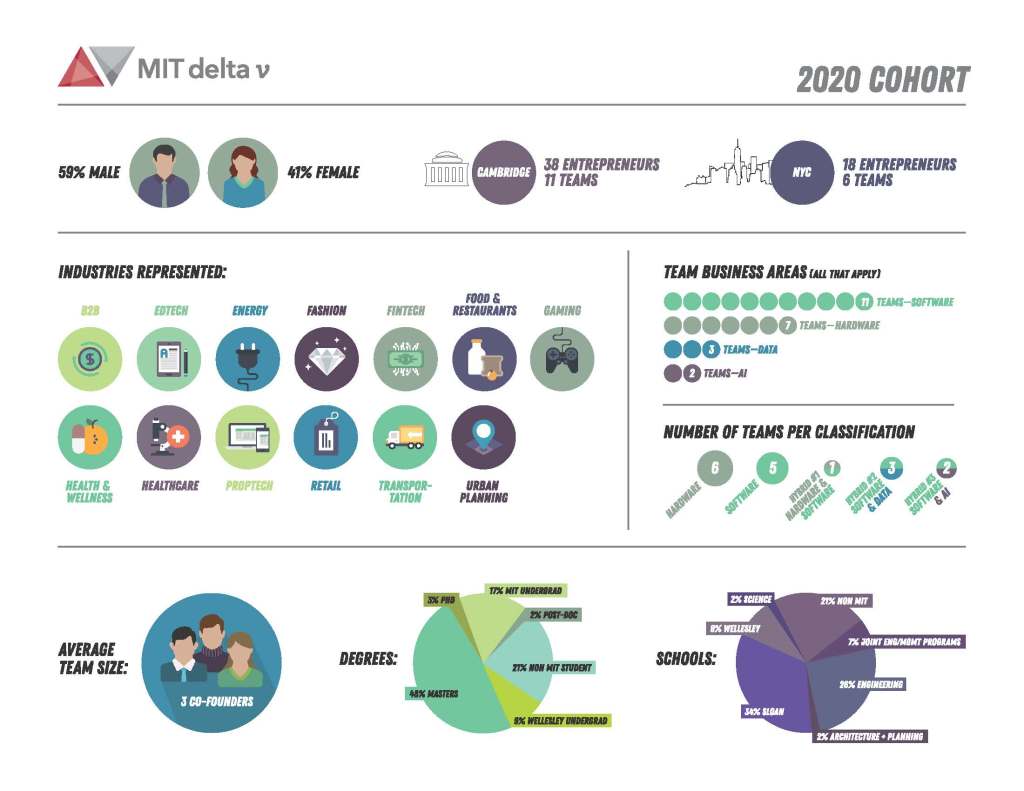
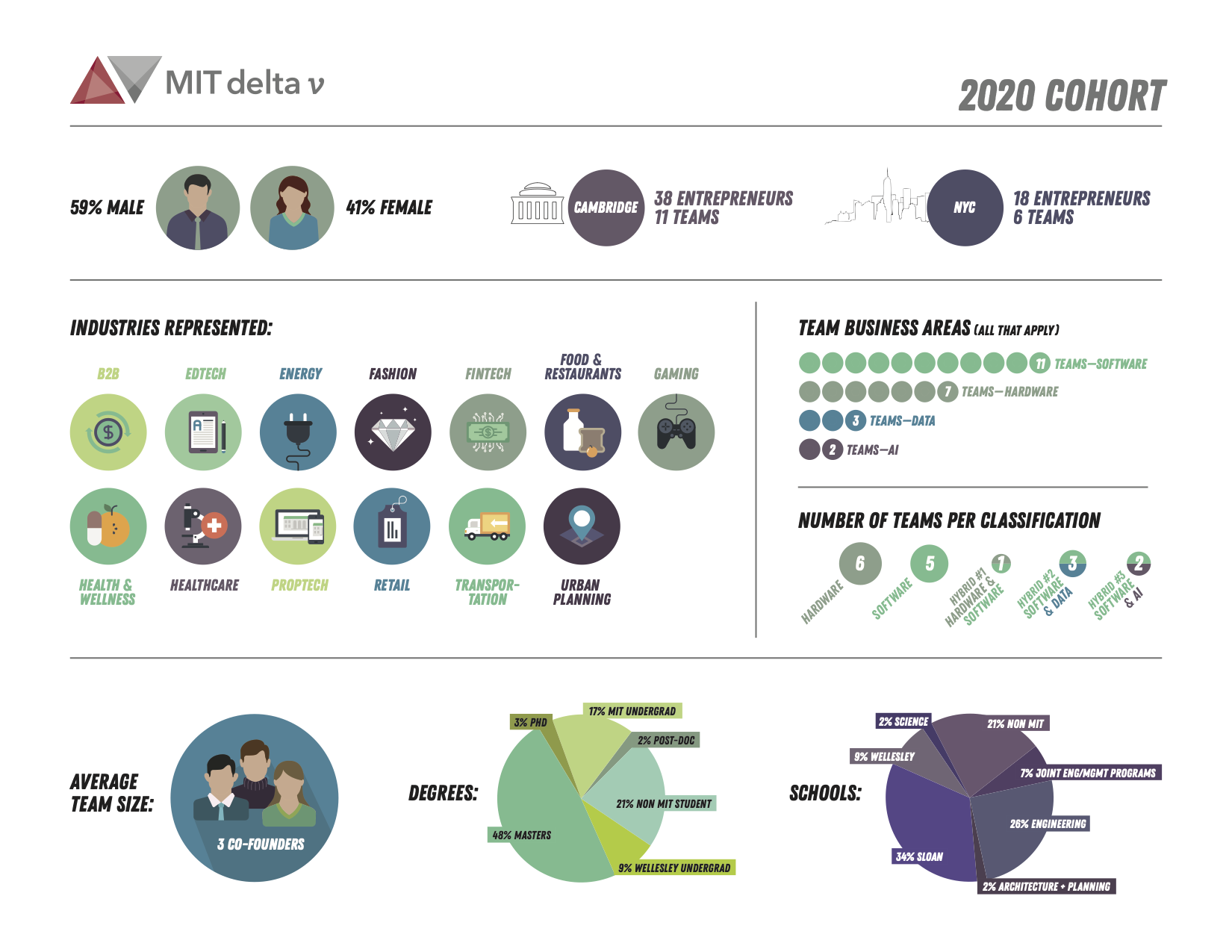
Our 2020 cohort of delta v teams was the smallest we’ve had in six years – 11 teams in Cambridge and six in New York City. We purposely selected fewer teams to allow for more individualized attention from our Entrepreneurs-in-Residence (EIRs), who are spending dedicated online time mentoring each team. (This also means if you didn’t get selected this year, think about applying again for 2021!)

This infographic shows the makeup of our 2020 delta cohort. Each year, we work on trying to get a diverse and balanced group of entrepreneurs tackling problems in a variety of industries.

More Talent!

A big part of delta v is learning from the pros. One of the benefits of our virtual session this summer is the sheer number of experts we’ve been able to line up. In fact, in the month of June alone, the delta v teams will have opportunities to hear from 21 different speakers delivering workshops.

With a virtual program, we have the benefit of being able to approach experts who are located anywhere, rather than focusing only on local resources or those willing to travel to the MIT campus. This summer, our students are fortunate enough to learn from many outstanding experts, including the following people:

Ryan Choi, MIT Alum, now with Y Combinator for a discussion on finding product-market fit and will be back for a discussion on hiring

Eleanor Carey, who spent 62 days at sea, rowing from California to Hawaii, gave an inspiring talk relating to the realities of entrepreneurship

James Baum, technology leader, investor, and advisor, who shared his advice on managing boards and will be back for office hours

George Petrovas, serial entrepreneur, who shared his founder journey and is on a delta v mock board

Brad Feld, Managing Director at Foundry Group will talk about fundraising in a Covid-19 environment

John Belizaire, CEO of Soluna, will speak about leadership

Perry Cohen, Founder Executive Director of The Venture Out Project will speak about his journey

Plus, our amazing faculty including Kirk Arnold, Kit Hickey, Erin Scott, Jason Jay, Bill Aulet, Paul Cheek, and Dip Patel.

More Mindfulness

This year at delta v, we will build on our Entrepreneurial Confidence and Communication (ECC) program to teach tools for self-awareness and mindfulness with the goal of better mental health and “anti-fragility” for entrepreneurs. We recently wrote about this program for the Harvard Business Review, and it has been well-received by students and the community. We believe that if we teach new entrepreneurs how to work through the stresses of entrepreneurship more effectively, it will lead to better decision making and healthier choices for their life and their business.

An interesting dimension to this year’s delta v cohort is that they are particularly receptive to learning about meditation and mindfulness for stress reduction, according to Kathleen Stetson, our ECC coach and creator of the program. She believes this is a direct result of the proliferation of information in the news and on social media about mental health concerns during the pandemic.

Demo Day

This year, Demo Day may be where we see the biggest impact of going virtual. Traditionally, at the end of the summer, all of the delta v teams gather to formally present their startups to the MIT entrepreneurship community. Things will change this year, but we are making some amazing plans for Demo Day and a post-event networking experience.

We will also hold a Virtual Investor Day, which is new this summer.  This will focus specifically on the financial foundation of the startups and will allow the final Demo Day pitches to be a bit shorter. Students will benefit by having two completed pitches when they finish the program.

Conclusion

Conducting the delta v accelerator program virtually is a first for all of us – we are learning too. We strive to bring this year’s delta v cohort an incredible and rewarding experience, and we are open to feedback and suggestions.

The delta v student venture accelerator is the most inspiring environment I can think of for an entrepreneur. There’s an energy here that propels each of our teams forward. For 90 days, our student-entrepreneurs will eat, sleep, and breathe their startups. They will be guided through a process that makes them really think through the realities of starting an actual business, not just chasing a cool idea. Our fervent desire is that some of our student-entrepreneurs will create companies that will help to solve some of the big, global problems we are seeing in our world today – such as preventing the next pandemic or eradicating racism.

As the delta v leadership team, our opportunity this summer is to assist our students in their educational journeys as entrepreneurs and to guide them in making entrepreneurship a force for good.